


Organization Chart Security Guard Service Company Profile




Try Before you Buy Download Free Sample Product
 Impress Your
 Audience
 100%
100% Editable
 Save Hours
 of Time


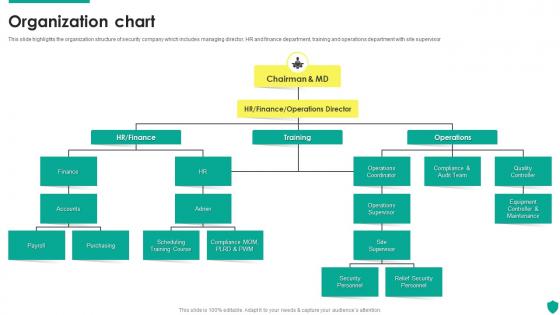
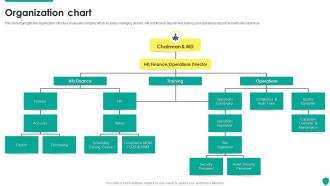
This slide highlights the organization structure of security company which includes managing director, HR and finance department, training and operations department with site supervisor.
People who downloaded this PowerPoint presentation also viewed the following :
Content of this Powerpoint Presentation
Imagine you have hired a new employee who goes around asking questions like “who is he?” “What is he responsible for?” “Who is the CEO?” “Who is the department head?” and so on.
It's not the person’s fault, though! Their curiosity about the organization and the eagerness to familiarize with every other employee drives their inquiries.
Now, think of a situation where you provide new joinees with a map about the organizational hierarchy including the respective roles and responsibilities of each employee. Such an organizational chart could help new joinees visualize the company structure, giving the illusion of the roles and responsibilities of each member, departmental information, and the relationship with each other. It can be hierarchical, flat, matrix, or divisional wherein the interconnected relationships can easily be seen from the top executives to lower-level managers.
Now, preparing such an intricate charter would be equally hectic. If only you had an “organization chart,” to provide a quick overview of the company structure at a glance, help establish a line of communication and also boost the decision making process.
We have a solution.
Slideteam’s organization chart template can be used in situations where you want to streamline communication and establish clear hierarchical authority. Our presentation template is fully customizable to showcase your organizational flow of power and distribution of responsibilities. Moreover, it can be used in every other industry to align goals and identify manpower needs.
In particular, this guide is about Slideteam’s organization chart for a security guard service company. Let us take you to a brief explanation of this PPT Design:
Template 1: Organization Chart for Security Guard Service
Organization Chart

This PPT Slide includes an organization chart for a security service company where you can define the roles of CEO, HR, Finance, and Operational Director. It is a clear depiction of the reporting structure in a security guard service company where top-level executives and front-line managers are duly aware of their accountability within the organization. Supervisors will enhance their oversight through the reporting relationships and team dynamics for providing support to the direction reports. Use this presentation template to make the organization chart structured, providing a bird’s eye view of the entire organization. It can visually map all formal relationships and build a line of communication that helps everyone reach out to the concerned person whenever required. Another benefit of using this PPT Layout is that you can do long-term planning wherein you just need to spot a minute on the org chart, helping you to solve the contingencies or system hiccups instantly.
Navigate the Organizational Chart for Making The Manpower Aligned and Empowered
You know org charts are a helping hand when it comes to making big decisions. Whether you are analyzing manpower needs, allocating tasks, or just want to track what others are doing; an org chart is the right way to get everything in one picture. Using our organization chart PPT Template will allow you to streamline communication and uplift the transparency of roles at the same time. From this, you can ensure a clear line of authority where everyone is aware of their roles and whom they are reporting to. You are building a culture of cooperation and collaboration which will drive you success in the long term.
Organization Chart Security Guard Service Company Profile with all 6 slides:
Use our Organization Chart Security Guard Service Company Profile to effectively help you save your valuable time. They are readymade to fit into any presentation structure.





FAQs for Organization Chart Security Guard
So most security companies have the CEO/Owner up top, obviously. Operations Manager runs the daily chaos. Site Supervisors handle specific client locations while Field Supervisors basically live in their cars checking on guards all day - seriously, the mileage on those company vehicles is insane. Then your actual Security Officers doing the real work. HR deals with hiring and training new people. You'll also see Scheduling Coordinators juggling shifts and Account Managers keeping clients happy. Bigger outfits sometimes throw in a Training Director too. Quick tip though - if their org chart looks like spaghetti with weird reporting lines, that's a red flag for communication problems later.
Dude, having a solid org chart is a game changer for security ops. When incidents happen, your guards instantly know who to call - supervisor, shift manager, or straight to the ops director. No wasted time figuring out the chain of command. Short sentences work. Then you avoid that nightmare where multiple people think they're handling the same breach because nobody knows whose job it is. I've seen that mess happen way too often at poorly run sites. Post your command structure somewhere visible so everyone can reference it. Trust me, it's like the difference between having directions versus driving around completely lost.
So most security companies have pretty predictable structures. You've got CEO/Owner at the top, then usually a General Manager underneath. Middle management is your Regional Managers handling multiple sites, plus Site Supervisors for daily stuff. Field Supervisors or Shift Leaders are basically senior guards who deal with scheduling headaches. Regular Security Officers do the actual work at the bottom. Bigger companies might have Training Coordinators or Account Managers thrown in too. Honestly, the reporting lines matter way more than job titles - that's who controls your schedule and decides if you're having a good day or not.
Dude, org charts are a lifesaver for this stuff. Your guards will actually know who to call instead of just hitting up whoever answers first - trust me, you don't want that chaos. Response times get way better because supervisors know their people. New hires can figure out the pecking order without asking a million questions. Information flows up and down smoother too. Honestly, I'd stick updated charts in all your guard stations and make sure everyone has their supervisor's contact saved in their phone. Makes everything less of a headache.
The flat vs hierarchical thing is brutal when you've got multiple sites. Communication gets messy fast. For emergencies you need clear command chains, but too many management layers just slow everything down and kill your margins. 24/7 operations make it worse - different clients want different things at each location. High turnover means you're constantly reshuffling people. Supervisors, guards, admin staff, client relations people... everyone needs their lane defined. Honestly? Map out how info actually flows in your company first, then build around that reality instead of some textbook org chart. Most security companies get this backwards and wonder why nothing works smoothly.
So basically, your org structure should grow with your headcount. When you're small, it's just the owner, maybe a supervisor or two, and your guards - everyone does everything. Medium-sized? You start getting department heads for ops, sales, HR. Big companies go nuts with regional managers, specialized teams like K-9 units, compliance people, the whole nine yards. I swear it's wild how fast a simple family business turns into this corporate machine. Don't make your structure too complicated though - if you've got 20 people, you don't need 5 management layers. Match the complexity to what you actually need.
So there's Event Security Coordinators doing logistics and crowd stuff, then Corporate Security Managers handling facilities. Executive Protection Officers are a thing too - honestly those corporate titles get ridiculous sometimes. You've got Operations Supervisors running daily stuff, Training Coordinators keeping everyone certified, Client Relations people managing contracts. Oh, and Cyber Security Liaisons if you're into that. Really depends what services you're focusing on though. Event companies need more logistics roles while corporate security is all about risk assessment positions. I'd figure out your main services first, then build around that.
Dude, the security industry is totally different now. Companies are hiring cybersecurity analysts and drone operators like crazy. Even regular security guards need to know how to use surveillance tech and apps - it's not just walking around with a flashlight anymore. Data analysts are reviewing camera footage (which honestly sounds boring but pays well). You'll also need IT support people, remote monitoring specialists, and someone to train everyone on the new systems. My cousin works for a security company and says half their org chart didn't exist five years ago. Start planning for these hybrid roles before you get left behind.
So basically, your org chart becomes this visual roadmap for everyone's career growth. New hires can see exactly where they might end up - from guard to supervisor to ops manager. Makes training so much more focused since people know what skills they need for the next level up. I'd definitely use it during onboarding to get people excited about their future here. Plus you'll spot gaps pretty quick - like realizing nobody has the right certifications for certain roles. Honestly beats having everyone guess what comes next. Reference it when you're doing development plans too.
So looking at the org chart, they've got compliance built right into the structure. There's a Compliance Officer reporting straight to senior management, which is good. Training Coordinators sit under HR and handle all the licensing stuff for guards. Each supervisor level has their own compliance duties too - way more organized than my last security gig, tbh. The reporting chain makes it super clear who's responsible for background checks, certs, and training updates. Your regional manager can break down how it works for your specific team if you need details.
You'll need three main roles working together: Operations Manager, Shift Supervisors, and Field Guards. Think of it like a chain - your Ops Manager deals with clients and scheduling, Shift Supervisors are the middlemen keeping everyone connected, and Field Guards are your eyes and ears reporting back. Communication flows both ways too - policies come down from management while incidents get reported up. Without good communication between these levels? Total disaster, trust me. Set up regular check-ins and clear protocols so nobody's left guessing what to do.
Set up regions first - North, South, whatever makes sense for your coverage areas. Put a regional manager over each one. Under them, copy the same setup everywhere: ops manager, shift supervisors, then your actual guards. Trust me, you'll thank yourself when there's a 2am crisis and people know exactly who to call. CEO sits at the top obviously. The tricky part is figuring out what stays corporate (HR, training, big client stuff) versus what each location handles on their own. Keep the chain of command super clear though - nothing worse than confusion during an actual incident.
Start with client retention and how fast your team responds to calls - that's your real test. Employee turnover will kill you in this industry, so watch those numbers like a hawk. Check if your supervisors are managing too many people at once. Also track how well info flows from dispatch down to the actual guards on site. Training completion rates matter too, plus how accurately incidents get reported back up the chain. Honestly, communication breakdowns are where most security companies screw up. Benchmark your current response times first, then fix the worst problem areas one by one instead of changing everything at once.
Look, quarterly is the bare minimum, but monthly makes way more sense if you're dealing with the usual security industry chaos - people quitting left and right, new contracts popping up. Update it whenever you promote guards, add sites, or shuffle teams around. Nobody wants to be looking at some ancient chart from six months ago wondering who half these people even are. Keep it straightforward though - guards just need to know their chain of command and who to bug when stuff hits the fan. Oh, and actually get the new version out to all your sites. Sounds obvious but you'd be surprised how often that gets forgotten.
Your company's culture totally drives how you set up that org chart. Military-style places? You'll see those rigid supervisor-to-guard lines everywhere. But if you're more team-focused, it gets flatter - maybe just team leads instead of formal bosses. Some cultures want specialists for each area, others cross-train everyone. I swear, I watched one company redo their whole structure just because the new CEO wanted a "different energy" (whatever that means). Point is, design it around how your people actually communicate and work, not some cookie-cutter format you found online.
-
Impressive templates. Designing a presentation is fun now!
-
Such amazing slides with easy editable options. A perfect time-saver.