

Security information and event management powerpoint presentation slides




Try Before you Buy Download Free Sample Product
 Impress Your
 Audience
 100%
100% Editable
 Save Hours
 of Time


SIEM provides real-time analysis of security alerts generated by the applications and network hardware. The purpose of SIEM is to aggregate and analyze activity from many different resources across the entire IT infrastructure. Here is a competently designed template on SIEM that will provide various SIEM services to the customers and provide them with the costs of the services offered. A company overview has been provided, focusing on our company, mission, vision, etc. Challenges and solutions have been covered here, which will help the customers to understand the need for SIEM software in their company. SIEMs competitive advantage has been focused along with the services offered by our company, such as SIEM services, log management, security intelligence, and threat intelligence. SIEM architecture focuses on the logging process, flow, sources, network device sizing, and flowchart. Hosting models are shared in this template, covering the traditional model, cloud SIEM, hybrid managed, fully managed model and the key points to consider while choosing the suitable model. The next evolution of SIEM software and the security operations maturity model are discussed for advancing SIEM technology. The costs of the SIEM services offered by the company are shared in this deck. Get access now.
People who downloaded this PowerPoint presentation also viewed the following :
Content of this Powerpoint Presentation
Slide 1: This slide displays title i.e. 'Security Information & Event Management' and your Company Name.
Slide 2: This slide presents agenda.
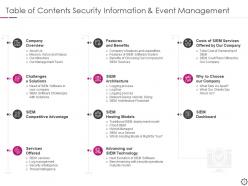
Slide 3: This slide exhibits table of contents.
Slide 4: This slide depicts title for 'Company Overview'.
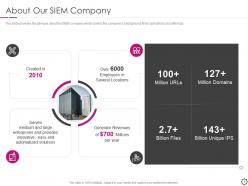
Slide 5: This slide provides the glimpse about the SIEM company which covers the company’s background, firms operations and offerings.
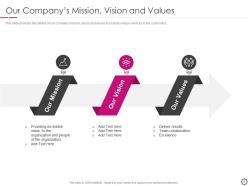
Slide 6: This slide provides the details of our company mission, vision and values to provide unique services to the customers.
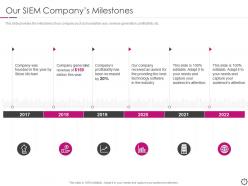
Slide 7: This slide provides the milestones of our company such as foundation year, revenue generation, profitability, etc.
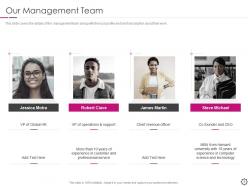
Slide 8: This slide covers the details of the management team along with their job profile and brief description about their work.
Slide 9: This slide shows title for 'Challenges and Solutions'.
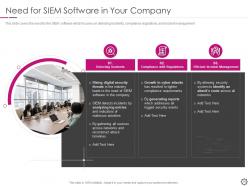
Slide 10: This slide covers the need for the SIEM software which focuses on detecting incidents, compliance regulations, etc.
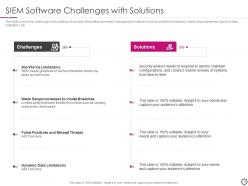
Slide 11: This slide covers the challenges and solutions of security information and event management software.
Slide 12: This slide displays title for 'SIEM Competitive Advantage'.
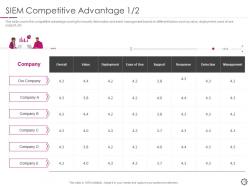
Slide 13: This slide covers the competitive advantage scoring for security information and event management.
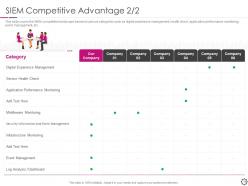
Slide 14: This slide covers the SIEM competitive landscape based on various categories such as digital experience management, etc.
Slide 15: This slide presents title for 'Services offered'.
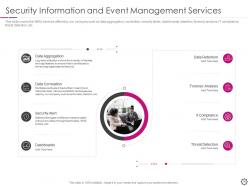
Slide 16: This slide covers the SIEM services offered by our company such as data aggregation, correlation, security alerts, etc.
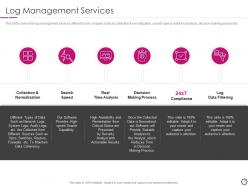
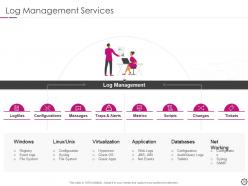
Slide 17: This slide covers the log management services offered by our company such as collection & normalization, search speed, etc.
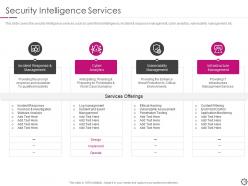
Slide 18: This slide covers the security intelligence services such as cyber threat intelligence, incident & response management, etc.
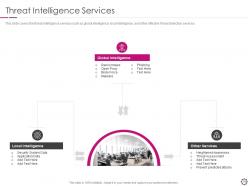
Slide 19: This slide covers the threat intelligence services such as global intelligence, local intelligence, etc.
Slide 20: This slide exhibits title for 'Features and Benefits'.
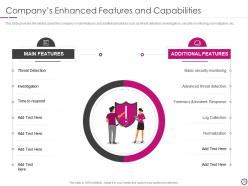
Slide 21: This slide provides the details about the company’s main features and additional features.
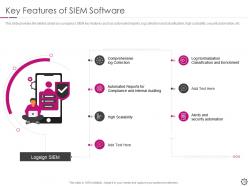
Slide 22: This slide provides the details about our company’s SIEM key features such as automated reports, log collection, etc.
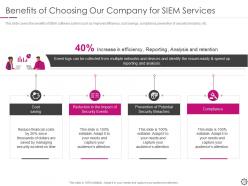
Slide 23: This slide covers the benefits of SIEM software system such as improved efficiency, cost savings, etc.
Slide 24: This slide shows title for 'SIEM Architecture'.
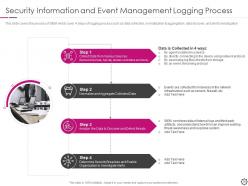
Slide 25: This slide covers the process of SIEM which cover 4 steps of logging process such as data collection, etc.
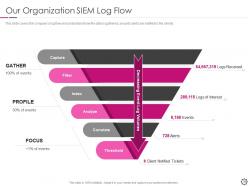
Slide 26: This slide covers the company’s log flow and understand how the data is gathered, security alerts are notified to the clients.
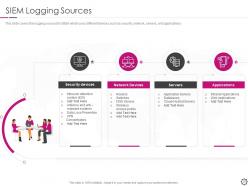
Slide 27: This slide covers the logging sources for SIEM which uses different devices such as security, network, servers, and applications.
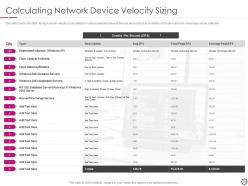
Slide 28: This slide covers the SIEM sizing wherein velocity is calculated for various selected network devices.
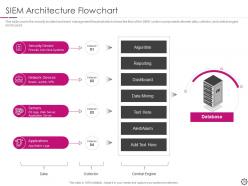
Slide 29: This slide covers the security incident and event management flowchart which shows the flow of the SIEM system components.
Slide 30: This slide depicts title for 'SIEM Hosting Models'.
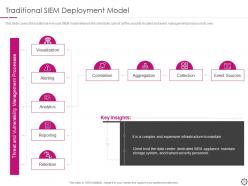
Slide 31: This slide covers the traditional in-house SIEM model wherein the client take care of all the security incident.
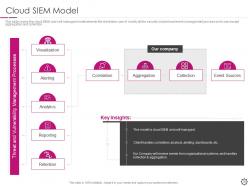
Slide 32: This slide covers the cloud SIEM and self managed model wherein the client take care of mostly all the security incident.
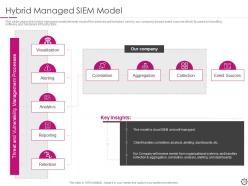
Slide 33: This slide covers the hybrid managed model wherein most of the services will be taken care by our company except event sources.
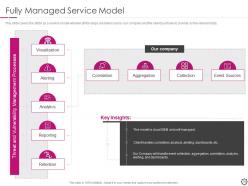
Slide 34: This slide covers the SIEM as a service model wherein all the steps are taken care by our company.
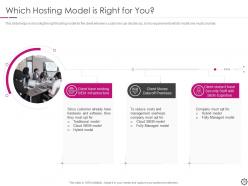
Slide 35: This slide helps in choosing the right hosting model for the client.
Slide 36: This slide displays title for 'Advancing our SIEM Technology'.
Slide 37: This slide focuses on the upcoming evolution of SIEM software which covers SIEM foundation, threat intelligence, etc.
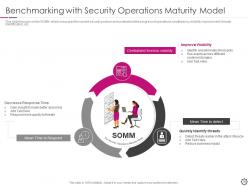
Slide 38: This slide focuses on the SOMM which measures the current security posture and understand the progress of operations readiness.
Slide 39: This slide presents title for 'Costs of SIEM Services Offered by Our Company'.
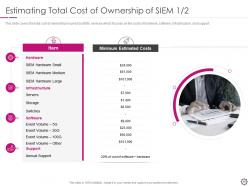
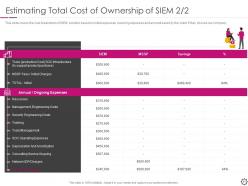
Slide 40: This slide covers the total cost of ownership incurred by SIEM services.
Slide 41: This slide covers the cost breakdown of SIEM solution based on initial expenses, recurring expenses etc.
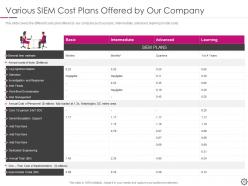
Slide 42: This slide covers the different costs plan offered by our company such as basic, intermediate, advanced, etc.
Slide 43: This slide exhibits title for 'Why to Choose Our Company'.
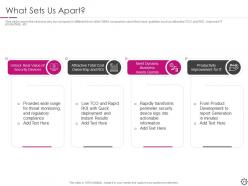
Slide 44: This slide covers the reasons why our company is different from other SIEM companies.
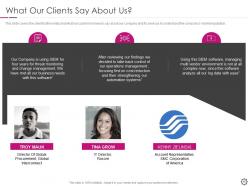
Slide 45: This slide covers the client testimonials and what our customers have to say about our company and its services.
Slide 46: This slide depicts title for 'SIEM Dashboard'.
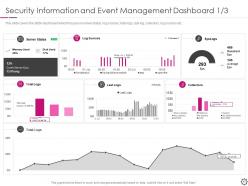
Slide 47: This slide covers the SIEM dashboard which focuses on server status, log sources, total logs, etc.
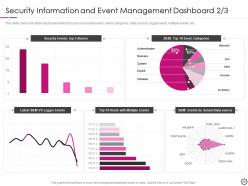
Slide 48: This slide covers the SIEM dashboard which focuses on security events, event categories, etc.
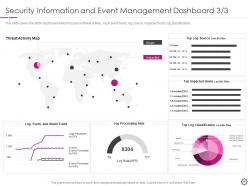
Slide 49: This slide covers the SIEM dashboard which focuses on threat activity, log & event trend, log source, etc.
Slide 50: This slide shows Log Management Services.
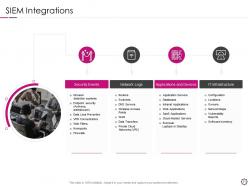
Slide 51: This slide displays SIEM Integrations.
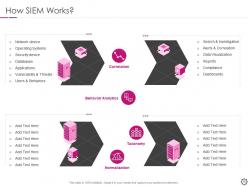
Slide 52: This slide presents 'How SIEM Works'?
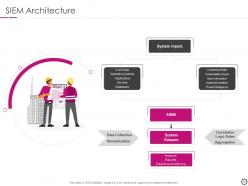
Slide 53: This slide exhibits SIEM Architecture.
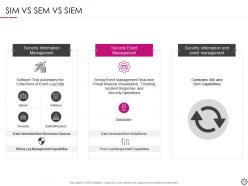
Slide 54: This slide depicts SIM VS SEM VS SIEM.
Slide 55: This is the icons slide.
Slide 56: This slide presents title for additional slides.
Slide 57: This slide shows about your company, target audience and its client's values.
Slide 58: This slide exhibits yearly timeline.
Slide 59: This slide depicts targets.
Slide 60: This slide displays puzzle.
Slide 61: This slide depicts posts for past experiences of clients.
Slide 62: This is thank you slide & contains contact details of company like office address, phone no., etc.
Security information and event management powerpoint presentation slides with all 62 slides:
Use our Security Information And Event Management Powerpoint Presentation Slides to effectively help you save your valuable time. They are readymade to fit into any presentation structure.


FAQs for Security information and event management
SIEM is Security Information and Event Management - it's like having a super vigilant security guard for your whole network. Pulls logs from everything: firewalls, servers, endpoints, all that stuff. Then it connects the dots to catch weird patterns or threats. The best part? Real-time alerts when sketchy things happen, so you're not discovering breaches months later (which honestly happens way too often). It analyzes tons of data 24/7 that would be impossible for humans to monitor. If you're shopping for one, map out what security tools you've got first - makes the whole process smoother.
So SIEM is like your security nerve center - pulls logs from everything and spots weird patterns you'd miss otherwise. The cool part? It connects dots between different events so you're not drowning in random alerts. When something sketchy happens, you can investigate super fast since it's all in one place. Honestly I've seen companies try to wing it without one and it's brutal - total chaos when incidents hit. Oh, and pro tip: feed your most critical stuff into it first, then expand from there.
Real-time monitoring is non-negotiable - that's where you catch everything as it happens. Log aggregation from all your sources matters too, plus you need correlation rules that actually work (not ones that spam you with false alarms). Dashboards should be dead simple because honestly, who wants to puzzle out some confusing interface at 2am? Oh, and make sure whatever you pick scales with your setup. If you're dealing with compliance stuff, the reporting features better be solid. Integration with your current security tools is huge. Just rank your must-haves first, then demo the top three options in your budget range.
So basically your SIEM is watching all your logs 24/7 - servers, firewalls, apps, the whole thing. It's scanning for weird patterns or attack signatures in real time. Think of it like... well, actually forget analogies, they're cheesy. The point is you catch threats while they're happening instead of finding out weeks later when someone's already ransacked your network. Way better than manual reviews where attackers have time to move around and cause real damage. You'll spot breaches, insider stuff, compliance issues - all as it unfolds so you can actually do something about it.
Dude, ML totally transforms how SIEM works. Your system learns what normal looks like on your network - login patterns, data access, all that stuff. Then it flags the weird stuff instead of bombarding you with useless alerts. The behavioral analytics piece is where it gets interesting though. It basically profiles your users and systems, so when someone starts acting fishy, you'll know right away. I've seen it cut false positives by like 80% in some setups. Bottom line? Go for SIEM tools with solid ML features if you actually want to catch threats without losing your mind.
So basically, SIEM tools pull logs from all your systems and automatically create those audit trails auditors want to see. They'll catch policy violations and ping you when sketchy stuff happens that could break SOX, HIPAA, or PCI rules. Most platforms have pre-built compliance dashboards already set up - honestly saves you hours of work. You can track user activity across everything too. Just don't fall into the trap of generating reports without actually reading them. I've seen too many companies do that and still fail audits because nobody was paying attention to what the data showed.
Ugh, alert fatigue is absolutely brutal - your team will hate you if you don't tune it right. Data overload and false positives are the main culprits. Budget-wise, you're looking at serious upfront costs for licensing, hardware, plus finding people who actually know this stuff (good luck with that). Integration with existing tools? Total pain. Takes forever to get useful insights too. Honestly, I'd start with a small pilot program focusing on your biggest priorities first. And whatever timeline you're thinking for tuning... triple it.
So basically, SIEMs hook up to your security tools through APIs, log forwarding, and built-in connectors. Firewalls, endpoint systems, vulnerability scanners - all that stuff can feed data in. Most newer ones also do webhook integrations and push alerts to SOAR platforms for automated responses, which is honestly pretty slick. You'll want to standardize your log formats first though - CEF or LEEF work well. Oh, and definitely map out what you've got running already. Figure out which tools are throwing the most important security events. That's where you'll get the biggest bang for your buck when setting everything up.
Track your MTTD and MTTR - how fast you're spotting and handling incidents. False positives matter too because your analysts will hate you if they're drowning in alerts. Detection coverage across attack types is key, plus log source availability so you're not missing blind spots. Honestly, the best metric? Count real threats caught vs what gets past you. I'd set monthly team reviews to spot trends and tweak rules. Oh, and don't obsess over perfect numbers - even good SIEMs miss stuff sometimes.
Honestly, cloud computing changed the whole SIEM game. Instead of buying tons of hardware upfront and hoping you got the sizing right, everything just scales automatically now. Way less stressful than the old days where you'd either overspend or run out of space. AWS Security Lake and Azure Sentinel are pretty solid cloud-native options - deployment is crazy fast compared to traditional setups. You're not dealing with server maintenance anymore either, which is nice. The built-in security stuff from cloud providers is a bonus too. I'd start by checking if one of those cloud solutions fits your setup.
So basically, on-prem means you're running everything in your own data center - total control but also total headache when stuff breaks. Cloud SIEM? The vendor handles all that maintenance garbage for you. On-prem keeps your sensitive data locked down tight, which some compliance folks love. But cloud solutions deploy way faster and scale without you having to buy more hardware. Honestly, it comes down to whether you'd rather deal with managing servers or trust someone else to do it. Also depends on your budget and how paranoid your security team is about data leaving the building.
Honestly, start with cleaning up your log formats before they even reach the SIEM - trust me on this one. Data normalization will save you so much pain when you're trying to piece together incidents later. Set up tiered storage too - keep recent stuff on fast drives, dump the old logs somewhere cheaper. The biggest thing though? Filter out the garbage at the source. Your firewall doesn't need to scream about every allowed connection like it's defcon 1. Take a hard look at what you're actually collecting vs what you use during investigations. Most places are drowning in useless data.
So playbooks are like having a game plan when your SIEM starts screaming about threats. Instead of panicking and wondering "now what?", you've got step-by-step instructions ready to go. They tell you who to call, what to check, how to investigate - the whole nine yards. Honestly, I learned this the hard way after spending way too long just staring at alerts during my first real incident. Total mess. Your SIEM catches the bad stuff, but playbooks actually walk you through fixing it without missing anything important. Start writing them down for your most common alerts. Trust me, you'll be grateful when you're dealing with an actual emergency at 2am.
Look, threat intel basically gives your SIEM actual context about what's dangerous instead of just blindly collecting logs. Your system can now match events against known bad IPs, malware signatures, attack patterns - stuff from VirusTotal or paid feeds. Way fewer false positives since you're alerting on real threats, not just random anomalies. Honestly, it's night and day difference. Think of it like upgrading from a basic security cam to one that actually recognizes sketchy behavior. Just grab one free threat feed first and you'll see what I mean about alert quality improving.
Honestly, AI and machine learning are about to totally change SIEM - way better threat detection and automated responses. Cloud-native platforms are taking over too, which makes sense since the scalability is insane compared to on-premise stuff. SOAR integration is getting much tighter, plus behavioral analytics can catch insider threats and zero-days that your old rule-based systems would totally miss. Oh, and if you're not already looking at cloud SIEM vendors, you should probably start now. The whole migration thing takes forever - learned that the hard way.
-
Very well designed and informative templates.
-
Much better than the original! Thanks for the quick turnaround.
-
Great experience, I would definitely use your services further.
-
Editable templates with innovative design and color combination.