


Enterprise Cyber Safety And Security Proposal Powerpoint Presentation Slides




Try Before you Buy Download Free Sample Product
 Impress Your
 Audience
 100%
100% Editable
 Save Hours
 of Time


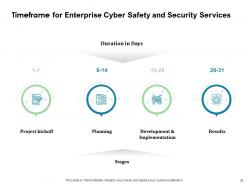
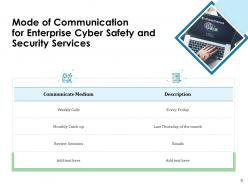
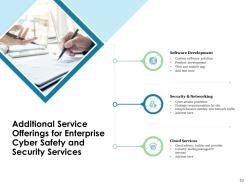
The increase in the number of cyberattacks on systems has called for cybersecurity methods. Cybersecurity refers to the practice of securing company information or data from being exposed. With rising cyberattacks, no company wants to take the risk ever, and due to this reason, corporations have started collaborating with cybersecurity service providers to keep their systems secure and safe. Therefore, incorporate our expertly-designed Enterprise Cyber Safety And Security Proposal PowerPoint Presentation Slides and propose your services confidently in front of your clients. Guarantee uninterrupted protection to all programs, best defense system to secure information, and network security monitoring through our professionally-designed internet protection PowerPoint template. The overall presentation is appealing enough to increase audience engagement. Explain your motive in the well-composed cover letter of this PPT layout. List the various components of your presentation in the table of contents slide. Identify the issues in securing the IT system and devise solutions to overcome the same. With our computer protection PowerPoint slideshow, explain project context and objectives thoroughly. Explain the importance of installing software in today’s times and ensure them to provide quality service by employing our network protection PowerPoint slideshow. Illustrate the process you follow while installing the software, such as project kickoff, planning, development, implementation, maintenance, and training. Take the assistance of the time frame layout to assign the timeline to each activity. Inform the mode of communication to your customers like weekly calls, monthly catch up, and review sessions with our expertly-created information protection PowerPoint graphic. Present the additional services of your company that include, software development, security, networking, and cloud services separately. Depict the budget plan and mention the cost involved in each activity, so clients know the total amount to arrange. Establish credibility by including testimonials and accomplishments of the past. Therefore, download our firewall PowerPoint design and amaze your audience with your proposal.
People who downloaded this PowerPoint presentation also viewed the following :
Content of this Powerpoint Presentation
Slide 1: This slide introduces Enterprise Cyber Safety and Security Proposal. State Proposal name, Submission date, User assigned and begin.
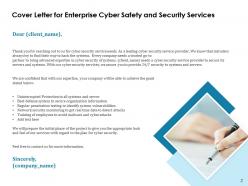
Slide 2: This slide displays Cover Letter for Cyber Security Services.
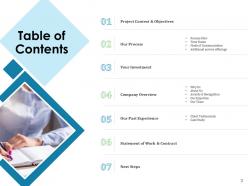
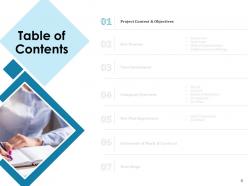
Slide 3: This slide showcases Table of Contents.
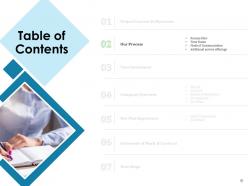
Slide 4: This slide depicts Table of Contents with- Project Context & Objectives.
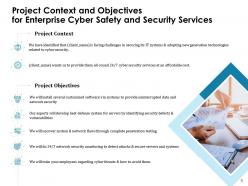
Slide 5: This slide describes Project Context and Objectives for Cyber Security Services.
Slide 6: This slide shows Table of Contents.
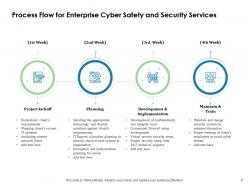
Slide 7: This slide depicts Process Flow for Cyber Security Service.
Slide 8: This slide showcases Timeframe for Cyber Security Services.
Slide 9: This slide displays Mode of Communication for Cyber Security Services.
Slide 10: This slide showcases Additional Service Offerings for Cyber Security Services such as- Security & Networking, Cyber attacks protection, Strategic recommendation for site, Comprehensive visibility into Network traffic, etc.
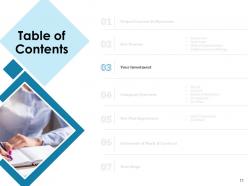
Slide 11: This slide displays Table of Contents with- Your Investment.
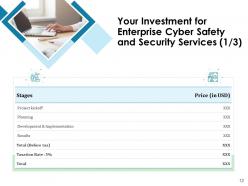
Slide 12: This slide represents Investment details for Cyber Security Services.
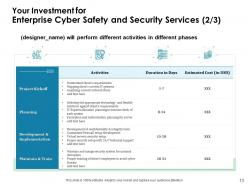
Slide 13: This slide shows Investment details for Cyber Security Services.
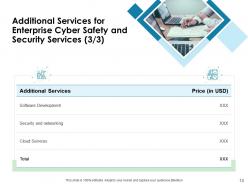
Slide 14: This slide presents Additional Services for Cyber Security.
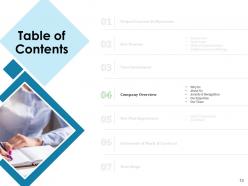
Slide 15: This slide depicts Table of Contents with- Company Overview, Why Us, About Us, Awards & Recognition, Our Expertise, Our Team.
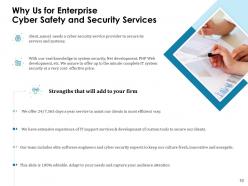
Slide 16: This slide describes Why Us for Cyber Security Services.
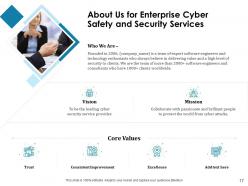
Slide 17: This is About Us slide to showcase Company Specifications.
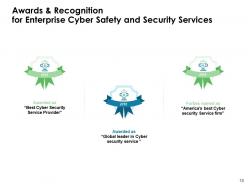
Slide 18: This slide displays Awards & Recognition for Cyber Security Services
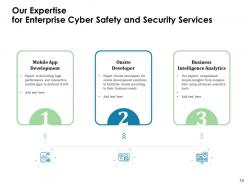
Slide 19: This slide shows Our Expertise contaning- Mobile App Development, Onsite Developer, Business Intelligence Analytics.
Slide 20: This is Our Team slide with Names and Designations.
Slide 21: This is Our Team for Cyber Security Organization.
Slide 22: This slide showcases Client Testimonials with Names and Designations.
Slide 23: This slide showcases Client Testimonials with Names and Designations.
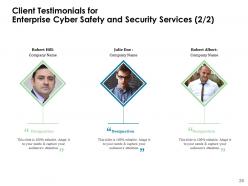
Slide 24: This slide displays Client Testimonials for Enterprise Cyber Safety and Security Services.
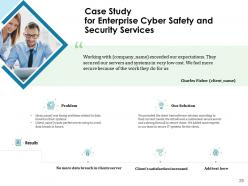
Slide 25: This slide represents Case Study for Enterprise Cyber Safety and Security Services.
Slide 26: This slide depicts Table of Contents with project context and objectives.
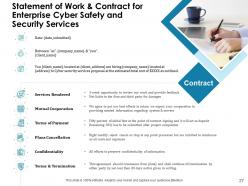
Slide 27: This slide showcases Statement of Work & Contract.
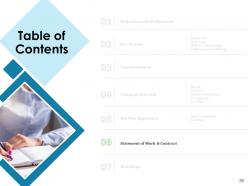
Slide 28: This slide displays Table of Contents.
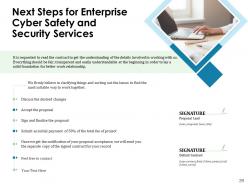
Slide 29: This slide showcases Next Steps for Enterprise Cyber Safety and Security Services.
Slide 30: This is Contact Us slide with Email address, Contact number and Address.
Slide 31: This is Icons Slide for Enterprise Cyber Safety and Security Proposal.
Slide 32: This slide is titled as Additional Slides for moving forward.
Slide 33: This slide displays Organization Mission and Vision Statement.
Slide 34: This is About Us slide to showcase Company specifications.
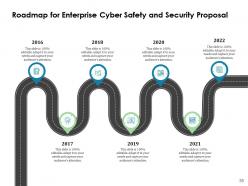
Slide 35: This slide displays Roadmap process.
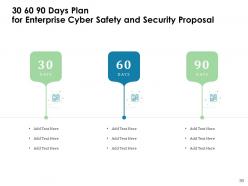
Slide 36: This is 30 60 90 Days Plan slide.
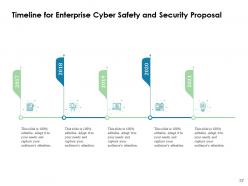
Slide 37: This slide showcases Timeline process.
Enterprise Cyber Safety And Security Proposal Powerpoint Presentation Slides with all 37 slides:
Use our Enterprise Cyber Safety And Security Proposal Powerpoint Presentation Slides to effectively help you save your valuable time. They are readymade to fit into any presentation structure.

FAQs for Enterprise Cyber Safety And Security Proposal
A successful enterprise cybersecurity strategy includes risk assessment frameworks, multi-layered security controls, incident response protocols, employee training programs, and continuous monitoring systems. These components work together by identifying vulnerabilities, preventing breaches, and ensuring rapid recovery, with many organizations finding that this integrated approach significantly reduces security incidents while maintaining operational efficiency and regulatory compliance.
Organizations assess cybersecurity vulnerabilities through regular penetration testing, comprehensive security audits, automated vulnerability scanning, threat modeling, and risk assessments. These strategic approaches enable businesses to identify weaknesses across networks, applications, and infrastructure while prioritizing remediation efforts, ultimately delivering enhanced security posture and reduced operational risks in an increasingly complex digital landscape.
Employees serve as the first line of defense through security awareness training, phishing recognition, strong password practices, regular software updates, and incident reporting. Through comprehensive cybersecurity education programs, organizations enhance their security posture by empowering staff to identify threats, follow protocols, and maintain vigilant practices, ultimately reducing human error vulnerabilities significantly.
Insider threats significantly complicate cybersecurity measures by exploiting legitimate access credentials, bypassing traditional perimeter defenses, and creating detection challenges that external attacks don't present. These threats force organizations to implement zero-trust architectures, enhanced monitoring systems, and behavioral analytics, with many financial institutions and healthcare organizations finding that comprehensive insider risk programs ultimately deliver stronger overall security postures and regulatory compliance.
Enterprises can ensure compliance with data protection regulations by implementing comprehensive data governance frameworks, conducting regular security audits, establishing clear data handling protocols, and maintaining detailed documentation of all data processing activities. Through automated compliance monitoring tools and staff training programs, organizations across sectors like healthcare and financial services streamline regulatory adherence while minimizing compliance costs and reducing regulatory risks.
Emerging cybersecurity technologies include zero trust architecture, AI-powered threat detection, extended detection and response (XDR), secure access service edge (SASE), and quantum-safe cryptography. These technologies enhance enterprise security by automating threat identification, streamlining network access controls, and enabling proactive defense mechanisms, with many organizations finding that strategic adoption delivers significantly faster incident response and reduced breach risks.
Businesses can measure cybersecurity ROI by calculating cost avoidance from prevented breaches, reduced incident response expenses, compliance savings, and improved operational efficiency. Financial institutions and healthcare organizations increasingly track metrics like decreased downtime costs, lower insurance premiums, and enhanced customer trust, ultimately delivering measurable competitive advantages and long-term business resilience.
Enterprise incident response best practices include establishing clear communication protocols, implementing automated threat detection systems, creating detailed response playbooks, conducting regular tabletop exercises, and maintaining comprehensive logging capabilities. These frameworks enhance organizational resilience by minimizing response times, reducing operational disruptions, and ensuring regulatory compliance, with many financial services and healthcare organizations finding that structured incident management ultimately delivers faster recovery and stronger security postures.
Organizations implement zero-trust security models by verifying every user and device, implementing multi-factor authentication, segmenting networks, monitoring traffic continuously, and applying least-privilege access controls. Through identity verification and micro-segmentation, companies in banking, healthcare, and retail enhance threat detection, reduce breach risks, and strengthen data protection, ultimately delivering improved security posture and regulatory compliance.
Enterprises face challenges including data visibility gaps, complex multi-cloud architectures, shared responsibility model confusion, compliance across jurisdictions, and identity management at scale. These security complexities are amplified by rapid cloud adoption, with many organizations finding that traditional perimeter-based defenses prove inadequate, ultimately requiring strategic investment in cloud-native security tools and comprehensive governance frameworks.
Cybersecurity training strengthens organizational security posture by reducing human error risks, improving threat recognition capabilities, and fostering security-conscious culture across all departments. Through comprehensive education programs, employees become active defenders rather than vulnerabilities, with organizations like banks and healthcare systems finding that well-trained staff significantly minimize phishing attacks, data breaches, and compliance violations, ultimately delivering stronger resilience and competitive advantage.
The most common cybersecurity threats facing large enterprises include ransomware attacks, phishing campaigns, insider threats, advanced persistent threats (APTs), and supply chain vulnerabilities. These threats increasingly target critical infrastructure, financial systems, and customer data across sectors like banking, healthcare, and manufacturing, with many organizations finding that comprehensive defense strategies combining threat detection, employee training, and zero-trust architectures deliver enhanced protection and operational resilience.
Enterprises leverage threat intelligence by integrating real-time data feeds, automated threat detection systems, proactive vulnerability assessments, and behavioral analytics into their security frameworks. This strategic combination enables organizations to anticipate attacks before they occur, streamline incident response protocols, and strengthen defense mechanisms, with many financial institutions and healthcare providers finding that intelligence-driven approaches significantly reduce breach risks while enhancing operational resilience.
Organizations can protect sensitive customer data through multi-layered encryption, zero-trust network architecture, regular security audits, employee training programs, and advanced threat detection systems. These strategies work together by securing data at rest and in transit, minimizing access points, and enabling rapid incident response, with many financial institutions and healthcare providers finding that this comprehensive approach significantly reduces breach risks while maintaining customer trust.
Third-party vendors significantly expand enterprise attack surfaces by introducing vulnerabilities through shared access, data exchanges, and integrated systems that can bypass internal security controls. Organizations manage these risks through comprehensive vendor assessments, continuous monitoring, contractual security requirements, and zero-trust architectures, with many financial services and healthcare institutions finding that strategic vendor risk management programs ultimately enhance overall security posture while enabling digital transformation.
-
Easy to edit slides with easy to understand instructions.
-
The Designed Graphic are very professional and classic.
-
The content is very helpful from business point of view.