


4ps Of Effective Corporate Governance Mechanism Template




Try Before you Buy Download Free Sample Product
 Impress Your
 Audience
 100%
100% Editable
 Save Hours
 of Time


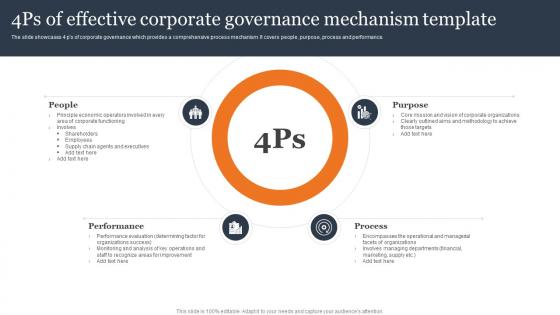
The slide showcases 4 ps of corporate governance which provides a comprehensive process mechanism. It covers people, purpose, process and performance.
People who downloaded this PowerPoint presentation also viewed the following :
4ps Of Effective Corporate Governance Mechanism Template with all 6 slides:
Use our 4ps Of Effective Corporate Governance Mechanism Template to effectively help you save your valuable time. They are readymade to fit into any presentation structure.





FAQs for 4ps Of Effective Corporate
So the 4Ps are People, Process, Purpose, and Performance - honestly it's just a fancy way to break down how organizations actually work. People is your leadership setup and who does what. Process covers decision-making, policies, all that workflow stuff. Purpose is your mission and values (the existential "why are we here" question). Performance tracks whether you're actually hitting your targets. They're all connected though - you can't fix one without looking at the others. I'd start by figuring out where you currently suck at each one, then tackle whatever's most broken first. Way easier than trying to do everything at once.
So basically the 4Ps force everyone to own their stuff. People governance means no more "that wasn't my job" when things blow up. Process standardization lets you actually figure out what broke and why - way better than just guessing. Performance metrics give you real numbers instead of hunches. Purpose alignment keeps teams focused on the same goals instead of just staying busy (which honestly happens more than it should). It's pretty much an accountability system that runs on autopilot once you set it up. I'd start by figuring out who makes what decisions right now.
So the 4Ps are basically your decision-making cheat sheet. **People** makes you think about who's affected and if they'll actually support this thing. **Process** is all about following the rules - boring but it'll save your ass later when someone asks why you did what you did. With **Performance**, you set up ways to measure if your decision actually worked or was just expensive theater. **Purpose** keeps you focused on what matters instead of chasing whatever fire needs putting out today. Honestly, I always run big decisions through all four before committing. You'd be surprised how often it catches something obvious you missed.
Look, the 4Ps thing (People, Purpose, Process, Performance) is honestly pretty solid for sustainability stuff. Getting the right stakeholders involved, having clear goals, setting up transparent systems, and actually measuring results - that's what separates projects that work from the ones that flop. I swear half the "sustainable" initiatives I've seen crash because they get obsessed with just one piece. Like they'll have great goals but terrible processes, or amazing data but nobody actually cares. When all four Ps line up though? That's when you can balance the economic and environmental stuff without everything falling apart. Quick tip - figure out which P sucks most in your current work. Start there.
So public participation is basically one of the main pillars in that 4Ps framework you mentioned. It gives people an actual say in how they're governed - works with the public sector, private sector, and partnerships to make things more transparent. Way better than those sleepy town halls we used to have (ugh, remember those?). When it's done right, it helps close that gap between what politicians think we want versus what we actually need. My advice? Build in multiple ways for citizens to give input from the start. Surveys, forums, focus groups - whatever fits your situation really.
Honestly, I'd map what you have now against the 4Ps framework - Purpose, People, Processes, Performance. Most places totally bomb on getting the right people in governance roles, so don't feel bad if that's messy. Define your org's purpose first since everything else builds from there. Then tackle the people piece, set up clear decision-making processes, and figure out metrics to track progress. Oh, and treat it like one connected system instead of four random buckets. Don't try fixing everything at once though - pick one P and spend a few months on it. Way less overwhelming that way.
Honestly, the trickiest part is that governance stuff doesn't work the same everywhere. Your "participation" pillar? Could totally blow up in cultures where questioning authority is seen as rude. What counts as transparency in one place might be offensive somewhere else. Power dynamics are weird like that - I learned this the hard way on a project once. Legal systems and trust levels are all over the map too. Collectivist societies care way more about consensus than getting things done fast. Don't just copy-paste the 4Ps framework everywhere. Spend time figuring out local norms first, then adapt accordingly.
Oh totally! The 4Ps work great for digital stuff, you just tweak them a bit. **People** becomes all about digital skills and getting teams comfortable with new tech. **Process** is where you map out digital workflows and figure out what can be automated (this part's actually pretty fun). **Performance** shifts to tracking things like user experience and system performance. **Purpose** stays mostly the same but might include digital transformation goals. It's basically the same framework wearing different clothes. I'd start by looking at what digital projects you have now and see which P they fall under - you'll spot the gaps pretty quick.
Look, the 4Ps are basically like having built-in watchdogs for your governance stuff. Clear **People** roles mean everyone knows who's doing what. **Processes** get documented so there's no mystery about how things work. **Policies** are out in the open, and **Performance** metrics track everything publicly. Honestly, it's pretty hard to pull shady stuff when you've got that kind of visibility baked in. Think of it like a digital paper trail - which sounds way less cool than it actually is. Just figure out where your current gaps are and see which P fixes what. That's your roadmap sorted.
Honestly, start simple with just 2-3 metrics per category or you'll go crazy trying to track everything. For People stuff, look at citizen engagement and trust surveys. Process is easier - track how fast decisions get made and compliance rates. Performance? Budget variance and service quality metrics work well. Purpose is the tricky one though - you need those long-term impact studies to see if you're actually hitting your mission. Mix hard numbers with feedback from different groups. Stakeholder satisfaction surveys are gold for this. Don't overthink it initially.
The 4Ps basically create a framework so resource allocation isn't just random or biased. Clear **Policies** mean everyone knows the rules upfront. **Processes** keep things consistent instead of relying on whoever's having a good day. For **People** - and this is key - you actually need different perspectives making decisions, not the same three people every time. **Performance** tracking shows if it's actually working or if you're just patting yourself on the back. Honestly, start by looking at who gets what now and why. The patterns might shock you a bit.
Look, the 4Ps work because they create these overlapping layers that make corruption way harder to pull off. **People** gives you different groups keeping tabs on each other. **Processes** force transparency and clear rules - no more backroom deals. Numbers don't lie, so **Performance** metrics will eventually expose when sketchy stuff is happening. And honestly? **Purpose** might be the most powerful one because it reminds everyone why they're there in the first place. None of them work solo though - they've gotta back each other up. When you're setting up governance, just build the anti-corruption stuff right into each P from day one.
Your leadership style totally affects how you pull off the 4Ps - I've watched so many initiatives crash because of this mismatch. Autocratic leaders bomb at the "People" part since nobody's buying in. Too hands-off? Your processes fall apart. Collaborative types usually crush "Partnerships" but then spend forever trying to get everyone to agree on everything (which honestly drives me nuts sometimes). Here's what works: match your approach to each P. Be direct with processes, team up for people stuff and partnerships, then get analytical with performance. Figure out which P trips you up most based on how you naturally lead.
Singapore's housing policy is honestly brilliant - they hit all 4Ps perfectly. Transparent allocation system for Process, community feedback sessions for People, clear wait-time metrics for Performance, and it all tied into their bigger social goals for Purpose. Estonia's digital government stuff is wild too (seriously, they make everyone else look like they're stuck in the 90s). Their online services show how you can blend citizen participation with actual measurable results. I'd start by checking out these examples and figure out how each P connects in your situation.
You'll want to run proper workshops walking people through the 4Ps - People, Purpose, Process, Performance. Map it to real scenarios they're dealing with. Most governance stuff crashes because folks never grasp the basics, honestly. Make it hands-on where they connect their actual challenges to each P. Case studies from your own company work way better than generic examples. Follow up with coaching sessions. Oh, and don't forget quarterly refreshers - this framework gets forgotten fast without practice. Keep it practical, not some boring theoretical lecture nobody remembers.
-
I am extremely pleased with these PPT slides that we used for our event. They were easy to modify and came out great in all aspects!
-
Their designing team is so expert in making tailored templates. They craft the exact thing I have in my mind…..really happy.