Data quality management framework for governance improvement

Rating:
90%
Data quality management framework for governance improvement
Slide 1 of 2
Favourites Favourites

Try Before you Buy Download Free Sample Product

Audience Impress Your
Audience
Editable 100%
Editable
Time Save Hours
of Time
The Biggest Sale is ending soon in
0
0
:
0
0
:
0
0
Rating:
90%
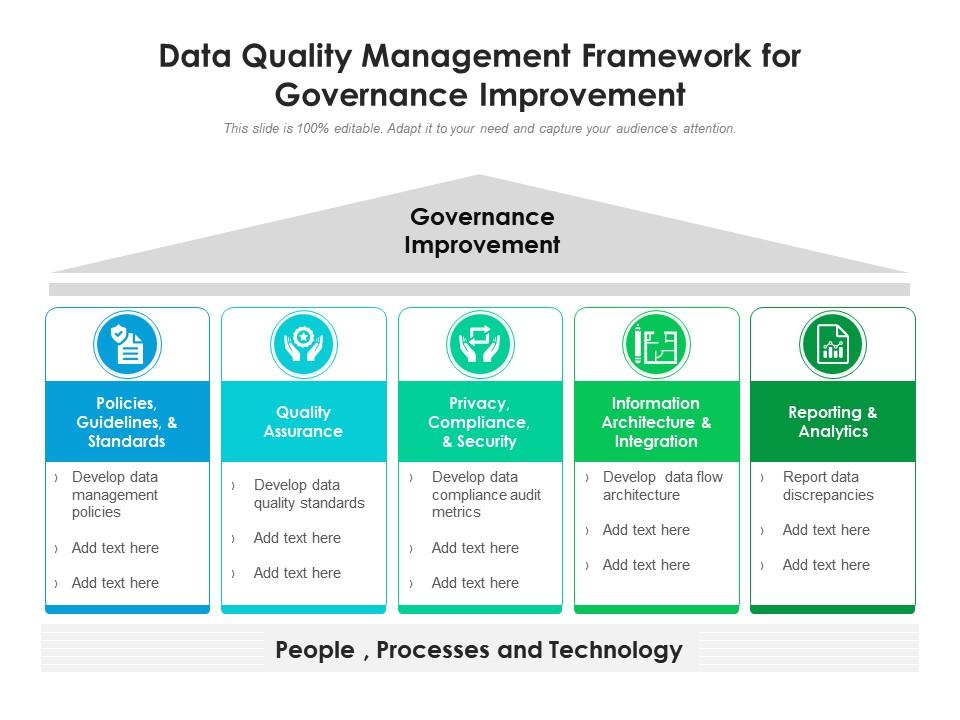
Introducing our premium set of slides with Data Quality Management Framework For Governance Improvement. Elucidate the five stages and present information using this PPT slide. This is a completely adaptable PowerPoint template design that can be used to interpret topics like Quality Assurance, Reporting And Analytics, Information Architecture And Integration. So download instantly and tailor it with your information.

FAQs for Data quality management framework

Focus on accuracy, completeness, consistency, timeliness, validity, and uniqueness. Accuracy means your data actually matches reality. Completeness catches missing values. Consistency keeps formats the same across different systems. Honestly, timeliness might be the biggest one - old data will wreck your decisions faster than anything. Validity checks if data follows your business rules, and uniqueness stops duplicates from screwing up your analytics. Don't try to tackle everything at once though. Pick 2-3 dimensions that are causing your team the most pain right now and build dashboards for those first. You can always add more later.

Track your accuracy rates and how complete your data sets are - those are the big ones. Dashboards help a ton for keeping tabs on this stuff consistently. But honestly? The real test is downstream impact. Are your reports actually more reliable now? Fewer customer complaints about wrong info? I'd survey the people using your data too since they'll be brutally honest about whether things improved. Oh and don't go crazy measuring everything - pick 3-4 core metrics first. You can always add more later once you've got the basics down.

So basically data governance is like having house rules for your data - otherwise people just wing it and mess things up. You need clear standards and someone actually owning each piece of data. It's the whole "who's responsible for what" thing, plus processes to catch problems before they snowball. Without it, good luck maintaining any kind of quality (trust me, I've seen the chaos). Set up validation checkpoints and feedback loops so issues get flagged early. Oh and definitely start by figuring out who owns what data in your company and get that stuff written down somewhere people can actually find it.

So here's the thing - AI and ML are game changers for cleaning up messy data. They'll spot duplicates and weird anomalies way faster than doing it manually. You can set them up to watch your data streams constantly and alert you when something's off. Plus they actually learn your specific patterns over time, which is pretty cool. My advice? Start simple though. Pick whatever data issue is driving your team crazy right now and throw AI at that first. Once you see how much cleaner everything gets, you can expand from there. Trust me, the automation makes such a difference.

Build data validation right into your streaming pipeline - schema checks, range validations, anomaly detection as data flows through. Set up automated alerts when quality metrics drop below thresholds, because discovering bad data after it corrupts downstream systems sucks (trust me). Circuit breakers are clutch - they quarantine problematic sources before poisoning your whole pipeline. Keep quality checks lightweight so they don't bottleneck real-time processing. I'd start with basic validations first. Then add more sophisticated rules as you spot patterns in your data issues. Oh, and don't overthink the initial setup.

Honestly, crappy data is like trying to drive with a dirty windshield - you're gonna crash eventually. Your sales team ends up ordering way too much of something nobody wants. Marketing sends weird emails to the wrong people and pisses them off. I watched one company make their entire quarterly budget based on numbers that were literally three weeks old, which was... not great. The worst part? Bad calls just keep stacking up on each other. My advice? Figure out which data actually matters most to your business and clean that stuff up first. Everything else can wait.

Manual data entry mistakes are the worst - people just fat-finger stuff all the time. Then you've got departments doing their own thing with formats, so sales calls someone a "lead" while finance calls them a "customer." Legacy systems are another nightmare since they barely communicate with each other, creating duplicates everywhere. Oh, and nobody ever cleans up old data, which is honestly such a pain. Integration between different platforms always causes issues too. Set up some automated checks and do regular cleanups before everything turns into a complete mess.

Set up dashboards that automatically track stuff like how complete and accurate your data is - check them weekly. Look for patterns. Maybe certain data sources always suck, or quality tanks after specific steps? Teams I know catch problems way faster this way. Use those numbers to figure out what to fix first based on what actually matters to the business. Monthly reviews work well - analyze the trends and spot where you can improve. Oh, and don't go overboard initially. Start with maybe 3-4 key metrics instead of measuring everything under the sun.

Dude, stop making data quality just an IT thing - spread that responsibility around. Set up dashboards people will actually check (not buried ones nobody sees). Most people have zero clue how crappy data screws up their day-to-day stuff, so show them real examples. I learned this the hard way at my last job. Training helps, but tie it to performance reviews too and celebrate when teams get their act together. Oh, and actually give people time and decent tools to fix things. You can't just wave a magic wand and expect perfect data.

Yeah, data integration definitely screws with quality. You're mixing datasets that have totally different formats and standards - duplicates and weird inconsistencies just happen. Schema mismatches are the worst, plus conflicting business rules and random human errors during mapping. Here's what actually works: profile your data first so you know what mess you're dealing with. Set up solid transformation rules and validation at every step. Oh, and get decent lineage tracking - trust me, you'll need it when something breaks and you're trying to figure out where it went wrong. It's like detective work but less fun.

Honestly, the hardest part isn't even the tech stuff - it's getting everyone on the same page. Different departments have totally different ideas about what "good data" looks like, which is... fun. Plus when budgets get tight, data quality projects are usually first to get axed. On the technical side, you're dealing with legacy systems that are basically held together with duct tape and prayer, trying to make everything play nice together. Oh, and don't get me started on setting consistent standards across the board. My two cents? Pick one really important dataset first, show some clear wins, then expand from there.

Honestly, training your team is probably the best investment you can make for data quality. People mess up data entry way less when they actually know what they're doing. Show them real examples from your own messy data - that stuff hits different than generic training slides. I worked with one team that was drowning in cleanup work, but after they started doing monthly sessions their workload basically got cut in half. Pretty wild. Focus on wherever you're entering the most data first, and make sure people understand why clean data actually matters. When they get it, they'll start catching weird stuff before it spreads everywhere.

First thing - actually calculate what crappy data is costing you. Failed campaigns, compliance headaches, hours wasted on garbage decisions. Most companies are genuinely floored by these numbers! Don't go for perfect data everywhere (trust me, that's a rabbit hole). Pick the stuff that actually moves the needle - revenue-driving data, critical ops. Start with simple automated validation rules, prove they work, then expand from there. I'd suggest cleaning up customer data for marketing first - it's visible, shows quick wins, and gives you ammo to get budget for bigger fixes later.

Okay so first thing - don't mess around with security and compliance stuff. Any vendor you pick needs rock-solid encryption and has to handle whatever regulations you're dealing with. Look for actual data quality experience, not just some general IT company trying to expand (learned that one the hard way). Check if they've worked with your type of data before. Set clear expectations upfront about accuracy, timing, all that. Oh and definitely keep some oversight on your end - like don't just throw everything at them and hope for the best. Start small with a test project first.

So regulatory stuff basically forces you to get way more serious about data quality than you'd normally bother with. HIPAA makes healthcare companies obsess over patient data accuracy, while finance has SOX breathing down their necks for perfect audit trails. Yeah, it's annoying but it works. Companies end up building automated checks and proper governance because they have to. Pharma needs everything FDA-ready, telecom deals with privacy rules - each industry's different. My advice? Figure out your specific requirements first, then build around those. Way easier than trying to fix everything later when auditors show up.

Ratings and Reviews

90% of 100
Review Form
Write a review
Most Relevant Reviews
  1. 100%

    by Demarcus Robertson

    Excellent template with unique design.
  2. 80%

    by Rodriguez Morgan

    Awesome use of colors and designs in product templates.

2 Item(s)

per page: