


Corporate governance structure hierarchy chart ppt examples




Try Before you Buy Download Free Sample Product
 Impress Your
 Audience
 100%
100% Editable
 Save Hours
 of Time


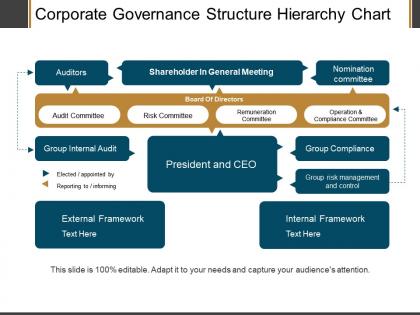
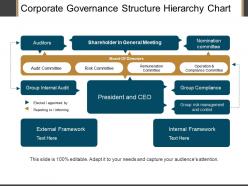
The corporate governance structure PPT slide incorporates the system of rules, practices, as well as the processes by which an organization gets a direction. The corporate governance framework presentation slide can provide the framework to attain an organization's objectives, however, it incorporates practically every sphere of the management, whether it is an action plan, internal controls to performance measurement or corporate disclosure. The corporate governance model PPT template highlight the set of rules & regulations, controls, policies, moreover, you can explain resolutions put in place for dictating corporate behavior. The user can take the assistance of the corporate governance system slide to discuss proxy advisors as well as shareholders who indirectly affect corporate governance. You can make your viewers understand that broadcasting an organization's corporate governance is a key component of community as well as investor relations.
People who downloaded this PowerPoint presentation also viewed the following :
Corporate governance structure hierarchy chart ppt examples with all 5 slides:
Compose your thoughts with our Corporate Governance Structure Hierarchy Chart Ppt Examples. Give them a dose of artistic brilliance.



FAQs for Corporate governance structure hierarchy
So basically you've got your board of directors running the show at the top, then your C-suite people (CEO, CFO, all those acronyms). Below that it's senior managers, middle managers, then regular employees. Board handles the big picture stuff and strategy, while executives deal with daily operations - though honestly that gets messy in smaller companies where everyone wears multiple hats. There's also audit committees and compensation committees that report back to the board. Oh, and make sure info flows both directions when you're setting this up. Nobody likes being left in the dark about decisions that affect them.
Big companies have tons of layers - boards, committees, regulatory stuff everywhere. Small businesses? The owner usually runs everything themselves, which honestly makes things way simpler. Corporate governance means shareholders pick board members who then watch over the executives. It's this whole separation thing. Meanwhile small business owners ARE the manager, board, whatever. Way less paperwork too - big corps deal with Sarbanes-Oxley and quarterly reports while small businesses have fewer hoops to jump through. If you're checking out companies, dig into their governance docs. Shows you who actually calls the shots and how decisions happen.
So board members are basically the people at the very top who run the show. Shareholders elect them to look out for their interests and make the big calls. They hire and fire CEOs, approve budgets, set how much executives get paid - honestly, sounds like a pretty sweet gig if you ask me. They also watch over financial stuff and make sure the company isn't breaking any laws. Oh, and they handle risk management too. If there's ever drama with management, the board gets final say. It's a ton of responsibility but they've got ultimate authority over everything.
Good governance really does pay off - both money-wise and reputation-wise. Investors trust you more when there's real oversight and transparent reporting happening. Customers notice too, honestly. They want to work with companies that seem ethical and reliable. The financial benefits are huge though. You dodge expensive scandals, regulatory headaches, and dumb operational mistakes that can wreck your stock price. My old boss used to say half the corporate disasters he saw were totally preventable with better board oversight. Just make sure your board isn't just nodding along to whatever management wants - they need to actually challenge decisions.
So independent directors are like the neutral referees on a company's board. Since they don't work for the company, they can actually push back on management without getting fired - which is huge. They handle the really important stuff like audits and CEO pay decisions. Honestly, I always look for boards that are at least majority independent when I'm researching stocks. The ones with too many insiders? Red flag. These outside directors basically protect regular shareholders from getting screwed over by asking the hard questions that employees might be scared to bring up.
So basically, regulations force your company structure into certain shapes whether you like it or not. SOX makes you have independent audit committees. Banking rules require risk committees at the board level - that kind of thing. You can't just design whatever's convenient for your business. The regs dictate who sits where, what committees exist, approval limits, all of it. Pretty annoying honestly, but I get why they exist after all the corporate scandals. You've gotta map everything against your industry's rules first, then work around those constraints to optimize what you can.
Honestly, resistance to change is gonna be your biggest headache. People don't want to give up their power or switch up their routines - totally predictable but still annoying. You'll also deal with getting the right board mix and actually making people follow new processes instead of just nodding along. Oh, and communication gaps between different levels happen constantly. Start by documenting who does what (sounds boring but trust me). Then train people and get your key players on board before changing everything. That order matters way more than I initially thought when I was dealing with this stuff.
Honestly, just start with digitizing your board communications - that's the easiest win. Board portals are game-changers because stakeholders get instant access to meeting minutes and voting records instead of waiting forever for updates. Real-time dashboards can track governance metrics automatically, which saves tons of manual work. Blockchain's pretty solid for keeping records tamper-proof too. AI can actually spot governance red flags before they blow up (though I'm still skeptical about how well that works in practice). Don't overthink the tech stack - pick something that plays nice with what you already have. Otherwise you'll just create another headache.
Look, governance and stakeholder engagement are totally connected - you can't do one well without the other. Your board needs to actually hear from shareholders, employees, customers, the whole crew to make decent decisions. Otherwise you're just guessing what people want. Build in regular ways to get feedback from these groups and work it into how your leadership team thinks about strategy and risks. Honestly, most companies are terrible at this part. But when you get stakeholder input flowing into your governance processes, your decision-making gets so much stronger. It's not rocket science, just requires being intentional about it.
Think of governance as setting up the ground rules for how your company spots and deals with risks. Your board and executives decide what risks they're cool with taking, then create processes so everyone's on the same page. I've watched too many places where departments just wing it independently - total mess. You need clear ownership and regular check-ins, otherwise risk management becomes this pointless paperwork thing. The trick is connecting it to actual business decisions instead of just bureaucratic nonsense. Short version: good governance stops different teams from contradicting each other.
Okay so first thing - get your roles crystal clear. Board, executives, management, everyone needs to know their lane. Find independent directors who'll actually push back, not yes-men. Audit and compensation committees are non-negotiable. Transparency saves your ass later, trust me. Document everything, set up proper reporting channels. Board evaluations should happen regularly, and obviously stay compliant with regulations (boring but necessary). Here's the thing though - don't go crazy trying to build some perfect system right away. Nail the fundamentals first, then add the fancy stuff as you scale up.
So here's the deal - good governance stops companies from being idiots about short-term gains. You get proper board oversight that actually makes management think about environmental and social stuff that'll screw you over later. Honestly, it's like babysitting sometimes. But it works. Your board should tie sustainability metrics right into exec pay - suddenly everyone cares about green goals when their bonus depends on it. Oh, and regular ESG reporting keeps everyone honest with stakeholders. Bottom line? Create board committees that watch sustainability metrics just as closely as the financial ones.
Good governance usually keeps activists away, honestly. Investors don't feel the need to fight when companies have solid oversight and transparent reporting. Activists go after the low-hanging fruit - you know, places with messy boards and sketchy accountability. It's ironic though, because a lot of these governance improvements happened because activists pushed for them years ago. Weird cycle, right? If you're looking at investments, find companies that got their act together before the troublemakers showed up. Way less drama that way.
Honestly, you've gotta flatten those old school hierarchies - they're killing your speed. Information needs to flow faster, and frankly, most boards still look stuck in the 90s. Mix up your teams with people who actually get today's world. Cross-functional committees work great for pivoting on stuff like cyber risks or ESG issues. Short sentences help too. The real trick is creating feedback loops so your governance evolves instead of becoming this anchor dragging your business down. Markets move too fast for rigid structures now - you'll get left behind if you don't adapt.
So corporate governance is basically your decision-making framework for M&A deals. Board has to approve big transactions - they're legally on the hook to check if it's good for shareholders. The structure also decides who gets to negotiate, do due diligence, sign papers (CEO vs board vs shareholders, depends on deal size). Honestly? This is where deals die if you don't have clear processes. I've seen companies scramble at the last minute because nobody mapped out the approval chain early. Don't be that guy - figure out your hierarchy upfront before deadlines start breathing down your neck.
-
Very unique and reliable designs.
-
The content is very helpful from business point of view.