


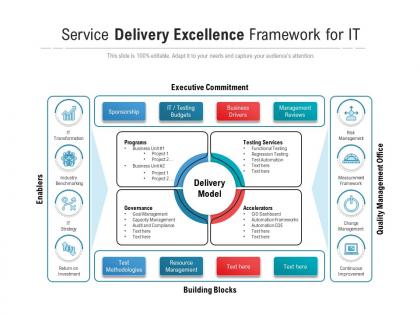
Service delivery excellence framework for it





Try Before you Buy Download Free Sample Product
 Impress Your
 Audience
 100%
100% Editable
 Save Hours
 of Time


Our Service Delivery Excellence Framework For It are topically designed to provide an attractive backdrop to any subject. Use them to look like a presentation pro.
People who downloaded this PowerPoint presentation also viewed the following :
Service delivery excellence framework for it with all 2 slides:
Use our Service Delivery Excellence Framework For It to effectively help you save your valuable time. They are readymade to fit into any presentation structure.
FAQs for Service delivery excellence
Honestly, focus on three main things: being customer-focused, reliable, and responsive. Figure out what your customers actually want - don't just assume you know. Consistency is everything; they need the same good experience every single time. I know everyone talks about speed, but getting it right the first time beats being super fast and screwing up. Give your frontline people power to fix stuff immediately instead of making customers call five different departments. Map out how customers currently interact with you and spot where they're getting frustrated. That's your starting point right there.
Mix it up with different ways to gather feedback - hit people right after they interact with you, but also send broader surveys every few months. NPS is everywhere these days (kinda overused if you ask me), so pair it with practical stuff like how fast you solve problems. Ask both satisfaction AND recommendation questions since they tell different stories. Here's the thing though - actually follow up with pissed off customers and see if your fixes are working. Set up automatic requests so you don't forget to ask. Oh, and track resolution times too.
Look, tech is basically what saves your ass in customer service these days. It handles the boring stuff automatically and gives you actual data to work with. Chatbots take care of simple questions. Your CRM tracks everything customers have done before. Some systems even catch problems before customers complain - which is honestly pretty sweet. But here's the thing - don't just buy random tools because they look cool. Map out where you're actually struggling first, then grab tech that fixes those specific headaches. Otherwise you'll just create more work for yourself.
Look, good training is what separates amazing customer service from the frustrating stuff we all hate dealing with. Your team needs to actually know your products and how to solve problems without running to a manager every five minutes. Confident employees make faster decisions. Customers can tell when someone knows what they're doing vs. just reading from a script - trust me on this one. I'd start by figuring out where your service is weakest right now. Then build specific training around those problem areas. It's not rocket science, but most places still get it wrong.
Start with solid training and actual processes that everyone follows - not just stuff sitting in a binder somewhere. Cross-train people so they can jump between different areas without looking clueless. Track your response times and customer satisfaction scores religiously. Do mystery shopping if you can swing it, plus regular quality checks. Weekly team meetings help catch problems before they spiral. Oh, and make sure you're actually getting customer feedback - sometimes the best insights come from complaints you didn't expect. The whole thing falls apart if you don't measure what's working.
Honestly, feedback mechanisms are like having a crystal ball for your business. You'll catch problems before they blow up and see patterns you'd totally miss otherwise. Think of it as your customers doing free quality control work - they're telling you exactly where you're screwing up and what's actually working. The tricky part is figuring out which fires to put out first, but at least you're not shooting in the dark anymore. Set up simple feedback points where it matters most (like right after service interactions), then - and this is key - actually do something with what people tell you. Otherwise you're just collecting complaints for fun.
So there's a few ways to tackle this. Industry reports from Gartner or Forrester are solid starting points. Customer satisfaction surveys help too - just compare your scores to sector averages. Response times and resolution rates are pretty standard metrics you can stack against published benchmarks. Mystery shopping works surprisingly well, though your staff might hate you initially. Industry associations give you access to good benchmarking data, or you could join peer networks. Honestly, just stalking competitor websites shows what they're promising customers. Pick maybe 3-4 metrics that actually matter instead of tracking everything under the sun.
Honestly, companies get way too caught up in their internal stuff instead of what customers actually experience. Don't try to fix everything at once - you'll burn out your team. Most places track dumb metrics too, like how fast someone picks up the phone instead of whether they actually solve the problem. Leadership not being aligned is probably the worst one though - your people end up confused and working against each other. Oh, and nobody bothers training staff on what good service looks like in real situations. Pick maybe 2-3 metrics that customers care about. Get everyone understanding the same standards first. Build from there slowly.
Dude, personalization is everything. When you actually remember what customers told you before and use their name, they immediately feel like you give a shit about them specifically. Trust builds way faster that way. I swear, the difference between "Hey John, saw you're still having that printer issue from last week" versus some generic response is night and day. Your customers won't have to repeat their whole story every single time either, which honestly saves everyone's sanity. Just start jotting down little notes about what bugs them or what they prefer. Reference that stuff later and you'll look like a rockstar.
Look, culture basically makes or breaks your service game. Bad culture? Your team might fix problems correctly but customers still walk away annoyed - I've totally seen this happen. Good culture means people actually want to help because that's just the vibe. Your employees will naturally hustle harder when they feel empowered and know customer focus matters. Plus you get consistency across everything. Oh and make sure people feel safe speaking up about issues or suggesting fixes - that psychological safety thing is huge for improvement.
Honestly, data analytics is a game-changer because it shows you what's actually broken, not just what feels broken. You'll spot patterns in complaints and catch bottlenecks before they spiral. The best part? No more guessing what to fix first. I'd start small though - pick one metric you're already tracking and really dig into what's driving those numbers. Way better than throwing darts at problems, you know? It takes the mystery out of why customers are frustrated or why your processes keep hitting snags.
Honestly, it just makes everything easier when you focus on what customers actually need. Your retention goes up, complaints drop, and people start referring others because they feel like you get them. Plus your team stops spinning their wheels on random stuff - every decision becomes about "will this help our customers or not?" I've seen companies completely turn around just by mapping out one customer journey and fixing the obvious pain points. Revenue follows naturally when people don't want to leave. Start small though - pick one touchpoint this week and see where you're making things harder than they need to be.
Honestly, the best teams just nail the basics - they actually talk to each other, share responsibility, and fix problems before they blow up. Trust makes a huge difference (which is harder to build than you'd think). When people genuinely have each other's backs, they spot issues customers never even see. Knowledge gets shared around too, so you're not totally screwed if someone calls out sick. Oh, and they're always tweaking how they do things instead of just dealing with whatever crisis pops up. Start with making people feel safe to speak up - that's where the magic happens.
Honestly, the coolest stuff I'm seeing is AI that catches problems before customers even know they exist. Real-time data is letting companies personalize everything too - not just slapping your name on emails, but actually useful customization. Most places are finally thinking about the whole customer journey instead of treating each interaction like it's random. Self-service portals are everywhere now (some are trash, but the good ones actually work). What really gets me excited though? Proactive communication. Like, telling people their order's delayed before they start wondering where it is. I'd start by mapping out where your customers currently get frustrated and figure out how to get ahead of those moments.
Okay so first thing - you gotta map out everywhere customers actually talk to you. Phone, email, chat, social media, whatever. Then make sure all those channels can see the same customer info in real-time. Like, if someone starts chatting online then calls later, your team should already know what happened before. God, there's nothing worse than explaining your problem three times to different people! Your staff needs to be able to pass customers between channels smoothly. Oh and make sure everyone's giving consistent answers - train your team on handling conversations that jump around between different channels.
No Reviews