Itil process map framework with service plan

Rating:
89%
Itil process map framework with service plan
Slide 1 of 2
Favourites Favourites

Try Before you Buy Download Free Sample Product

Audience Impress Your
Audience
Editable 100%
Editable
Time Save Hours
of Time
The Biggest Sale is ending soon in
0
0
:
0
0
:
0
0
Rating:
89%
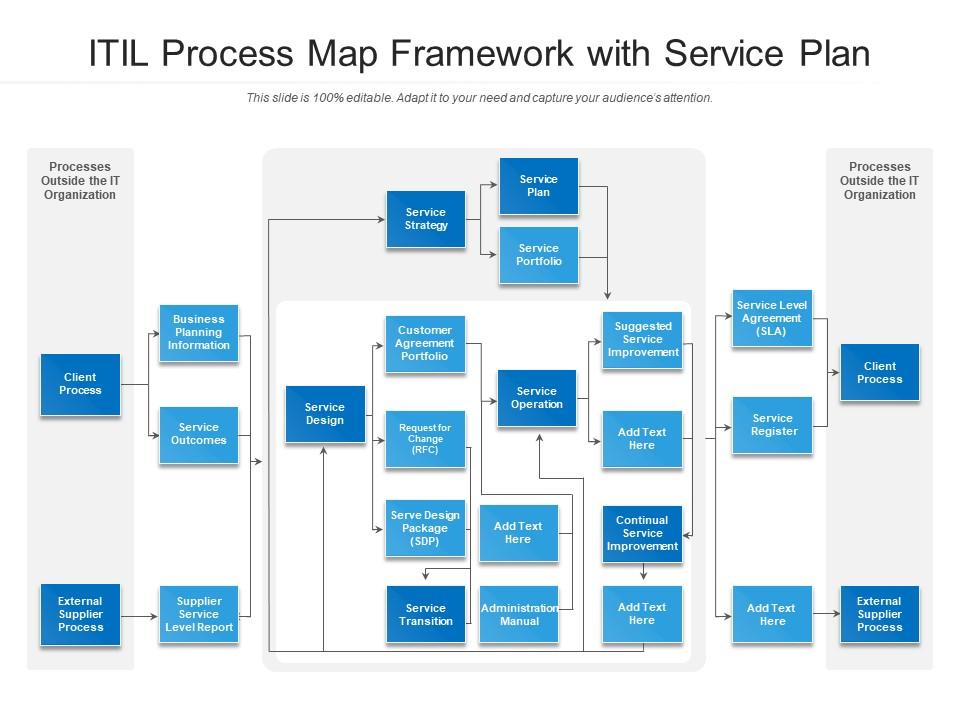
Presenting our well-structured ITIL Process Map Framework With Service Plan. The topics discussed in this slide are Service Operation, Service Portfolio, Service Strategy, Service Outcomes, Service Plan. This is an instantly available PowerPoint presentation that can be edited conveniently. Download it right away and captivate your audience.

Content of this Powerpoint Presentation

Description:

The image shows a PowerPoint slide titled "ITIL Process Map Framework with Service Plan," which outlines the Information Technology Infrastructure Library (ITIL) framework processes in relation to a service plan. The ITIL framework is a set of best practices for creating and improving an IT service management process. The slide is divided into several blocks, each representing different aspects and stages of the ITIL service lifecycle:

1. Service Strategy: 

This block likely outlines the initial steps of defining the strategy for IT services.

2. Service Design: 

This stage involves the detailed planning of IT services and processes.

3. Service Transition: 

Here, the focus is on the implementation and change management of new or changed services.

4. Service Operation: 

This block covers the day-to-day management of services.

5. Continual Service Improvement: 

This phase is for ongoing service and process enhancement.

Additional elements include:

1. Client Process: 

Indicates the client's own processes that interface with IT services.

2. External Supplier Process: 

Represents the processes of third-party suppliers that are integrated with the IT services.

3. Supplier Service Level Report: 

Refers to the reports provided by suppliers regarding the level of service delivered.

4. Service Level Agreement (SLA): 

A formal agreement on the expected service level between the service provider and the client.

5. Service Register: 

Likely a database or record of all services provided.

Use Cases:

This slide can be used in multiple industries that rely on IT services:

1. Technology:

Use: Implementing IT service management.

Presenter: IT Manager

Audience: IT team, stakeholders

2. Finance:

Use: Managing IT systems for financial operations.

Presenter: CTO

Audience: Finance professionals, IT staff

3. Healthcare:

Use: Overseeing healthcare IT systems.

Presenter: Health Informatics Specialist

Audience: Healthcare administrators, IT personnel

4. Government:

Use: Structuring public sector IT services.

Presenter: IT Service Management Lead

Audience: Government employees, contractors

5. Telecommunications:

Use: Aligning ITIL processes with telecom services.

Presenter: Telecom Project Manager

Audience: Network engineers, service managers

6. Education:

Use: Managing educational institutions' IT services.

Presenter: Director of IT Services

Audience: Educational administrators, IT staff

7. Retail:

Use: Implementing ITIL for retail information systems.

Presenter: Retail IT Coordinator

Audience: Retail managers, IT support team

FAQs for Itil process map framework

So you've got these 26 processes spread across five lifecycle stages - strategy, design, transition, operation, and improvement. Plus four main functions like the service desk (which honestly handles way more than people think). Each process breaks down the inputs, outputs, activities, and who does what. The visual process flows are clutch because they show how everything connects. Makes it way easier to spot where your current setup is falling apart. I mean, once you actually dive into it, the framework covers pretty much everything you need to map out how IT services really function.

Look, ITIL Process Map is basically your bridge between what the C-suite wants and what your IT team actually does day-to-day. You take those high-level business goals and map them to specific ITIL processes that'll move the needle. Want better customer satisfaction? There's a process for that. Need to cut costs? Different process. It's honestly pretty straightforward once you get the hang of it - though admittedly took me forever to explain it to my old boss. Just pick your top 3 business priorities first, then figure out which ITIL processes can actually measure and impact those goals. Don't overthink it.

ITIL is built around continuous improvement - it's literally everywhere in the framework, not just that one "continual service improvement" stage. Every process feeds into making things better next time. Handle an incident? That's data. Roll out a change? More input for improvements. Honestly, the best approach is just picking whatever process is driving your team crazy right now and getting some basic metrics on it. I swear the small wins stack up faster than you'd think - plus it's way less overwhelming than trying to fix everything at once.

Honestly, ITIL is pretty solid for breaking down those annoying department walls. It gives teams a common language and clear handoff points - like your network guys actually know when to loop in security instead of just tossing issues over the fence. The process map shows you exactly how changes ripple between departments, which is super helpful. No more "not my problem" responses (well, fewer anyway). My advice? Look at where your teams are stepping on each other's toes right now, then see how ITIL's workflows could smooth that out. The dependency mapping alone will probably surprise you.

Honestly, the biggest pain is gonna be people resisting change. Everyone's comfortable with their messy workflows, even when they suck. ITIL processes are super interconnected too - there's a steep learning curve that'll frustrate your team at first. Resource constraints will hit you hard since you need dedicated people and time to do this right. Oh, and if your current tools don't play nice with ITIL frameworks, you're in for some serious system headaches. I learned this the hard way at my last job. Start with just one process area though - build some wins before you roll out everything else.

Focus on metrics that actually tell you something useful - incident resolution times, change success rates, service availability percentages. Customer satisfaction scores matter too, but honestly they can be pretty vague sometimes. The real wins come from measuring efficiency gains like fewer escalations between teams or spotting problems faster. Compare your baseline numbers to current performance regularly. Oh and don't just hoard data like some kind of metrics dragon - actually look at the trends and tweak your processes based on what's working and what isn't.

Oh man, there's actually a bunch of stuff you can use. ServiceNow and Remedy are pretty solid for the day-to-day incident and change management stuff. For mapping things out, Visio works great - or Lucidchart if you want something web-based. Some tools like Axios come with ITIL templates already built in which is nice. Most teams I know just throw everything in Confluence or SharePoint anyway since everyone's already using it. Honestly though? Don't overthink it at first. Just use whatever you've got lying around and see how it goes. You can always get fancier later once you figure out what actually works for your team.

So ITIL basically gives you this roadmap for running IT services without everything falling apart. Your teams stop arguing about processes because everyone's using the same playbook. Incidents get resolved way faster, and honestly, change management becomes less of a nightmare. Customers notice the difference too since things actually work smoothly. What I'd do first - just map out how you handle incidents right now. You'll be shocked at the weird gaps you find. The whole thing has built-in feedback loops, so you're constantly tweaking and improving stuff instead of just hoping it works.

So basically, ITIL Process Map gives you these templates that build risk management right into your regular IT stuff. Risk assessments get baked into incident management, change management, problem management - all of it. Instead of scrambling to think about risk later, it just becomes how you work. The framework shows exactly where to check for potential impacts and document your mitigation steps. Honestly, it's pretty clever how they designed it. Your team starts following good risk practices without realizing it. I'd say start with change management risk assessments first - that's where you'll get the most bang for your buck right away.

You don't have to pick between ITIL and Agile - they actually work great together. ITIL handles your governance stuff while Agile takes care of development. Your Agile teams can totally follow ITIL's incident or change management, just with faster cycles and way more collaboration. Honestly, most teams are already doing this without realizing it. The Process Map Framework helps you figure out where Agile fits into your existing ITIL setup. I'd start by looking at which ITIL processes your dev teams already bump into and smooth those out first.

So ITIL Process Map is basically your roadmap for getting IT governance sorted out. It standardizes how you handle services and processes, which honestly makes everything way less chaotic. Everyone knows their role and what they're supposed to do - no more confusion about who's responsible for what. The cool thing is it aligns your IT stuff with actual business goals and gives you solid ways to measure how you're doing. Makes audits less of a nightmare too since you're following proper standards. I'd start by comparing what you're doing now against the framework to see where you're missing pieces. Trust me, it's like finally having directions instead of just winging it.

So process mapping basically gives you this visual roadmap of how everything flows. You'll spot bottlenecks and redundant steps that you'd never notice just reading through boring documentation. Teams finally get how their work connects to everyone else's - honestly, it's pretty satisfying when people stop working in silos. Finding automation opportunities becomes way more obvious too. Oh, and stakeholders will actually understand what the hell you're talking about in meetings for once! My advice? Start with whatever process is driving everyone crazy right now.

Oh yeah, the ITIL Process Map is super flexible! Pick the most critical processes for your business first - honestly, trying to do everything at once is a nightmare. Modify the templates by plugging in your approval workflows and connecting them to whatever systems you're already using. Language matters too - make it sound like how your team actually talks, not corporate speak. I'd treat it more like a starting point than some sacred document you can't touch. Get one or two processes running smoothly first. Once those are solid, you can branch out from there.

Start with ITIL Foundation - you can't really make sense of the Process Map without understanding the basic terminology first. The visual stuff looks crazy overwhelming when you first see it, trust me. But once you get the flow between different IT service processes, it actually starts making sense. Your team needs solid analytical skills too, plus some background in process improvement. I'd probably focus on process mapping abilities as well since that's huge for this kind of work. Get the Foundation cert done first, then just dive into practicing with whatever maps you've got in your current setup. That hands-on time is where it really clicks.

So ITIL Process Map is basically a compliance cheat code - it comes with all the documented processes and controls that auditors want to see. Most of the heavy lifting is already done for you. Maps perfectly to ISO 20000, SOX, GDPR because it's got change control and incident tracking baked in. Honestly, audit season becomes so much less stressful when you can just point to your established ITIL processes. First thing I'd do is figure out which regulations actually apply to you, then see how your current processes stack up against those requirements. Way better than scrambling to document everything from scratch.

Ratings and Reviews

89% of 100
Review Form
Write a review
Most Relevant Reviews
  1. 100%

    by Alexander Ramirez

    Very well designed and informative templates.
  2. 80%

    by Denver Fox

    Great quality product.
  3. 80%

    by Clifford Powell

    Presentation Design is very nice, good work with the content as well.
  4. 100%

    by Columbus Vasquez

    Easy to edit slides with easy to understand instructions.
  5. 100%

    by Ed Lawrence

    Illustrative design with editable content. Exceptional value for money. Highly pleased with the product.
  6. 80%

    by Clemente Myers

    Excellent work done on template design and graphics.
  7. 100%

    by Dewayne Nichols

    Thanks for all your great templates they have saved me lots of time and accelerate my presentations. Great product, keep them up!
  8. 80%

    by Domenic Spencer

    Great quality slides in rapid time.
  9. 80%

    by Dwain Johnston

    Great product with effective design. Helped a lot in our corporate presentations. Easy to edit and stunning visuals.

9 Item(s)

per page: