

Service delivery framework powerpoint presentation slides




Try Before you Buy Download Free Sample Product
 Impress Your
 Audience
 100%
100% Editable
 Save Hours
 of Time


Service Delivery Framework PowerPoint Presentation Slides: Meet the customer’s requirements with the help of content-ready Service Delivery Framework PowerPoint Presentation Slides. Improve an existing service or create a new one from scratch. Use service delivery PowerPoint templates to outline a plan for the whole user experience. This complete presentation covers topics like phases in service design, service design process, service design process and tools, service design elements, service delivery model, etc. Incorporate this ready-to-use service delivery framework PPT slides to deliver products and services that satisfy the customer’s needs. Devise strategies and execute the plan to improve the services and products by incorporating the ready-made service delivery framework PPT templates. This complete presentation is completely customizable. You can edit the color, text, icon, and font size as per your need. Add or delete the content if required. Download professionally designed service delivery complete presentation and create an appropriate service design and delivery plan. Insist on folks being fair in their assessment with our Service Delivery Framework Powerpoint Presentation Slides. Discourage them from indulging in jibes.
People who downloaded this PowerPoint presentation also viewed the following :
Content of this Powerpoint Presentation
Slide 1: This slide introduces Service Delivery Framework. State Your Company Name and begin.
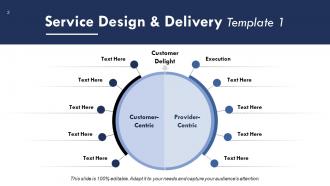
Slide 2: This slide shows Service Design & Delivery Template 1 describing customer and provider centric service design with related text boxes.
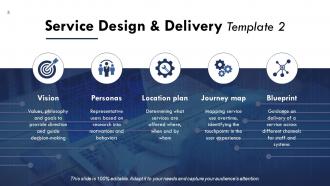
Slide 3: This slide presents Service Design & Delivery Template 2 describing- Vision, Personas, Journey map, Blueprint and Location plan.
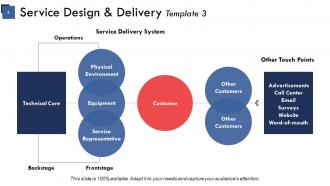
Slide 4: This slide displays Service Design & Delivery Template 3 defining service delivery system with the help of a diagram.
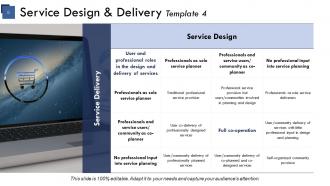
Slide 5: This slide represents Service Design & Delivery Template 4 with related imagery and text boxes to go with.
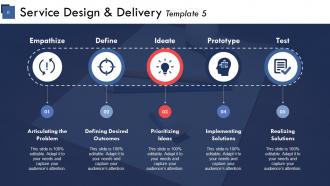
Slide 6: This slide showcases Service Design & Delivery Template 5 with- Empathize, Define, Ideate, Prototype and Test.
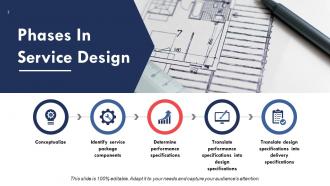
Slide 7: This slide shows Phases In Service Design describing- Conceptualize, Identify service package components, Determine performance specifications, Translate performance specifications into design specifications and Translate design specifications into delivery specifications.
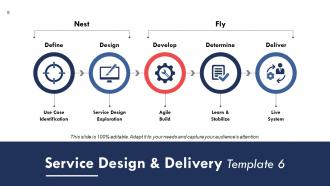
Slide 8: This slide presents Service Design & Delivery Template 6 describing Nest and Fly. Nest includes Define and design services whereas Fly includes Develop, Determine and Deliver services.
Slide 9: This slide shows Service Delivery Framework Icons.
Slide 10: This slide is titled Additional slides for moving forward. You may change the content as per need.
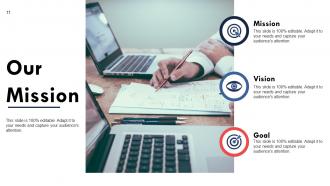
Slide 11: This is Our mission slide with imagery and text boxes to go with.
Slide 12: This is Our team slide with names and designation.
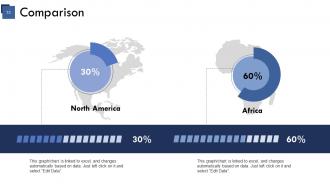
Slide 13: This is a Comparison slide. Show relevant comparing data here.
Slide 14: This is an Our Goal slide. State your important goals here.
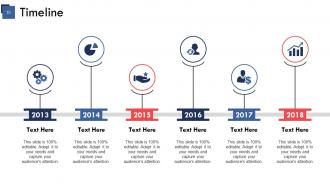
Slide 15: This is a TIMELINE slide to show information related with time periods.
Slide 16: This is a Quotes slide to convey message, beliefs etc.
Slide 17: This is a Bulb or Idea slide to state a new idea or highlight specifications/information etc.
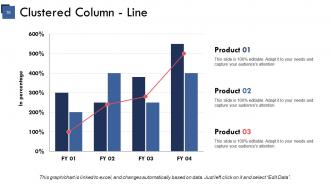
Slide 18: This slide shows Clustered Column - Line chart with three products comparison.
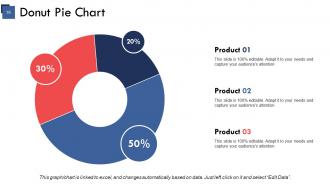
Slide 19: This slide displays Donut Pie Chart with three products comparison.
Slide 20: This is a Thank You slide with Address# street number, city, state, Contact Number, Email Address.
Service delivery framework powerpoint presentation slides with all 20 slides:
Try your hand at anything with our Service Delivery Framework Powerpoint Presentation Slides. They are an asset in any field.


FAQs for Service delivery framework
You'll need the full lifecycle stuff - strategy, design, transition, operation, and continual improvement. Clear governance helps a ton, plus defined processes and proper resources for each phase. Most teams totally skip performance metrics at first (big mistake, trust me). Build in feedback loops so you actually learn what works. Oh, and map your current state before doing anything else - can't fix what you don't understand. That mapping will help you figure out what to tackle first anyway.
Honestly, most frameworks suck because they're way too generic. Start with actually talking to your customers - surveys, interviews, whatever works. Figure out who your different customer groups are and what they actually care about. Your enterprise folks probably want a dedicated person they can call, but smaller customers? They just want to fix things themselves online. The tricky part is making your framework flexible enough that you're not scrambling when things change. And trust me, they will change. Map out those segments first though - that's where the real insights come from.
Tech basically runs the whole show when it comes to service delivery. You can automate all the boring stuff, see what's happening in real-time, and let customers handle things themselves. Data analytics will catch problems you'd totally miss otherwise - that part's been a game changer for us. Cloud platforms tie everything together nicely too. Without decent tech, even a solid framework just crumbles when you actually try to use it. I'd start by looking at your current setup and figure out what manual tasks are killing your time. Those are usually the best places to start automating first.
Basically, these frameworks make your customers way happier because they know what they're getting every time. No surprises, no guessing games. You standardize everything - processes, training, those service agreements - and suddenly people can actually count on you. Here's the thing though: you catch problems early instead of letting them blow up later (trust me on this one). Consistency builds trust, which obviously leads to more loyal customers. My advice? Map out how customers currently experience your service first. You'll probably find some random inconsistencies you didn't even realize were there.
Track your incident resolution times and service uptime - that's the bread and butter stuff. Customer satisfaction scores and NPS will tell you if people actually like dealing with you. Oh, and don't sleep on employee satisfaction metrics because unhappy staff equals terrible service (learned that one the hard way). Pick maybe 5-6 metrics that actually matter to your goals. More than that gets overwhelming fast. Check them monthly and tweak your approach based on what you're seeing. First-call resolution rates are clutch too if you're handling support calls.
Build your framework with swap-out parts instead of one rigid block - way easier to change later. Monthly check-ins with customers work great for catching shifts early. Having clear escalation paths saves you when pivot time hits. I've watched so many teams just freeze up because they never planned for change (honestly drives me crazy). Standardized processes that bend without breaking are your friend. Train your team to spot those market signals that scream "time to switch things up." Quick decisions beat perfect ones when you're adapting fast.
Honestly? People hate change, even when their current system is a total mess. That's your biggest headache right there. Nobody wants to own the implementation either - classic "not my job" situation. Plus leadership always thinks this stuff happens overnight when it actually takes forever and costs way more than expected. Oh, and defining who does what becomes this whole political nightmare. Start with something small though, like a pilot with one team. Get a few wins under your belt first before trying to convince the entire company to jump on board.
Honestly, getting departments to actually work together is a game changer. No more of that annoying silo thing where nobody knows what anyone else is doing. Your teams start solving problems faster when they can just talk to each other instead of playing telephone. Resources get shared better too - way less of that duplicate work nonsense. Customers stop getting the runaround, which let's be real, we've all experienced and it sucks. I'd start small though. Pick one service that touches multiple departments and figure out where things currently fall apart. You'll probably be surprised how much smoother everything runs once people start communicating.
Start with your biggest pain points first - those are where inconsistency hurts most. You'll want solid processes documented somewhere everyone can actually find them (not buried in some random folder). Train your team regularly, but honestly, the documentation only works if people use it. Quality checks at key stages help catch problems before customers do. Weekly reviews of your consistency metrics are clutch - that's where you'll spot patterns and fix gaps. Oh, and set up feedback loops with customers too. Short feedback cycles beat perfect processes every time. Create playbooks for your common scenarios, but keep them simple enough that your team won't ignore them.
Yeah, it totally depends on your industry. Healthcare's obsessed with compliance and safety protocols - makes sense obviously. Tech companies are the opposite, they want everything fast and agile. Financial services? They're paranoid about risk and regulations, like crazy strict. Manufacturing loves their structured processes - Six Sigma and all that. Creative agencies just wing it more with flexible project stuff. Honestly, I'd start by checking what other companies like yours are doing, then tweak it for your situation. Don't reinvent the wheel.
Look, training your team basically gives them the confidence to actually handle customer stuff without panicking. You'll notice way fewer mistakes and things get solved faster. I know it sounds super obvious, but companies always cut training first when money gets tight - which is backwards if you think about it. Your people can deal with the tricky situations instead of passing everything to managers. Customers stay happier, less chaos for everyone. Honestly just figure out where you're bleeding customers first, then build training around fixing those specific problems.
Honestly, start by figuring out which business goals each service actually supports - sounds obvious but most people skip this step. Then build your KPIs around those specific outcomes instead of random metrics that look good on paper. The real challenge? Getting everyone to actually understand WHY they're doing what they're doing. I swear, half the teams I've worked with just check boxes without connecting the dots. Set up regular check-ins to catch when things drift off course, and create quick feedback loops so strategic shifts can actually trickle down to day-to-day work. Your team needs to see how their tasks connect to the bigger picture.
So basically, grab feedback right when you finish a service - that's when it's freshest. Build it into your quality checks too. Honestly, most companies just collect feedback and then it dies somewhere in corporate hell, which is super annoying. You want direct conversations, surveys, even complaints - look for patterns. The real trick? Actually doing something with what you learn. Don't try to tackle everything at once though. Pick one feedback method first and connect it straight to how you improve things. That way you'll actually see changes happen.
So basically these frameworks just make everything run smoother - you get consistent processes and people actually know who's responsible for what. Response times get way faster because there's no more confusion about workflow between teams. The standardization thing is honestly huge, saves you from constantly starting from scratch every time something comes up. Plus your teams become way more predictable, which means you can finally plan capacity properly and spot where things need fixing through better data. Oh and definitely start by just mapping out what you're doing now - find the biggest mess-ups first, that's where you'll see results fast.
Track your response times, resolution rates, and customer satisfaction scores - this stuff gives you real insight into what's actually happening. Honestly, most companies just guess at their problems instead of looking at the data. You'll spot bottlenecks way earlier and can predict when you're gonna get slammed with requests. Set up dashboards that people actually use (not those fancy ones that look cool but nobody checks). Oh, and you can finally figure out which services are worth the money vs. which ones are just bleeding cash. Use those insights to keep tweaking things.
No Reviews