

Iterative process product development three phase in circular manner





Try Before you Buy Download Free Sample Product
 Impress Your
 Audience
 100%
100% Editable
 Save Hours
 of Time


Instill a desire to improve communal harmony with our Iterative Process Product Development Three Phase In Circular Manner. Inspire folks to join the effort.
People who downloaded this PowerPoint presentation also viewed the following :
Content of this Powerpoint Presentation
Description:
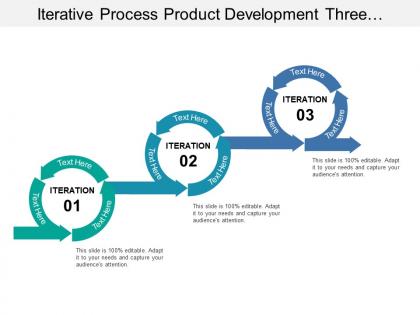
The image presents a slide with a title "Iterative Process Product Development" and illustrates a cyclical three-step process. Each of the three arrows represents an iteration and contains placeholder text labeled "Text Here", indicating that specific details about each phase of the process can be entered by the presenter. The design is meant to depict a loop, suggesting that once iteration 03 is completed, the process may return to iteration 01 for further refinement.
Use Cases:
This slide template can be highly applicable in various industries that rely on iterative processes for product development, improvement, or project management. Here are seven industries where such a slide could be used:
1. Software Development:
Use: To illustrate the phases of agile development cycles.
Presenter: Project manager or scrum master
Audience: Development team, stakeholders, or clients
2. Automotive Industry:
Use: To demonstrate the stages of vehicle design and testing.
Presenter: Design engineer or product manager
Audience: Engineering team, executives, or investors
3. Pharmaceuticals:
Use: To outline the clinical trial process.
Presenter: Clinical research coordinator or R&D manager
Audience: Research scientists, regulatory authorities, or partners
4. Construction:
Use: To describe iterative steps in a construction project.
Presenter: Construction manager or architect
Audience: Contractors, clients, or project sponsors
5. Marketing:
Use: To detail iterative approaches in campaign development.
Presenter: Marketing director or campaign strategist
Audience: Marketing team, brand managers, or advertisers
6. Education:
Use: To plan and refine curriculum development processes.
Presenter: Curriculum developer or educational consultant
Audience: Educators, administrators, or education boards
7. Manufacturing:
Use: To show product lifecycle stages from design to production.
Presenter: Operations manager or process engineer
Audience: Manufacturing team, process improvement group, or supply chain partners
Iterative process product development three phase in circular manner with all 5 slides:
Be constructive in your approach with our Iterative Process Product Development Three Phase In Circular Manner. Display eagerness to do it correctly.
FAQs for Iterative process product development three phase
Look, just ship something basic first - don't overthink it. Get real people using it ASAP because they'll surprise you with how they actually interact with your product. I've seen too many teams waste months perfecting features nobody ends up caring about. Your v1 will be kinda janky and that's perfectly fine. Quick feedback beats perfect code every time. Focus on testing your biggest assumptions rather than adding bells and whistles. Oh, and when you're planning your next sprint? Start with whatever you're most uncertain about - that's usually where the real insights are hiding.
Honestly, you gotta bake feedback collection into everything from the start. Set up user interviews, check your analytics, watch support tickets - basically multiple ways for people to tell you what sucks. Make it systematic instead of just randomly asking around (though random convos can be surprisingly helpful too). After each round, actually sit down and dig through what you heard. Pick the stuff that hits your main goals and affects lots of users - don't try fixing every tiny complaint at once. Oh, and this part's huge: circle back to people who gave feedback and show them what you changed. They'll love you for it.
So many ways to tackle this! Scrum and Kanban are solid for managing iterations - I'm partial to Kanban myself since it's less rigid. Jira's the gold standard but honestly kinda bloated if you're a smaller team. Trello's way cleaner for simple stuff. Design thinking workshops are clutch for the discovery phase. A/B testing lets you actually validate with real users instead of just guessing. But here's the thing - the specific methodology doesn't matter as much as just getting consistent feedback loops going. Start with whatever project management tool your team already knows, throw in some user feedback collection (surveys, analytics, whatever works), and build from there. Don't overthink it.
Honestly, just start with 2 weeks and see how it goes. Your team size and what you're building matters way more than following some playbook though. Small teams crushing simple features? Go shorter - maybe a week. But if you're doing complex stuff like rebuilding infrastructure (ugh, been there), you'll need longer cycles or everyone burns out fast. Watch what actually gets done vs. what you plan. Rolling work over constantly? Make sprints longer. Finishing early and twiddling thumbs? Shorten them. Most teams land somewhere between 1-4 weeks once they figure out their rhythm. Don't overthink it initially - you'll adjust as you learn what works for your specific situation.
Honestly, the worst thing teams do is obsess over tiny details while ignoring the big stuff that actually matters. Set clear success metrics from day one - otherwise you're just wandering around hoping something works. Don't skip user feedback between rounds either, even though it feels painfully slow. I learned this the hard way lol. Keep your cycles short, like 2-3 weeks tops. Always ship something real that stakeholders can actually see and touch. Oh, and define what "done" means before you even start each round - saves so much confusion later.
Your personas need to be front and center during every sprint - seriously, I can't tell you how many teams build these detailed personas then shove them in a drawer somewhere. When you're prioritizing features, literally ask "would Sarah actually use this?" or "does this fix Mike's biggest headache?" Post those persona cards where everyone can see them during standups. Map your user stories back to specific personas during sprint planning so you're not just building random features that sound cool. It keeps the whole team focused on real user problems instead of going down technical rabbit holes (which happens way too often tbh).
Honestly, prototyping is your best friend for staying grounded. Test your assumptions before building anything real - saves you so much heartache later. I always tell people to match the prototype to what you actually need to learn. Sometimes a messy paper sketch does the job perfectly. Other times you'll need something clickable to really get feedback. The whole point is catching problems early when they're cheap to fix, not after you've launched and users are already frustrated. Quick validation with real people beats guessing every time.
Honestly, you gotta nail down your goals before each iteration even starts. Pick real metrics that matter - user engagement, conversions, whatever you're actually trying to move. Don't make my mistake of chasing vanity numbers that look pretty but mean nothing lol. Track consistently through the whole iteration and compare against your starting point. Oh and keep your scope tight - you want to see what THIS specific round of changes did. Write down what bombed and what crushed it so you're not flying blind next time.
Honestly, you've gotta get teams talking to each other regularly - like actual conversations, not boring status updates that put everyone to sleep. Those cross-functional standups work well if people share real blockers and wins. Every quarter, do these "impact mapping" sessions so teams actually see how their stuff affects everyone else. Oh, and try rotating people into other teams' meetings sometimes - gives them the bigger picture. Pairing folks from different departments on actual features is pretty smart too. Builds relationships while they're solving real problems together, which feels way more natural than forced team-building crap.
Dude, iterative development actually makes you faster, not slower. Instead of waiting months for some "perfect" product (which doesn't exist btw), you're shipping working versions early. Short cycles are everything here. Real users give you feedback that stops you from building completely useless features for half a year. Sure, all those iterations might seem like extra work, but you're dodging those nightmare scenarios where you discover huge problems right before launch. I'd start with your must-have features and build from there. Way better than the waterfall approach honestly.
Yeah so it really depends on what industry you're in. Healthcare and finance? Good luck - you'll be stuck with endless approval cycles and documentation because of all the regulations. Manufacturing's tricky too since changing physical tooling costs actual money, unlike just tweaking code. Consumer tech companies can afford to move fast and fix stuff later. But if you're doing B2B enterprise work, everything needs to be bulletproof since companies rely on that stuff daily. Honestly, the biggest thing is figuring out how much risk your industry can handle and planning your iterations around that reality from the start.
Dude, culture totally makes or breaks this stuff. Those Silicon Valley types who celebrate screwing up? They ship fast because nobody's scared of putting out messy first versions. Risk-averse places though - ugh, they're the worst for this. Everyone wants endless approvals, teams won't release anything early, and feedback takes forever. I swear I've watched good products just die because leadership couldn't handle the whole "fail fast" thing. You gotta spot these cultural roadblocks right away. Maybe start celebrating the lessons from failures, not just the wins. Sounds cheesy but it actually works.
Honestly, just pick a simple template and stick with it - what changed, why, and how it affects users. Screenshot UI stuff because nobody wants to read paragraphs about button colors. I've watched so many teams go overboard with fancy documentation systems, then ditch the whole thing after like three weeks. Link everything back to the original feedback or data that made you change it in the first place. Oh, and assign one person to actually maintain this thing. Otherwise it'll just collect digital dust with your other abandoned processes. The goal is making it scannable - people should get the gist in seconds.
Dude, iterative development is honestly a game changer. Instead of building something for months and praying customers like it, you're checking in with them constantly. Get their feedback early, test stuff as you go, make changes. Way better than that old "build it and they will come" approach - which never works btw. Short feedback loops are everything. When customers see their suggestions actually get implemented, they feel invested in your product. Plus you won't waste time building features nobody wants. It's more like having an ongoing conversation than just throwing something over the wall and hoping for the best.
Track your leading and lagging indicators - that's the real way to see if iterations are actually working. User engagement stuff like adoption rates, how fast new users find value, retention cohorts. Revenue per user matters too, obviously, but it lags behind everything else. Don't forget development velocity because honestly, slow iteration cycles kill momentum faster than anything. Weekly dashboards work well for this - just focus on trends, not individual data points. One random thing: conversion rates can be super misleading if you're not segmenting properly, so watch out for that.
-
Best Representation of topics, really appreciable.
-
Great quality product.