


Integrated product development life cycle




Try Before you Buy Download Free Sample Product
 Impress Your
 Audience
 100%
100% Editable
 Save Hours
 of Time


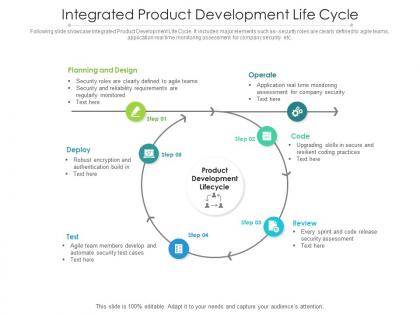
Following slide showcase Integrated Product Development Life Cycle. It includes major elements such as- security roles are clearly defined to agile teams, application real time monitoring assessment for company security etc.
People who downloaded this PowerPoint presentation also viewed the following :
Integrated product development life cycle with all 2 slides:
Use our Integrated Product Development Life Cycle to effectively help you save your valuable time. They are readymade to fit into any presentation structure.
FAQs for Integrated product
The integrated product development process includes concept development, design and engineering, prototyping and testing, manufacturing planning, and market launch preparation. These stages work simultaneously through cross-functional collaboration, enabling teams to streamline timelines, reduce costs, and enhance product quality, with many organizations finding that this approach delivers faster time-to-market and stronger competitive positioning.
Cross-functional teams enhance collaboration in integrated product development by bringing together diverse expertise from engineering, design, marketing, and manufacturing early in the process, eliminating traditional silos and communication barriers. This strategic combination enables faster decision-making, reduces costly late-stage revisions, and ensures market viability, with many organizations finding significantly shorter development cycles and improved product-market fit.
Customer feedback serves as a critical compass for product design decisions, informing feature prioritization, usability improvements, interface modifications, and functionality adjustments throughout development cycles. Through iterative testing and user validation, companies streamline design processes, reduce costly revisions, and enhance market fit, with many organizations finding that early customer integration ultimately delivers higher adoption rates and competitive differentiation.
Agile methodologies enhance integrated product development by enabling iterative prototyping, cross-functional collaboration, and continuous customer feedback integration throughout the development cycle. Through sprint-based workflows and daily standups, teams streamline communication between engineering, design, and marketing departments, ultimately accelerating time-to-market while reducing development costs and improving product-market fit across diverse industries.
**INPUT**: What technologies are revolutionizing integrated product development practices? **OUTPUT**: Technologies revolutionizing integrated product development include AI-powered design optimization, cloud-based collaboration platforms, digital twins, IoT sensors, and advanced simulation software. These technologies streamline development cycles by enabling real-time collaboration, predictive testing, and data-driven design decisions, with many manufacturing and automotive companies finding significantly faster time-to-market and enhanced product quality.
Managing time and resource constraints in product development requires strategic prioritization, agile methodologies, cross-functional collaboration, and continuous stakeholder communication. Through integrated planning and resource allocation, organizations streamline development cycles, minimize bottlenecks, and optimize team productivity, with many companies finding that adopting flexible frameworks and clear milestone tracking ultimately delivers faster time-to-market and enhanced competitive advantage.
Organizations should track time-to-market reduction, cross-functional collaboration efficiency, product quality scores, customer satisfaction ratings, and development cost optimization. These metrics enable companies to measure how effectively integrated approaches streamline workflows, reduce silos, and accelerate innovation cycles, with many finding that comprehensive tracking ultimately delivers faster product launches and enhanced competitive positioning.
Risk assessment integrates into product development through systematic evaluation at each phase, including concept validation, design reviews, prototype testing, market analysis, and pre-launch assessments. This approach enables organizations to identify potential technical, financial, and market risks early, ultimately reducing development costs, accelerating time-to-market, and enhancing product success rates across industries.
Cultural diversity within teams significantly enhances product development outcomes by bringing varied perspectives, reducing groupthink, and improving market understanding across different customer segments. These diverse teams deliver more innovative solutions, identify potential blind spots earlier, and create products with broader appeal, with many technology companies and consumer goods manufacturers finding that multicultural development teams ultimately produce more successful, globally competitive products.
Data analytics informs integrated product development decisions by analyzing customer behavior patterns, market trends, performance metrics, and user feedback across all development stages. Through predictive modeling and real-time data insights, teams can optimize resource allocation, identify potential design flaws early, and validate product-market fit, ultimately reducing development costs while accelerating time-to-market and enhancing customer satisfaction.
Best practices for integrating sustainability into product development include lifecycle assessment integration, sustainable material selection, energy-efficient design principles, circular economy considerations, and stakeholder engagement throughout development phases. These approaches enable organizations to reduce environmental impact, minimize waste, and enhance resource efficiency, with companies in automotive, electronics, and consumer goods finding that sustainable integration delivers cost savings, regulatory compliance, and competitive market advantage.
Prototyping enables teams to test concepts, gather user feedback, and identify design flaws early in the integrated product development process, reducing costly revisions and accelerating time-to-market. Through rapid iterations and stakeholder validation, companies streamline decision-making, enhance product-market fit, and minimize development risks, ultimately delivering more competitive products while optimizing resource allocation across cross-functional teams.
Companies face challenges including communication barriers between technical and business teams, conflicting departmental priorities and timelines, inconsistent data sharing systems, and resistance to collaborative workflows. These integration hurdles often result in delayed product launches, increased development costs, and misaligned product features, with many organizations finding that implementing cross-functional project management tools and establishing unified success metrics significantly streamlines coordination.
Lessons learned from previous projects can be effectively utilized through systematic documentation systems, cross-functional knowledge-sharing sessions, standardized review processes, and integrated feedback databases. Manufacturing companies and tech firms increasingly leverage these insights by embedding lessons into design templates, risk assessment frameworks, and decision-making protocols, ultimately accelerating development cycles while reducing costly repeated mistakes.
Digital transformation revolutionizes integrated product development by implementing cloud-based collaboration platforms, AI-driven design optimization, IoT sensors for real-time testing, and automated workflow management systems. These technologies streamline cross-functional communication, accelerate prototype iterations, and enhance data-driven decision making, with manufacturing and automotive companies finding significantly faster time-to-market and reduced development costs.
-
Easily Understandable slides.
-
Excellent work done on template design and graphics.