

Product development life cycle phases powerpoint presentation slides





Try Before you Buy Download Free Sample Product
 Impress Your
Audience
 100%
Editable
 Save Hours
of Time


We well understand that crafting a cool PowerPoint design about different stages of product lifecycle is often challenging. To overcome this challenge here we are presenting a readymade sample of product development life cycle phases PowerPoint presentation. Using PowerPoint presentation slides of this deck you can underline the significant aspects of product life cycle management to improve product quality and identify potential sales opportunities. Not only this, our slide presentation supports to pictorially present the product life cycle analysis in front of management for better decision making. Furthermore, with help of this PPT model you can also illustrate the exact purpose of different product life cycle strategies. Above all, we have included exclusive presentation slides like the product concept, brand product matrix, penetration pricing, marketing communication mix and growth stage etc. You can also contact our graphic designers to get customized visual communication as per your requirement. In short, we have got the best PPT sample to portray a product life cycle. So, quickly click to download and get it before everyone else. Improvise freely with our Product Development Life Cycle Phases Powerpoint Presentation Slides. Alter anything as you desire.
People who downloaded this PowerPoint presentation also viewed the following :
Content of this Powerpoint Presentation
Slide 1: This is an introductory slide to Product Development Life Cycle Phases. Add company name and proceed.
Slide 2: This slide shows agenda. You can add your company agenda and use it accordingly.
Slide 3: This slide displays Product Life Cycle And Development in a circular form consisting of- Design, Manufacturing, Distribution, End Of Life, Customer.
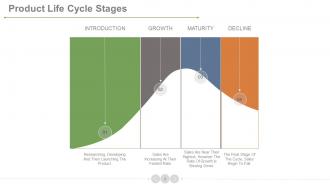
Slide 4: This slide shows 4 main Product Life Cycle Stages- INTRODUCTION, GROWTH, MATURITY, DECLINE.
Slide 5: This is an Introduction Stage slide showing the following 6 parameters- Cost, Targets, Competition, Profits, Sales.
Slide 6: This is Building Product Awareness In The Market slide showing Brand Awareness Cycle.
Slide 7: This slide presents The Product Concept showing Core Product Or Service in a circular form.
Slide 8: This slide presents Brand-Product Matrix. State your Products and Brands here.
Slide 9: This slide shows Product Quality Check with the following parameters- GOOD, BAD, AVERAGE, POOR, EXCELLENT.
Slide 10: This slide presents Penetration Pricing.
Slide 11: This slide presents Distribution Of A Product flow chart- Retailer, Wholesaler, Manufacturer, Contractor, End User.
Slide 12: This is Marketing Communication Mix slide showing- Public Relations, Direct Marketing, Personal selling, Sales promotion, Advertising.
Slide 13: This slide showcases Building Brand Preference in a graphical image form with the following parameters- Relevance, Time.
Slide 14: This slide shows Market Share with- Increased Sales Performance, Increased Deal Flow, Increased Deal Visibility, Higher Deal Completion Rate.
Slide 15: This slide shows Features Comparison Of The Products.
Slide 16: This is a Growth Stage slide showing- Promotions, Distribution Channels, Pricing, Product Quality.
Slide 17: This slide showcases Maturity Stage.
Slide 18: This slide showcases Decline Stage graphically.
Slide 19: This is Repositioning A Product slide with puzzle pieces and target imagery to go with.
Slide 20: This slide shows Repositioning Strategy with- Image Repositioning Product Repositioning Intangible Repositioning Tangible Repositioning
Slide 21: This is Extending The Product Life Cycle slide shown graphically.
Slide 22: This is Readvertising The Product slide with loudspeaker imagery showing- SHORTER PLC, LONGER PLC. It also shows 2 types of advertising- Low Advertising, High Advertising.
Slide 23: This is Price Reduction slide with imagery and text boxes to state.
Slide 24: This is Exploring New Market slide shown on a world map image.
Slide 25: This slide presents Channel Promotional Events such as- REGIONAL EVENTS, REFERRAL PROGRAM, TRADE SHOWS, BUY BACK PROGRAM, PRESS RELEASE.
Slide 26: This slide shows Our Trade Show Calendar. Present monthly stats of your trade show here.
Slide 27: This slide shows Competitive Intelligence matrix with High and Low parameters.
Slide 28: This slide displays Communication Plan Timeline with- Developing Marketing Communication Program, Marketing Communication Plan, Evaluation & Control Of Marketing, Budget Planning, Situational Analysis.
Slide 29: This slide presents Social Media Plan in a timeline form. Use it to show yearly stats of- Facebook, Twitter, LinkedIn, Instagram, YouTube.
Slide 30: This slide showcases Product Roadmap with icon imagery. Present yearly stats of your product here.
Slide 31: This slide presents Website Update Plan in a timeline form.
Slide 32: This slide presents Customer Testimonial. State it here.
Slide 33: This slide is titled Additional Slides to move forward. You can change the slide content as per need.
Slide 34: This is Our Vision slide with icon imagery. State your vision, mission, goals and strategies here.
Slide 35: This is Our Team slide. Mention name, designation etc. here.
Slide 36: This is an About Us slide. State about your company team, company essentials, highlights etc. here.
Slide 37: This is an Our Goal slide. State your important goals here.
Slide 38: This is a Comparison slide to compare two products/ entities etc.
Slide 39: This slide presents Financial scores to display.
Slide 40: This is a Quotes slide to convey message, beliefs etc.
Slide 41: This is Dashboard slide to show information in percentages etc.
Slide 42: This slide showcases Locations on a World map image and text boxes to make it explicit.
Slide 43: This is a Timeline slide to present important dates, journey, evolution, milestones etc.
Slide 44: This is a Post It slide to mark events, important information etc.
Slide 45: This is a Newspaper slide to highlight something or add memorabilia.
Slide 46: This is a Puzzle pieces image slide to show information, specifications etc.
Slide 47: This slide showcases Target with imagery.
Slide 48: This is a Circular image slide. State specifications, information here.
Slide 49: This is a Venn diagram image slide to show information, specifications etc.
Slide 50: This is a Mind Map image slide with text boxes to fill information.
Slide 51: This is a MATRIX slide. Put relevant comparing data here.
Slide 52: This is a LEGO box image slide with text boxes to show information.
Slide 53: This is a Silhouettes slide to show people specific information etc.
Slide 54: This is a Hierarchy slide to show information, organization structural specifications etc.
Slide 55: This is an Idea slide with bulb imagery to show information, innovative aspects etc.
Slide 56: This is a Magnifying glass image slide to show information, scoping aspects etc.
Slide 57: This is a Bar Graph image slide to show product comparison, growth etc.
Slide 58: This is a Funnel image slide to show information, funneling aspects, specifications etc.
Slide 59: This is a Thank You image slide with Address, Email and Contact number.
Product development life cycle phases powerpoint presentation slides with all 59 slides:
Boost the availability of jobs with our Product Development Life Cycle Phases Powerpoint Presentation Slides. Create a demand for better infrastructure.




FAQs for Product development life cycle phases
So there's six main phases you'll hit: ideation, market research, planning, prototyping, testing, and launch. First you brainstorm ideas, then figure out if people actually want this thing through research. Map out your timeline and resources during planning. Prototyping gets messy but it's honestly the best part - you're finally building something real! Testing with actual users comes next, and seriously don't skip this step. I've seen too many people rush to launch and then spend 10x more fixing stuff they could've caught earlier. Launch when you're ready, not when you're impatient.
Honestly, market research and customer feedback are huge for your PDLC - like, every single stage needs them. Up front, you're using research to make sure your product idea actually makes sense and people want it. Then while you're building stuff, customer feedback saves you from creating something totally wrong (learned that one the hard way lol). During testing and launch, feedback shows you what's clicking and what's flopping. The trick is setting up those feedback loops from day one instead of just doing it once. Get customer insights rolling early and don't let that pipeline dry up.
Honestly, prototyping is like your best friend in product development - it stops you from building stuff nobody actually wants. Get your concept down on paper first, even if it's just sketches or basic wireframes. Nothing fancy needed at this stage. Test your assumptions early and often. Users will tell you things you never thought of (and sometimes crush your dreams, but better now than later). The whole point is catching problems before you've blown your budget on development. I always tell people to start messy and cheap. Don't overthink it - you'll iterate anyway.
Honestly, cross-functional teams are a game changer for product development. You get engineers, designers, marketing people, and product managers all talking from the start instead of working in their own little bubbles. Decisions happen way faster that way. Plus you'll catch problems early rather than scrambling to fix stuff later when it costs a fortune. The cool thing is everyone starts getting each other's world - like marketing finally understands why that "simple" feature request takes three months to build. Engineers start caring about user experience too. Just make sure you do regular standups with all teams and give everyone a real voice in milestone reviews.
Honestly, just start talking to people one-on-one - that's where you'll get the real insights. Customer interviews are gold. Surveys work too, but nothing beats actual conversations. Build a super basic prototype or MVP to test your main idea. Oh, and landing pages are brilliant for this - they're cheap as hell and show you if people actually want what you're building. Way too many founders skip validation and then wonder why nobody cares about their product later. Surveys and focus groups? Sure, but people lie in groups. They'll tell you what sounds nice instead of what they'd actually buy. Start with interviews though.
Honestly, agile works great with PDLC - you're just chopping everything into smaller chunks. Think mini-cycles every 2-4 weeks instead of these massive waterfall phases that drag on forever. Way less painful when you catch problems early, trust me. You still hit the same milestones (concept, development, testing, all that), but now you're getting feedback constantly and can actually change direction if needed. I'd start by looking at your current PDLC phases and figuring out how to break them into sprints. That's where you'll see the real time savings kick in.
Each PDLC phase needs its own metrics, honestly. Start with idea volume and feasibility during ideation. Design/development is all about hitting milestones, staying on budget, and nailing those prototype tests. Testing gets tricky - you're juggling defect rates, user satisfaction, and performance data. Pro tip: don't let bad data mess you up here, it happens more than you'd think. Launch phase? Focus on adoption rates and whether people actually like what you built. Seriously though, pick 2-3 key metrics per phase max. Otherwise you'll drown in spreadsheets. Get that dashboard running early so problems don't blindside you later.
So build in market check-ins at every stage gate - that's your lifeline. Monitor social listening and what competitors are doing during ideation. Agile sprints during development let you pivot features fast when data changes. Testing phases are honestly where the magic happens - our weirdest user feedback turned into our best pivots. Don't get married to your original specs, that's death. Monthly trend reviews keep everyone aligned, and yeah, sometimes you gotta kill features that just aren't working. Stay flexible with the roadmap or you'll miss opportunities.
Oh man, where do I start? Most teams skip user research at the beginning - huge mistake. Scope creep will destroy you during development, and honestly? People never test enough before launching. Don't fall in love with your first idea either (I'm guilty of this myself). Communication breakdowns between engineering and design are brutal. You've gotta define success metrics upfront or you'll have no clue if what you built actually works. Set clear exit criteria for each phase and stick to them - easier said than done though.
Dude, stakeholder involvement is SO important - like, it'll literally make or break your whole product. Get them involved right from the start during ideation so you actually understand what the market wants. Then keep getting their feedback while you're building stuff, because catching problems early saves you a ton of headaches later. I've watched so many teams crash and burn because they built everything in a bubble and only showed stakeholders at the very end. That's just asking for trouble. Map out who your key people are first, then set up regular check-ins with them throughout each phase. Seriously, start identifying those core stakeholders now.
Honestly, get your marketing and sales people involved way earlier than feels necessary - like months ahead. I learned this the hard way lol. Make detailed checklists with clear owners so stuff doesn't slip through cracks. Pilot tests are your best friend for catching problems early. Your documentation should actually help people, not just check boxes. Here's what really worked for me though: regular sync meetings between dev, marketing, and ops during those final weeks. Don't wait until you're done building to set up launch processes. Start your go-to-market planning now while you've got breathing room.
Honestly, having a solid PDLC saves you so much headache later. You'll catch issues early when fixing them doesn't cost a fortune – way better than scrambling after launch. Testing your assumptions at each step beats crossing your fingers and hoping things work out. Your team stays on the same page too, which is huge. I swear half of project failures come down to people working toward different goals. Plus you get actual data on what's working, making your next version that much better. Quick tip – start writing down whatever process you're using now, even if it's messy.
Honestly, tech runs everything in product development these days. AI digs up market insights way faster than old-school surveys. Prototyping tools? Total game changer - you can test stuff in days now. Remember when version control used to be such a mess? Cloud PLM fixed that headache completely. Automation handles all the boring testing work that used to take forever. Oh, and collaboration platforms keep remote teams from losing their minds trying to stay coordinated. Just don't get caught up chasing whatever's trendy - pick tools that actually fix your team's real problems.
Don't treat compliance like something you'll deal with later - that's how projects crash and burn. Figure out all your regulations upfront during concept phase, then set specific milestones for each stage. Get legal and regulatory people involved throughout development, not just for those formal gate reviews. Seriously, document EVERYTHING because regulators are obsessed with paper trails. Oh, and always pad your timeline for compliance reviews - they drag on forever and will totally screw your launch if you're already behind. I've watched too many teams learn this the hard way.
So basically, just bake feedback loops into every PDLC phase. After each milestone, collect whatever data you can - customer feedback, team thoughts, performance stuff. Teams always want to skip this when they're swamped, but honestly it's where you learn the most. Quick sprint reviews work great. Post-launch sessions too. Document the patterns you start seeing across different projects (this part's kinda boring but super helpful later). The whole trick is making it automatic, not something you remember to do when you have time. Otherwise you'll just keep making the same mistakes.
-
Appreciate the research and its presentable format.
-
Out of the box and creative design.