


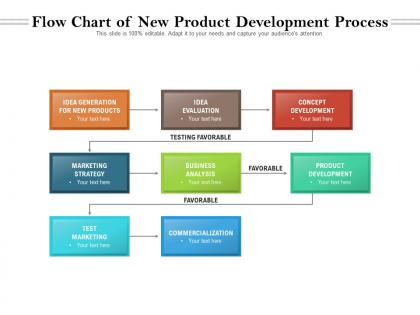
Flow chart of new product development process




Try Before you Buy Download Free Sample Product
 Impress Your
 Audience
 100%
100% Editable
 Save Hours
 of Time


Our Flow Chart Of New Product Development Process are topically designed to provide an attractive backdrop to any subject. Use them to look like a presentation pro.
People who downloaded this PowerPoint presentation also viewed the following :
Flow chart of new product development process with all 2 slides:
Use our Flow Chart Of New Product Development Process to effectively help you save your valuable time. They are readymade to fit into any presentation structure.
FAQs for Flow chart of new
So basically you've got six main stages to work through. Start with idea generation and concept development, then dive into market research to see if it's actually viable. Build your prototypes next - this part's fun but can get expensive fast. Testing comes after that, and honestly, most people totally rush this step and end up kicking themselves later. Launch is your final stage, but here's the thing - the whole process isn't really linear. You'll probably circle back to earlier stages based on what you discover. Set up clear checkpoints between each phase so you don't throw money at ideas that just aren't working.
Honestly, market research saves you from chasing ideas nobody wants. I've watched so many teams fall in love with concepts that sound amazing but totally miss the mark. You need to dig into what's actually frustrating your customers first. Their pain points become your brainstorming fuel. Look at competitor gaps too - there's usually something obvious they're all missing. Before each session, share those customer insights with your team. Keeps everyone focused on real problems instead of just... whatever sounds cool. Oh, and test concepts early! Way better than building something and hoping people care.
Dude, cross-functional collab is everything. Without it, you'll build something gorgeous that nobody wants or that's impossible to actually make. Get engineering, design, marketing, and sales chatting from the start - don't just toss requirements around like hot potatoes. I've watched so many products crash because teams stayed in their little bubbles. Everyone aligned early means you spot issues fast and ship stuff customers actually love. Oh, and set up regular check-ins where everyone gets to weigh in on the big calls. Trust me on this one.
Look, most teams I've worked with use some kind of scoring system - they'll rate features on customer demand, revenue impact, and how much dev work it'll take. But here's the thing: don't just build whatever's loudest on Twitter or Slack. Those aren't always your real users talking. Start with features that actually solve your core problem first. Then you can add the flashy stuff based on real data, not just because someone's CEO friend mentioned it at lunch. Oh, and competitive stuff matters too - sometimes you gotta build something just so you don't look behind.
Honestly, 3D printing is your best bet for physical stuff - cheap, fast, and you can mess around with designs easily. Digital products? Just use Figma or literally sketch on paper first. I know it sounds basic but cardboard mockups are actually amazing for testing if something feels right in your hands. For complicated projects, mix 3D printed parts with random stuff you can buy online. Oh, and start super rough - like embarrassingly simple. Test your main idea first, then make it pretty later. No point polishing something that might not even work, you know?
Don't just ask for feedback randomly - build it right into your dev process. Pick one method (surveys, interviews, whatever) and stick with it for three sprints minimum. Quick weekly check-ins with customers during each iteration work great. Support tickets are goldmines too if you're actually looking for patterns. Honestly, most teams mess this up by being inconsistent about it. Have someone own the whole thing and report back weekly - otherwise it just becomes another thing you forget to do. Start simple though, don't overcomplicate it.
Honestly, focus on the stuff that actually matters - user adoption rates, customer acquisition cost, and how long until you're profitable. Revenue growth is obvious, but retention rates tell you way more about whether people genuinely want your product or just got suckered into buying it once. Customer satisfaction scores are huge too. Track your dev cycle times so you don't repeat the same mistakes next round. Here's the thing though - pick like 3-5 metrics max. I tried tracking everything once and it was a nightmare. Check them monthly and you'll catch problems before they get ugly.
Regulatory stuff can absolutely wreck your timeline - I'm talking months or years depending on what you're building. Healthcare and finance are the worst offenders, honestly. You've got approval processes, compliance testing, mountains of documentation. Then there's the whole back-and-forth dance with regulatory bodies that never goes as smoothly as you'd hope. Don't make the mistake of treating this as an afterthought - bake those delays right into your initial timeline. My advice? Get your regulatory team involved during the concept phase so you can actually map out realistic timeframes for your specific product.
Ugh, honestly the worst part is timing - everything hits at once. Your supply chain will mess up right when you need inventory. Customers find bugs you somehow missed. And don't get me started on competitors who magically announce their stuff the same week as yours (like seriously?). Your sales team won't be ready, messaging gets all scrambled between departments. Plus people adopt way slower than you think they will. I learned this the hard way last year. Build in extra time for literally everything and have backup plans, because trust me - something's gonna break.
Honestly, tech can be a game changer for speeding things up. AI tools are clutch for rapid prototyping - you'll shave weeks off just testing concepts. Those digital collab platforms? Life saver for keeping everyone on the same page without sitting through another pointless meeting. 3D modeling catches your design screwups before they cost you serious money. Automated testing and analytics help you make quicker decisions too, which is huge. I'd say figure out where you're getting stuck most and tackle that bottleneck first with whatever tool makes sense.
Honestly, just nail these three things: test your ideas with real customers super early, build quick prototypes to fail fast, and get all your teams talking from the start. Don't build anything big until you've validated your assumptions - I've seen so many startups burn cash on products nobody wants. Quick and dirty prototypes are your friend here. Also make sure marketing, engineering, and ops are aligned instead of working in silos. Most product disasters happen because people skip the boring validation stuff and jump straight to coding. Oh, and set up regular check-ins to pivot if things aren't working.
Honestly, you gotta nail your value prop first - it's like your compass for everything else. I've watched too many teams just spin their wheels building random stuff because they skipped this part. What problem are you actually solving? And for who, specifically? Test that with real people before you go crazy building features. Your value prop becomes the thing that helps you say no to bad ideas (trust me, there will be lots) and keeps your whole team focused on what actually matters. Otherwise you'll just pivot forever and burn through cash.
Oh man, there's so many good options out there. Jira and Asana work great for sprints and task tracking. Monday.com has really clean visual dashboards if that's your thing. But honestly? I've watched teams spend weeks debating tools when basic Trello gets the job done fine for smaller stuff. Linear and ClickUp are clutch for bigger projects with complex roadmaps though. My take is just pick whatever your team will consistently use - doesn't matter how fancy it is if half your people ignore it.
So there's basically three ways companies figure out pricing for new stuff. Cost-plus means you just add markup to what it costs to make. Then there's competitive pricing where you match what everyone else is charging (or go lower). Value-based is probably the smartest though - you charge based on what customers actually think it's worth. Most companies mix all three because doing just one is kinda risky. You should definitely survey your target market first, check out competitor prices, and know your break-even numbers. Oh and test different price points with real people before you commit to anything.
Most failed launches boil down to not actually knowing your customers or rushing things. Teams skip real user testing, ignore warning signs, or think because they're excited, everyone else will be too. Honestly, it's wild how often people fall in love with their own idea and miss red flags. But here's the thing - failed products usually had solid pieces, just bad timing or execution. Document what actually worked, figure out where your research sucked, and bake those lessons into how you test ideas next time. Don't waste the learning.
-
Out of the box and creative design.
-
Innovative and attractive designs.
-
Much better than the original! Thanks for the quick turnaround.
-
Awesomely designed templates, Easy to understand.