New business development process flowchart with deliverables

Rating:
84%
New business development process flowchart with deliverables
Slide 1 of 2
Favourites Favourites

Try Before you Buy Download Free Sample Product

Audience Impress Your
Audience
Editable 100%
Editable
Time Save Hours
of Time
The Biggest Sale is ending soon in
0
0
:
0
0
:
0
0
Rating:
84%
Introducing our New Business Development Process Flowchart With Deliverables set of slides. The topics discussed in these slides are Analyze Investment And Return, Business Strategy, Client Products. This is an immediately available PowerPoint presentation that can be conveniently customized. Download it and convince your audience.

People who downloaded this PowerPoint presentation also viewed the following :

Content of this Powerpoint Presentation

Growing a business using all available channels is the commonly-understood definition of business development. The model could be franchise, direct to consumer or business to business, ultimately expanding the sphere of market operations is business development.

The metrics for business development measurement are more profits, greater revenue and more customers. In a sense, it is like planning how to take your business places. Even a world-renowned chain like McDonalds took the business development route of global expansion, when the brothers, the original founders, had to sell it to Ray Kroc.

A strategic business development flowchart is an indispensable tool. Find its best version here.

For the normal company or enterprise, however, the challenge in new business development is to ensure success and no wasted effort in abandoning markets or designing ill-conceived products and services. The answer to doing this well is the drawing up a new business development process flowchart with deliverables.

At SlideTeam, we understand the businesses’ pain point in doing this as they struggle with defining and selecting the infinite variables, and understanding the complex relationships these have with each other.

Find this best-in-class template on new business technology development flowchart here.

Hence, we have curated PPT Templates that depict the process with deliverables. It saves the top brass both time and money, and we offer these templates in 100% editable and customizable format as well.

Let’s explore!

Template1 New Business Development Process Flowchart with Deliverables

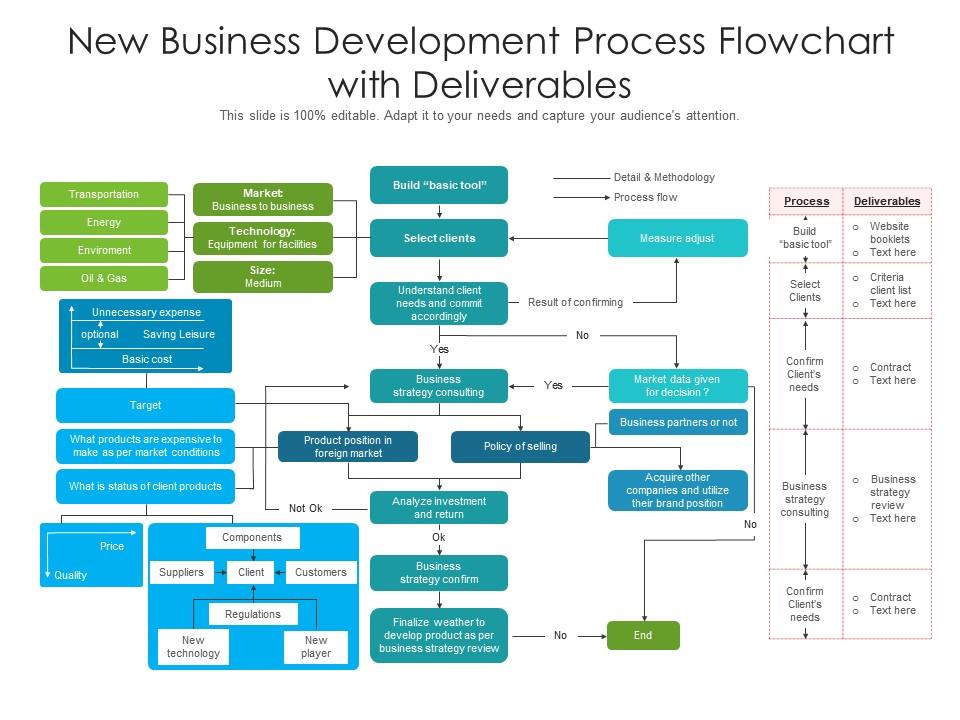
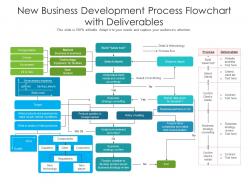
This PPT Template represents a flowchart on new business development that gives you both the detail and methodology, and the process flow. The two distinctions is made through the legend in the chart itself. Each process in business development and its deliverable is also mentioned to the extreme right of the clutter-free document, despite the tremendous information that it so clearly delivers. Users will find this slide to valuable, in that they can clearly fill in the details and present o stakeholders. The Step 1 starts with market that is your target, the technology you like and the size of the business as you want to keep it.

All these three feed into the next-level detail and methodology of building a basic tool, selecting clients, and understanding client needs. From understanding client needs, the process turns into a flow chart of yes/no. If needs are understood, we move into business strategy consulting or we adjust, till client needs are fully understood. Thus, the business development process keeps moving into more complex tools after this client, which the slide captures very well for you.

The business development process encapsulated in the PowerPoint Template ends when it finalized whether the company will develop product as per business strategy review. Get this PPT Now!

SYSTEMATIC, RATIONAL CHOICES

New business development is like creating something out of nothing, or using a blank sheet to fill it with a drawing of your choice. The work involved is immense, with no clear rights and wrongs. Hence, a flowchart is the logical answer to ensure choices remain rational and systematic, as that is the way of the business world. Get this wonderfully formatted flowchart to ensure that new business development starts well, and executed even better.

PS Find this Sales Process Flowchart for Business Development to make your mark.

FAQs for New business development process

Okay so there's like 6 main stages: prospecting, qualifying leads, needs assessment, proposal/pitch, negotiation, then closing. Honestly you'll live in those first three stages - that's where everything gets decided. Prospecting is just finding potential clients. Then qualifying weeds out the time-wasters from actual prospects worth your effort. Needs assessment is where you really dig into what's bugging them and what they actually need. After that you pitch your solution, negotiate the details, and close it. Oh and seriously - don't skip the qualifying part even if you're eager to move forward. Trust me, it saves so much headache later.

Dude, market research is like having GPS for your business decisions. Skip it and you're basically driving blind - not fun when you hit a wall. Survey your current customers first, they'll straight up tell you what other problems they need fixed. Plus you'll figure out who actually has budget to spend and what your competitors are doing wrong. I know it sounds boring but the data helps you pick the right partnerships and nail your pricing. Way better than just guessing and hoping it works out.

Dude, networking is literally everything in biz dev. People buy from folks they actually know and trust - sounds obvious but so many people skip this part. Your contacts become like an early warning system for new deals and partnerships before they're even public. I always block out time each week to hit up old clients or industry people, even just a "hey how's Q4 going?" text. Honestly beats cold emails by a mile. The trick is actually helping them out when you can, not just asking for stuff. Oh and follow up consistently - I'm terrible at this sometimes but it really works when you stick with it.

So basically you want to figure out who actually needs what you're selling AND can afford it. Look at demographics, what problems they're dealing with, how they buy stuff. If you already have customers, start there - see what they have in common. Then do some research on competitors and the market. Honestly, being super narrow works way better than casting a wide net. Like "small manufacturing companies, 50-200 people, inventory headaches" instead of just "businesses." Make detailed buyer personas but actually talk to real people to check if you're right. You can always expand later once your messaging really clicks with that core group.

Track your pipeline value and conversion rates first - those are the money makers. Deal size and cycle length matter too. Revenue attribution is what the bosses obsess over, but honestly? Don't ignore relationship stuff like partnership quality scores. Activity metrics help catch problems early - things like outreach volume and meeting ratios. Customer satisfaction from your BD deals is huge but people forget about it. Set up a weekly dashboard, then do monthly reviews. Way easier to fix trends before they become disasters that cost you real money.

Honestly, automation is where it's at for BD stuff. CRM systems handle all that tedious lead tracking automatically. Email sequences nurture prospects while you sleep. AI research tools dig up client info way faster than doing it manually - saves me hours honestly. LinkedIn automation works great but don't blast everyone or you'll come off super spammy. Analytics show you what's actually working so you stop chasing dead ends. Oh, and start small with just one tool then build from there. Trust me on that one.

So competitive analysis is clutch for finding market gaps and figuring out how to position yourself differently. I basically stalk competitors on LinkedIn way too much, but whatever - you learn so much about pricing strategies that actually work and what customers hate about current solutions. Short sentences work. Then you can spot partnership opportunities and see which sales channels are crushing it. Start simple though - pick like 3-5 direct competitors and just throw their features, pricing, and recent moves into a basic spreadsheet. Trust me, you'll discover what messaging actually resonates with people.

Skip the features list - nobody cares about your product specs. Talk about the actual problem you're solving instead. Who's it helping and how exactly? Ditch buzzwords like "innovative" too. Seriously, everyone says that crap. Real numbers work way better than vague claims. I'd test a few different versions with people first to see what actually hits. The good ones make prospects think "holy shit, they get it" - like you crawled inside their head and figured out their worst headache, then handed them the perfect cure.

Dude, cross-department collaboration is huge for BD - like, it literally makes or breaks deals. Sales knows what actually sells, marketing brings qualified leads, product keeps you from overpromising features that don't exist yet. Finance structures deals that won't implode later. I've watched so many solid partnerships completely tank because someone forgot to loop in the right people early on (usually finance, tbh). Working in a silo is just setting yourself up to fail. Pick 2-3 key people from other departments and start having regular check-ins with them. Trust me, your BD efforts will be way more effective.

Honestly, stay in touch regularly - not just when you need something from them. That's where most people screw up. Check in to see how they're doing, what new problems they're facing. I try to keep tabs on what's happening in their industry too, so I can bring them ideas before they even think to ask. The whole point is becoming someone they actually want to hear from. Oh, and deliver more than what you originally promised - that goes a long way. You want to be their first call when something comes up, not just another sales guy.

First, check if your goals actually mesh - not just the fancy pitch deck stuff, but real objectives. Company culture is huge too. I've watched partnerships blow up because nobody bothered checking if teams could even work together. Dig into their past partnerships and financials. Talk to their regular employees, not just the C-suite folks who are obviously gonna sell you. Here's what I'd do: start with a tiny pilot project first. Figure out your success metrics beforehand too, or you'll be arguing about results later. Don't jump into anything big right away - test the waters.

Long sales cycles are brutal - that's probably your biggest headache right there. Companies take forever to make decisions, and half the time you can't even figure out who's actually calling the shots. Your team's gonna face rejection constantly, which honestly just wears people down. What works? Qualify leads way harder upfront so you're not wasting time. Map out all the key players early and don't put everything on one contact. I learned that the hard way. Also, be real about timelines with your team and celebrate the small stuff - closed meetings, good demos, whatever keeps people motivated. Track why deals fall through too. That feedback's gold.

Dude, positioning is everything for biz dev. When prospects hit your site, they should instantly get what makes you different - otherwise you're starting every conversation from scratch explaining what you even do. Sharp positioning means better leads and higher prices because people already understand your value. I've watched companies spin their wheels for months just because their messaging was scattered. Plus your sales convos become way more focused. You're not pitching services, you're solving problems they actually have. Honestly, if your website doesn't immediately communicate your unique value, that's probably where I'd start.

Honestly, I'd focus on three main things: deal size, how likely they are to close, and timing. Create a basic 1-10 scale for each, then multiply them. Obviously the big deals ready to close now get your attention first. But don't sleep on those quick wins - especially when your pipeline's looking rough. I actually think strategic value matters too sometimes. Like, a smaller client might introduce you to their huge partner company later. Oh, and review your scores weekly because stuff changes constantly in sales.

Look, client feedback is basically free intel on how to fix your business development. The complaints? Gold mine. Same with the praise - shows you what's actually working. I'd set up regular check-ins with recent clients and ask pointed questions about their experience with your team. You'll catch gaps in your approach that way, plus spot opportunities you totally missed before. It's like having someone else do your market research, which honestly beats guessing what went wrong when deals fall through. Their insights will help you nail down what's breaking in your sales process.

Ratings and Reviews

84% of 100
Write a review
Most Relevant Reviews
  1. 80%

    by Efrain Harper

    Visually stunning presentation, love the content.
  2. 100%

    by Doyle Andrews

    It saves your time and decrease your efforts in half.
  3. 80%

    by Daren Henry

    Best Representation of topics, really appreciable.
  4. 80%

    by Clarence Mendoza

    Unique and attractive product design.
  5. 80%

    by Richard Scott

    Content of slide is easy to understand and edit.

5 Item(s)

per page: