


New Service Development Process Model




Try Before you Buy Download Free Sample Product
 Impress Your
 Audience
 100%
100% Editable
 Save Hours
 of Time


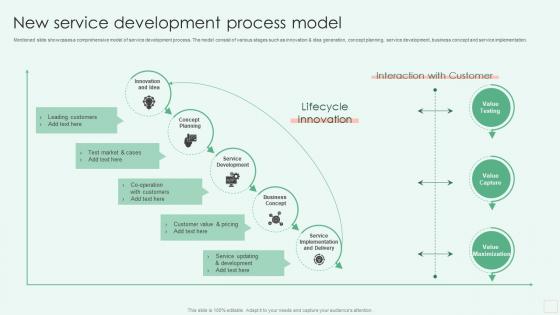
Mentioned slide showcases a comprehensive model of service development process. The model consist of various stages such as innovation and idea generation, concept planning, service development, business concept and service implementation.
People who downloaded this PowerPoint presentation also viewed the following :
New Service Development Process Model with all 6 slides:
Use our New Service Development Process Model to effectively help you save your valuable time. They are readymade to fit into any presentation structure.





FAQs for New Service
So you've got idea generation, concept development, business case analysis, service design, testing, then launch. Start by collecting ideas from customers or staff - maybe spot some market gaps too. Pick your best concepts and flesh them out. Honestly, the business case phase kills most ideas, but that's actually good - saves you from wasting money later. Design how you'll actually deliver the service, then test it with a small group first. Oh, and definitely loop in your frontline people throughout this whole thing. They'll catch operational problems you'd never see sitting in meetings all day. Refine based on feedback, then full rollout.
Dude, you really need to figure out what customers actually want before building anything. I can't tell you how many startups I've watched crash because they just went with their gut instead of doing basic research first. Run some surveys, focus groups, competitor analysis - whatever gets you real data on pain points and pricing. Testing your messaging early saves you from that awkward "nobody gets what we're selling" moment later. Trust me, it's way cheaper than having to pivot after you've already spent everything. The research also shows you who you're really competing against and where the gaps are.
Look, customer feedback is everything when you're designing services. Collect it constantly throughout development - waiting until the end is pointless because then you can't actually fix anything. I've watched so many teams learn this the hard way. Your customers will spot pain points you'd never think of, plus they'll tell you what features actually matter vs what you assumed they wanted. Set up different ways to get their input - surveys work, but so do interviews and beta testing. Oh, and don't just ask once. You'll need multiple touchpoints to really understand what's working and what isn't.
Honestly, you've got to get in there and actually watch what people do - not just what they tell you. Surveys are fine, but half the time people don't even know what they want until it's right in front of them. I'd focus on catching those little moments where they're clearly annoyed with whatever they're currently using. Watch for weird workarounds they've created. Social media complaints are pure gold too. Same with reading through competitor reviews - you'll spot the gaps pretty quick. Mix a few different approaches and pay attention to where things get frustrating in their day-to-day stuff.
Honestly, start with making people feel safe to screw up - nobody innovates when they're scared of getting fired. Block out maybe 2 hours a week for pure experimentation. Mix up your teams too, because marketing people thinking with engineers always creates weird magic. Actually listen to what's pissing off your customers instead of guessing. Regular brainstorm sessions help, but here's the thing - you gotta celebrate the failures just as much as wins. Failed experiments still teach you tons. Oh, and don't do that fake "innovation time" thing where it's just extra work disguised as freedom. People see right through that nonsense.
Tech trends basically set the limits for what you can even build. AI lets you do conversational stuff now, 5G makes real-time features actually work - that's your foundation right there. Plus people's expectations change as they get used to new tech, so you gotta keep up. But here's the thing - you can't chase every flashy new thing that pops up. I'd focus on maybe 2-3 trends that actually solve problems your customers have. The rest is just noise, honestly. Pick what matters and build around that instead of trying to be everywhere at once.
Honestly, I'd split it into three main areas. First, track how people are actually using your service - acquisition rates, whether they're hitting your core features, and retention (this is where most new stuff dies, btw). User satisfaction is next - NPS scores, support tickets, general feedback vibes. Business metrics matter too obviously - revenue per user, what it costs to serve them, ROI timeline stuff. I'd do weekly check-ins for the first three months since things change fast early on, then maybe switch to monthly reports once you've got your groove.
Honestly, don't try to retrofit scalability later - it's a nightmare. Build your processes flexible from the start with automation and workflows that won't collapse when you get busy. Your tech stack better be solid too because there's nothing worse than everything crashing right when business picks up. I learned this the hard way lol. Make sure your team structure can grow - clear roles, good training systems, all that. Test small first, then slowly ramp up while watching what breaks. You'll catch the bottlenecks before they kill you.
Honestly, the biggest killers are skipping customer research and over-engineering everything from the start. Teams get obsessed with their brilliant idea but forget to check if anyone actually wants it - been there! Don't build the whole thing at once either. Start small with your core feature and add from there. Communication breakdowns wreck projects faster than bad code, so keep everyone on the same page. My take? Get in front of real customers super early. Build quick prototypes and test with tiny groups first. Seriously saves you from wanting to throw your laptop out the window later.
Partnerships are game-changers for building services, seriously. You get access to skills, resources, and customers that would take forever to develop yourself. Why build everything from scratch when you can team up with someone who's already crushing that part? Look for partners who fill your weak spots - maybe they have the tech skills you lack, or distribution channels you can't afford yet. First step is honestly mapping out what you're missing vs. what you've got nailed down. Then hunt for companies that naturally complement those gaps. Sharing costs beats going solo every time.
Look, start with the boring stuff first - privacy, fairness, transparency. Don't grab data you don't actually need. Test that your thing works for different types of people, not just your demo. Be upfront about what you're doing with user info. I totally get it though - when you're building something cool, it's tempting to just focus on making it work. Been guilty of that myself. Oh, and if you're doing anything computationally heavy, think about the environmental hit too. Way easier to build this stuff in from the start than retrofit later. Always ask "who gets screwed over by this?" before worrying about growth.
Honestly, presentation templates are lifesavers for service development projects. They keep everything organized and make sure your whole team isn't just winging it. You can map customer journeys, nail down those tricky touchpoints, and actually explain your ideas to stakeholders without getting blank stares. Workshops especially benefit from good templates - there's nothing worse than staring at an empty whiteboard while everyone looks confused. The structure helps, but you've still got room to get creative. Find maybe 2-3 templates that click with how your team works, then tweak them for different project stages. Trust me on this one.
Dude, storytelling is everything when you're launching a new service. Instead of boring people with feature lists, you're showing them exactly how their problem gets solved. Paint the whole picture - where they're stuck now, what changes, how much better things get afterward. Way more memorable than bullet points, trust me. When they're weighing options weeks later, your story will pop back into their heads while your competitor's spec sheet won't. I'd probably start with like 2-3 different customer scenarios that show off various ways people use what you're offering.
Honestly, the key is making innovation feel normal instead of scary. Celebrate when people try smart stuff that doesn't work out - nobody experiments if they're gonna get roasted for failing. Give teams actual time for this (like 10% of their week) and mix up departments so different people bounce ideas off each other. But here's the thing that really matters: your bosses have to actually walk the walk. If leadership keeps promoting the "play it safe" crowd while just talking about innovation, you're screwed. Oh, and put innovation metrics right into performance reviews. Otherwise it stays a side hobby.
Honestly, I'd grab like 5-10% of your target users first. Way less stressful than a huge launch - trust me on this one. Set up easy ways for people to complain when stuff breaks (and it will). Track the basics: are people happy? Can they actually finish what they're trying to do? Run it for at least a few weeks because some problems hide until day 10 or whatever. The real key though? Actually fix the crap they tell you is broken before you roll it out to everyone. I've seen too many people skip that step and regret it later.
-
Illustrative design with editable content. Exceptional value for money. Highly pleased with the product.
-
Slideteam offers pocket-friendly products. As a college student this is a really necessary thing to look at while paying for something.