

Retail Store Order Management Process Flow Chart




Try Before you Buy Download Free Sample Product
 Impress Your
 Audience
 100%
100% Editable
 Save Hours
 of Time


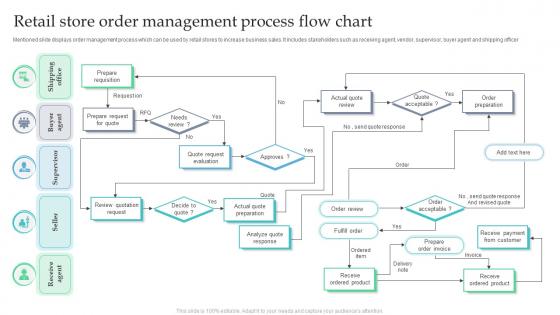
Mentioned slide displays order management process which can be used by retail stores to increase business sales. It includes stakeholders such as receiving agent, vendor, supervisor, buyer agent and shipping officer.
People who downloaded this PowerPoint presentation also viewed the following :
Retail Store Order Management Process Flow Chart with all 6 slides:
Use our Retail Store Order Management Process Flow Chart to effectively help you save your valuable time. They are readymade to fit into any presentation structure.





FAQs for Retail Store Order Management
Honestly, start by mapping out what systems you're already using - that's where most people mess up. Your OMS needs to handle real-time inventory, order workflows, customer communication, and payments obviously. But the integration stuff is what'll make or break you. It has to connect with your POS, warehouse systems, all those marketplaces. Oh and reporting too - you'll want visibility into fulfillment times and where things get stuck. I've seen so many retailers pick something that looks great but can't actually talk to their existing setup. Pain in the ass to fix later.
Honestly, automation is your best friend here. Get those order confirmations and shipping alerts set up so customers aren't constantly hitting you up asking "where's my stuff?" People are weirdly obsessed with tracking - like, they'll refresh that delivery map 20 times a day, so give them real-time updates. Connect your inventory system directly to order management too, because overselling is a nightmare you don't want. Cut out manual steps wherever you can since that's where things get screwed up. I'd start by looking at your current process and figure out what's slowing you down most.
Honestly, automation is a game changer for all that boring repetitive stuff. When orders come in, the system just handles everything - processes them, updates inventory, sends notifications to customers. It's wild how everything connects too. Stock gets checked and reserved instantly, picking lists get generated, accounting updates automatically. No more hunting down order statuses or doing manual data entry (thank god). The key is finding something that plays nice with whatever tools you're already using. That's where you'll actually save time and cut down on mistakes. Way less headache overall.
Honestly, inventory visibility is what separates smooth operations from constant headaches. Real-time stock levels across all your locations? That's how you fulfill orders fast and dodge those awkward "oops, we're sold out" moments. Your orders automatically route to the closest warehouse with stock. No more overselling disasters or manual stock checks eating up your team's time. Though I'd start by checking how current your inventory data actually is - you might be shocked at how outdated it gets. The difference in fulfillment speed is pretty dramatic once you get it dialed in.
Look, start with order accuracy and how fast you're getting stuff out the door - those are pretty obvious ones. Inventory turnover matters too, plus customer satisfaction scores. Your order-to-cash cycle time is huge though, shows how quickly you turn orders into actual money. Return rates will kill you if you ignore them, same with shipping costs per order. I'd probably throw in stockout frequency and perfect order rate too (complete, on-time, no damage). Honestly, just pick 3 or 4 that match whatever's driving you crazy right now, then add more later.
Honestly, multi-channel retail is chaos because inventory gets scattered everywhere - your site, Amazon, physical stores. Customers want real-time accuracy but orders fly in from all directions. Tracking stock levels becomes a nightmare, and don't even get me started on preventing oversells. You need a centralized system that syncs everything in real-time. Set up automated routing rules based on location and what's actually in stock. Before anything though, map out every single touchpoint you have. I did this once and found like 3 channels I'd totally forgotten about. Different warehouses make fulfillment way trickier too.
So analytics basically helps you spot trends you'd totally miss otherwise. Historical sales, seasonal stuff, customer habits - even weird things like weather patterns. One retailer I heard about cut their stockouts by 30% just from better predictions, which is pretty crazy. Feed your system clean data from everywhere - POS, online, social, all of it. Here's what I'd do: focus on your bestselling 20% of products first. Way easier to see results fast that way, then expand from there once you've got the hang of it.
Oh man, inventory sync issues are gonna be your worst enemy - stuff never matches up between channels and you'll oversell constantly. Shipping delays are brutal too. Plus trying to get all your systems talking to each other? Total headache. Returns are messy since you're rushing to restock but still need quality checks. Honestly the warehouse coordination thing feels impossible some days. I'd say fix your real-time inventory tracking first, that'll solve like half your problems. Then just chip away at the integration stuff bit by bit.
Your return policy basically dictates your whole backend setup. Got a generous 90-day policy? You're gonna need solid reverse logistics and extra inventory sitting around for all those returns. Plus tracking systems, restocking workflows, quality checks - the whole nine yards. Stricter policies cut down on operational headaches but might hurt sales. Honestly, I've seen companies get burned by promising returns they couldn't handle smoothly. The trick is matching what you tell customers with what you can actually pull off operationally. Otherwise you're setting yourself up for chaos.
Oh man, supply chain issues are the absolute worst - they turn your whole order system into a nightmare. Suddenly you're juggling backorders, dealing with pissed off customers, and delivery dates that change every five minutes. Honestly feels like you're constantly putting out fires. You'll be updating order statuses nonstop and sending "sorry, it's delayed again" emails. Real-time inventory tracking helps a ton, plus having backup suppliers lined up. The automated customer notifications are a lifesaver too - saves you from manually explaining delays all day. Build that flexibility in early or you'll hate your life later.
Look at your past seasons first - figure out when things get nuts and staff up for those times. Don't hire permanent people though, that's expensive. Use temp workers or partner with other warehouses when you need extra space. Test your systems before the chaos hits because nothing's worse than your site crashing right when everyone's ordering. Oh, and manage inventory smart so you're not sitting on a bunch of stuff nobody wants afterward. Honestly, flexibility is everything - have backup plans ready because something will definitely go wrong when you least expect it.
Start with inventory visibility - that's what everything else depends on. Real-time stock updates and automated order routing are huge. Integration with your current systems (POS, warehouse, ecommerce) is where most people mess up though. Split shipments and returns can get messy fast if the system isn't built right. Look for something that handles backorders smoothly too. Oh, and customizable workflows - trust me, every business has weird little processes that don't fit the standard mold. Demo it with your actual data first. Don't just take their word for it.
Your shipping promises basically dictate your whole operation. Same-day delivery? You'll need inventory super close to customers and crazy fast picking. Two-day shipping gives you way more wiggle room - you can batch orders together and use warehouses further out. The shipping speed becomes your biggest constraint and everything works backwards from there. Where you put inventory, which fulfillment centers to use, even order cutoff times - it all has to match what you're telling customers. I'd map out what you're currently promising versus what you can actually pull off. That'll show you where things don't line up.
So first thing - map out your whole order process before you even think about APIs. I made that mistake once and it was a nightmare. Real-time data sync is everything here. Start with inventory updates, order status stuff, and customer notifications - that's your bread and butter. Your systems need to handle traffic spikes without crashing (obvs), and build in error handling because something will definitely break. Oh, and don't try to do everything at once! Pick your most reliable products for a pilot run first, then expand from there once it's actually working.
Honestly, AI can handle so much of the annoying order stuff. Demand forecasting, inventory optimization, smart routing based on where customers are and what's in stock. Fraud detection too. The coolest part is predictive analytics - it'll warn you about supply chain issues before they screw you over. I read somewhere that retailers are cutting processing time by like 40% with better routing algorithms. Pretty wild. Just start simple though - maybe automated inventory alerts or basic forecasting. You don't have to go crazy and rebuild everything right away.
-
My presentations were a bit amateur before I found SlideTeam’s designs. I’ve been able to find slides for nearly every topic I’ve had to present. Thanks, Slideteam!
-
Kudos to SlideTeam for achieving the high success rate in delivering the top-notch slides.