


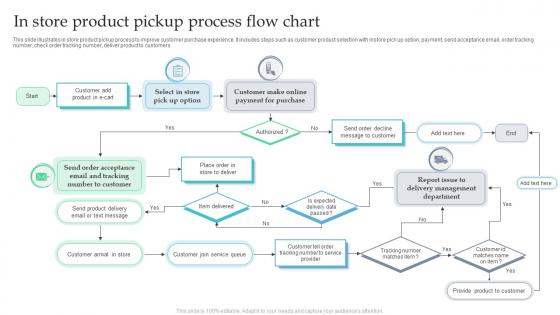
In Store Product Pickup Process Flow Chart




Try Before you Buy Download Free Sample Product
 Impress Your
 Audience
 100%
100% Editable
 Save Hours
 of Time


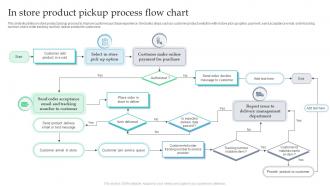
This slide illustrates in store product pickup process to improve customer purchase experience. It includes steps such as customer product selection with instore pick up option, payment, send acceptance email, order tracking number, check order tracking number, deliver product to customers
People who downloaded this PowerPoint presentation also viewed the following :
In Store Product Pickup Process Flow Chart with all 6 slides:
Use our In Store Product Pickup Process Flow Chart to effectively help you save your valuable time. They are readymade to fit into any presentation structure.





FAQs for In Store Product Pickup
The in-store pickup process involves customers placing orders online, receiving confirmation notifications, visiting designated pickup areas, verifying identity, and collecting items, while retailers manage inventory allocation, order preparation, customer communication, and handoff coordination. This streamlined approach enhances customer convenience by reducing wait times, enables retailers to optimize inventory management and staff efficiency, with many businesses finding that strategic pickup zones ultimately deliver faster service experiences and increased customer satisfaction.
Retailers can optimize in-store pickup systems through dedicated pickup zones, real-time inventory tracking, automated notification systems, streamlined verification processes, and trained staff assignments. These strategic improvements enhance customer experiences by reducing wait times, minimizing errors, and providing seamless service integration, with many retail organizations finding that optimized pickup operations ultimately deliver increased customer loyalty and competitive advantage.
Essential technology tools for streamlining in-store pickup include mobile apps with order tracking, barcode scanning systems, automated notification platforms, dedicated pickup management software, and GPS-enabled arrival detection. These technologies enhance operational efficiency by reducing wait times, minimizing order errors, and enabling real-time inventory visibility, with many retailers finding that seamless pickup experiences drive customer loyalty and increase repeat purchases.
Clear communication improves in-store pickup by providing real-time order status updates, precise arrival instructions, and streamlined check-in processes through automated notifications and designated pickup areas. These communication enhancements enable retailers to reduce customer wait times, minimize confusion at pickup locations, and deliver faster service experiences, with many stores finding that proactive messaging significantly increases customer satisfaction and operational efficiency.
Inventory management serves as the foundation for successful in-store pickup operations by ensuring real-time stock accuracy, preventing overselling, and enabling seamless order fulfillment across channels. Through integrated systems, retailers streamline allocation processes, minimize customer disappointment from unavailable items, and optimize store-level inventory positioning, with many finding that strategic inventory visibility ultimately delivers faster pickup times and enhanced customer satisfaction.
Retailers can leverage data analytics to improve in-store pickup efficiency by analyzing customer behavior patterns, optimizing inventory placement, predicting demand fluctuations, and streamlining fulfillment workflows. Through predictive analytics and real-time data insights, grocery stores, electronics retailers, and fashion brands enhance order accuracy, reduce wait times, and allocate staff resources more effectively, ultimately delivering faster customer experiences while minimizing operational costs.
Common challenges include long wait times, difficulty locating pickup areas, inadequate order tracking, staff unfamiliarity with systems, and poor communication about order status. These issues frequently occur in busy retail environments, grocery chains, and electronics stores, ultimately creating customer frustration, reducing operational efficiency, and potentially driving shoppers to competitors with more streamlined pickup experiences.
In-store pickup significantly enhances customer loyalty by offering convenience, speed, and control over delivery timing, while reducing shipping costs and wait times. This omnichannel approach strengthens brand relationships through positive touchpoints, with many retailers finding that pickup customers make additional purchases during collection visits, ultimately driving repeat business and long-term retention.
Essential security measures for in-store pickup include order verification systems, secure storage areas, staff authentication protocols, customer identity confirmation, and surveillance monitoring. These technologies streamline operations by minimizing theft risks, reducing order mix-ups, and ensuring data protection, with many retailers finding that comprehensive security protocols ultimately enhance customer trust while delivering faster, more reliable pickup experiences.
Retailers can train staff through comprehensive product knowledge sessions, customer service protocols, efficient order verification procedures, and technology platform proficiency. Through role-playing scenarios and hands-on practice, employees develop skills in managing pickup queues, handling order discrepancies, and creating positive customer interactions, ultimately delivering faster service and enhanced customer satisfaction.
Multiple in-store pickup options include same-day collection, scheduled pickup slots, curbside service, express lanes, and flexible timing windows. These services enhance customer convenience by accommodating different schedules and preferences, reduce shipping costs for retailers, and drive additional foot traffic to stores, with many businesses finding that customers often make supplementary purchases during pickup visits.
Visual merchandising enhances in-store pickup by creating dedicated, clearly marked pickup zones with prominent signage, streamlined wayfinding systems, and branded displays that reduce customer confusion and wait times. Through strategic placement of pickup counters, digital order status boards, and complementary product displays, retailers like Target and Best Buy deliver faster service fulfillment while encouraging additional purchases, ultimately improving customer satisfaction and operational efficiency.
Strategies to reduce in-store pickup wait times include dedicated pickup counters, mobile notifications for order readiness, curbside service options, barcode scanning systems, and pre-staged inventory organization. These approaches streamline operations by minimizing customer queuing, enabling faster order verification, and optimizing staff workflows, with many retailers finding that strategic pickup zones and real-time inventory tracking ultimately deliver enhanced customer satisfaction and increased operational efficiency.
Mobile app integration enhances in-store pickup by enabling real-time order tracking, automated arrival notifications, and streamlined check-in processes that eliminate waiting times. These technologies deliver faster service through barcode scanning, GPS-triggered alerts, and inventory synchronization, with many retailers finding that customers complete pickups 60% faster while enjoying improved convenience and operational efficiency.
Target's Drive Up service, Walmart's curbside pickup towers, Best Buy's contactless pickup lockers, Nordstrom's reserve online pickup system, and Home Depot's automated order fulfillment represent successful innovative implementations. These retailers streamline customer convenience through mobile notifications, designated parking spots, and automated retrieval systems, ultimately reducing wait times, enhancing customer satisfaction, and driving increased omnichannel engagement across their operations.
-
“As you have innovative ideas and they are all customizable, this saves a huge chunk of your time to prepare well-read presentations.”
-
I have been using SlideTeam for the past six months. Very happy and satisfied!