

Iso 27001 isms training program for employees ppt download





Try Before you Buy Download Free Sample Product
 Impress Your
 Audience
 100%
100% Editable
 Save Hours
 of Time


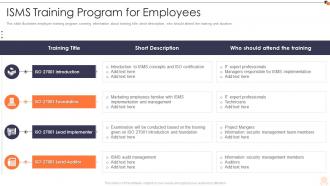
This slide illustrates employee training program covering information about training title, short description, who should attend the training and duration.
People who downloaded this PowerPoint presentation also viewed the following :
Iso 27001 isms training program for employees ppt download with all 6 slides:
Use our ISO 27001 Isms Training Program For Employees Ppt Download to effectively help you save your valuable time. They are readymade to fit into any presentation structure.





FAQs for Iso 27001 isms training program for
So you'll want to cover risk management training and policy development first. Incident response procedures are huge too - can't skip that. Gap analyses and internal auditing give your team real hands-on practice, which honestly beats theory every time. Yeah, the documentation is boring as hell but you need it for certification. Don't forget awareness training for everyone, not just IT people. Oh, and start with a basic overview session before jumping into the role-specific stuff. Both technical implementation and ongoing management need to be in there somewhere.
Start with a gap analysis - compare where you're at now against those 114 ISO 27001 controls. Most companies grab a checklist or assessment tool for this. Fair warning though, it's gonna feel overwhelming at first. Your team can handle it internally, or you could bring in an outside consultant if you want that objective perspective. The trick is being completely honest about what's really working versus what just looks good on paper (trust me on this one). After you've got that baseline sorted, you'll know exactly which areas your training needs to hit hardest.
Honestly, the security improvements alone make it worth it. Your team becomes way more aware of risks, and you get actual processes that work instead of just winging it. Clients love seeing you're certified too - builds massive trust, especially if they're picky about data protection. Finance and healthcare companies basically require it now, plus EU customers expect it. Oh, and your incident response becomes so much smoother since everything's properly documented. I'd probably start with a gap analysis first though - shows you exactly what needs fixing before you dive in.
So the training basically gets your team on the same page about spotting and handling security risks - that's what ISO 27001 is all about. Your people learn how to actually assess threats and pick the right controls for your specific situation. Plus you get frameworks for keeping tabs on risks long-term, which honestly saves you from scrambling later. Once everyone's using the same approach, you won't have those annoying gaps where stuff falls through the cracks. I'd start with your key players, then have them teach everyone else. Builds that whole risk-aware mindset across the company.
Look, you're basically the company's human firewall. Most data breaches? They happen because someone clicked a sketchy link or shared their password with the wrong person. The training shows you how social engineering actually works and why you shouldn't plug in random USB drives you find. It's not just IT's problem anymore - we're all responsible for keeping things secure. You'll learn to spot threats and report weird stuff properly. I know the security rules feel annoying sometimes, but your everyday choices really do affect everyone. Think of yourself as a defender, not just someone following boring protocols.
So officially you need to update ISO 27001 training yearly, but that's honestly pretty weak. New regulations drop all the time, plus security incidents happen - you can't just sit around waiting for your annual review. The threat landscape is nuts right now. I'd do quarterly check-ins to see what's changed, then big updates once a year. Oh and keep notes throughout the year of stuff that needs addressing - saves you from that last-minute panic when it's time to actually update everything. Don't wait if something major happens though.
So you'll get solid experience with risk assessment and setting up security controls throughout the company. Gap analysis and internal auditing are covered too - plus incident response planning. Not gonna lie, the documentation side is pretty intense at first, but you kinda need it. Training staff on security awareness becomes part of your toolkit, along with monitoring how well your whole system actually works. Leading implementation projects is probably the coolest part, and you'll be ready for those certification audits. Oh, and figure out what role you want first - saves you from getting lost in all the different skill areas during training.
Honestly, start with before/after tests to see what people actually learned. Phishing sims work great too - they'll show you if folks are really getting it or just going through the motions. Track your incident reports because fewer breaches = win. I'd also ask participants what they thought of the training itself - sometimes it's just boring and needs tweaking. Oh, and quarterly reviews help you spot trends. The simulation stuff is probably your best bet though since it mimics real threats. Don't overthink it!
Honestly, the hardest part is getting people to actually care instead of just zoning out. Most folks think security training is this tedious thing they have to sit through - can't really blame them tbh. What works way better is showing them how it affects their actual job, not some generic "here's why passwords matter" presentation. Role-based stuff hits different when you're talking real scenarios they'd actually face. Skip the boring slideshow death march and do interactive workshops instead. Oh, and if your executives clearly don't give a damn, forget it - everyone picks up on that vibe immediately. Find some enthusiastic people in each team who can get others interested.
Start with the actual ISO 27001 standard - boring but necessary. The ISO website has decent implementation guides too. NIST frameworks are gold, and SANS has some solid template stuff you can borrow from. Bodies like ISACA and (ISC)² have resources worth checking out. Your certification body probably has sample docs they'll share if you ask nicely. Mix and match from different sources though - that's where the magic happens. Don't just copy one template and call it done. Build something that actually makes sense for your company's situation, not some generic cookie-cutter thing.
Start with real scenarios that actually matter to your team - like walking through what happens during a data breach or having people write security policies for their own departments. Tabletop exercises work really well too. Role-playing might sound cheesy but honestly it sticks way better than PowerPoint slides. I'd throw in some case studies from companies that actually went through ISO 27001 certification. Mini risk assessments are solid practice. The trick is connecting everything back to problems your organization already deals with - otherwise people zone out and it becomes another boring training session nobody remembers.
Honestly, you gotta hit the big ones - cloud security and AI/ML risks are massive right now. Zero trust is completely changing how we approach network security, so definitely cover that. Ransomware response planning is critical too (learned that one the hard way at my last job). Remote work security needs its own section since we're all hybrid now. IoT security matters if you've got any connected devices, which... basically everyone does. Privacy by design and DevSecOps integration are becoming standard practice. I'd prioritize whatever hits your industry hardest first, then build from there. Supply chain security rounds it out nicely.
Honestly, survey people first to see what they actually know about security - saves you from explaining basics to experts or vice versa. Mix things up with workshops and case studies instead of just slides (trust me, everyone's sick of PowerPoint marathons). Real examples from their workplace hit way harder than made-up scenarios. Make it modular so you can pivot if half the room looks dead inside. The trick is showing how ISO 27001 affects what they do every day, not just dumping compliance stuff on them. Oh, and tailor everything to their specific roles - what matters to IT won't matter to HR.
Look for trainers with ISO 27001 Lead Auditor or Lead Implementer certs from IRCA, PECB, or BSI. Trust me, I've watched too many "security experts" completely botch the details of this standard. It's painful. Real implementation experience matters way more than just book knowledge - ask them about actual ISMS projects they've run and get client references. CISSP, CISA, or CISM credentials are solid bonuses too. Oh, and avoid anyone who can't explain the standard without drowning you in jargon.
Actually read through all those feedback forms - I know it's boring but there's good stuff in there. When three people complain about the same module being confusing, that's basically a neon sign telling you what to fix. But also notice what they raved about and lean into that more next time. I like to sort comments into three buckets: content problems, delivery issues, and format stuff. Then pick one or two changes to test in your next session. Don't try to fix everything at once or you'll go crazy. Track if people seem happier after the tweaks.
-
Best Representation of topics, really appreciable.
-
Commendable slides with attractive designs. Extremely pleased with the fact that they are easy to modify. Great work!