


ISO 27001 Certification Process Powerpoint Presentation Slides




Try Before you Buy Download Free Sample Product
 Impress Your
 Audience
 100%
100% Editable
 Save Hours
 of Time


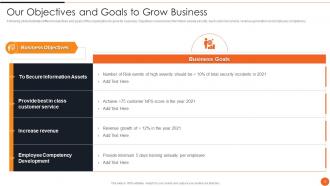
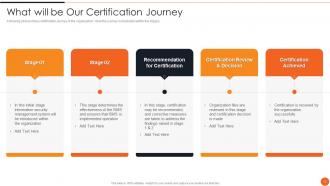
Keeping confidential information of the organization, customers, and the personal data of valuable employees is not an easy task. To achieve the purpose mentioned above, organizations rely on the information security management system. Here is a professionally designed ISO 27001 Certification Process template that will be helpful to the organization that wants to introduce and manage the information security management system. The organization can illustrate its future goals through the our objectives and goals to grow business section. Organization can display their journey to achieve the certification with the help of the what will be our certification journey section. Introducing ISMS within the organization and managing it to get the certification section will help the organization to show the incorporation of the ISMS framework within its corporate control. Clause 6 planning can be met by the organization through the applicability statement. Internal ISMS audit program and activities and performance indicators, and evaluation dashboard sections may help the organization fulfill clause 9 Performance evaluation. Finally, the mitigation plan to resolve encountered risk events section will help the organization comply with clause 10 improvement. Customize this 100 percent editable template now.
People who downloaded this PowerPoint presentation also viewed the following :
Content of this Powerpoint Presentation
Slide 1: This slide introduces ISO 27001 Certification Process. State Your Company Name and begin.
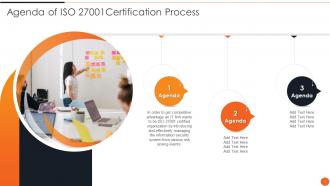
Slide 2: This slide states Agenda of the presentation.
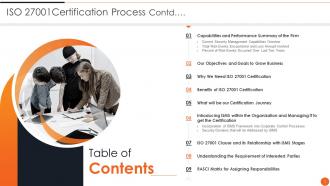
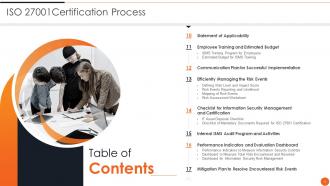
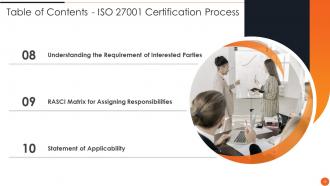
Slide 3: This slide presents Table of Content for the presentation.
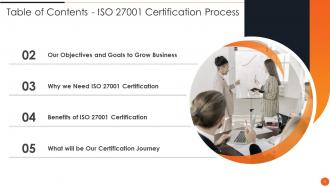
Slide 4: This is another slide continuing Table of Content for the presentation.
Slide 5: This slide highlights title for topics that are to be covered next in the template.
Slide 6: This slide presents Current Security Management Capabilities Overview.
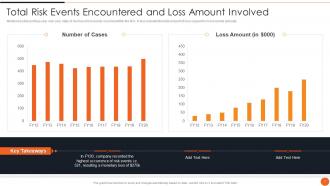
Slide 7: This slide displays Total Risk Events Encountered and Loss Amount Involved.
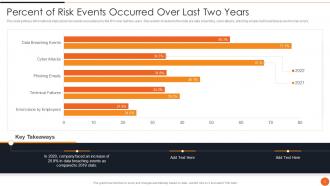
Slide 8: This slide represents Percent of Risk Events Occurred Over Last Two Years.
Slide 9: This slide shows title for topics that are to be covered next in the template.
Slide 10: This slide showcases Our Objectives and Goals to Grow Business.
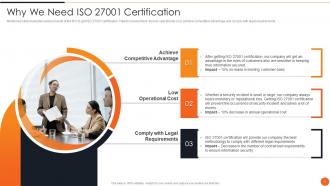
Slide 11: This slide presents various needs of the firm to get ISO 27001 certification.
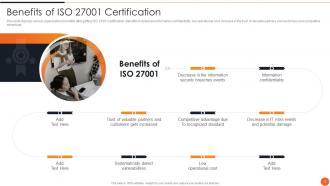
Slide 12: This slide displays various organizational benefits after getting ISO 27001 certification.
Slide 13: This slide represents certification journey of the organization.
Slide 14: This slide shows title for topics that are to be covered next in the template.
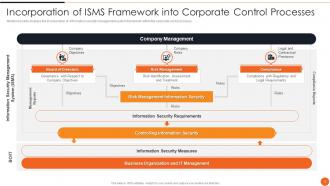
Slide 15: This slide presents Incorporation of ISMS Framework into Corporate Control Processes.
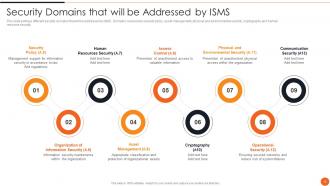
Slide 16: This slide portrays different security domains that will be addressed by ISMS.
Slide 17: This slide shows title for topics that are to be covered next in the template.
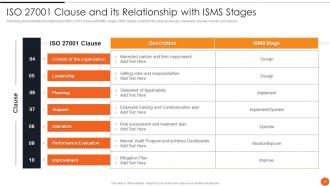
Slide 18: Following slide illustrates the relationship of ISO 27001 clause with ISMS stages.
Slide 19: This slide shows title for topics that are to be covered next in the template.
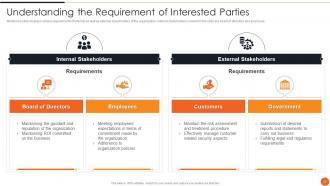
Slide 20: This slide presents Understanding the Requirement of Interested Parties.
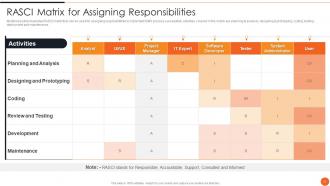
Slide 21: This slide displays RASCI matrix that can be used for assigning responsibilities to implement ISMS process successfully.
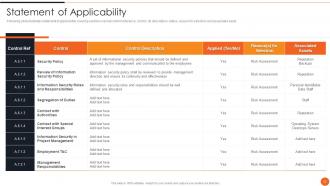
Slide 22: This slide represents statement of applicability covering sections namely control reference, control, its description, etc.
Slide 23: This slide shows title for topics that are to be covered next in the template.
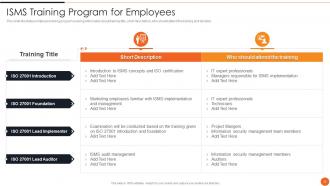
Slide 24: This slide illustrates employee training program covering information about training title, short description, etc.
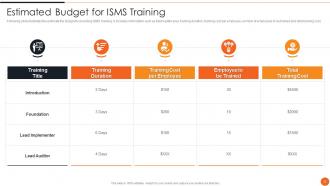
Slide 25: This slide presents estimate the budget for providing ISMS training.
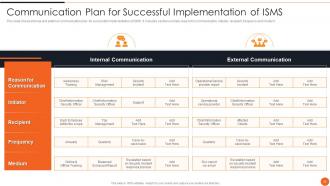
Slide 26: This slide shows internal and external communication plan for successful implementation of ISMS.
Slide 27: This slide shows title for topics that are to be covered next in the template.
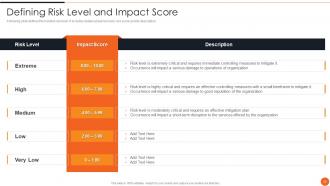
Slide 28: Following slide defines the incident risk level. It includes details about risk level, risk score and its description.
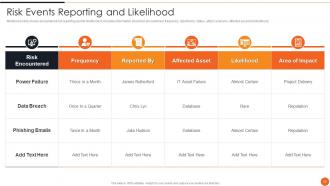
Slide 29: This slide represents encountered risk reporting and its likelihood.
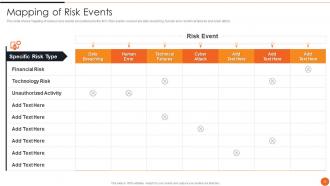
Slide 30: This slide shows mapping of various risks events encountered by the firm.
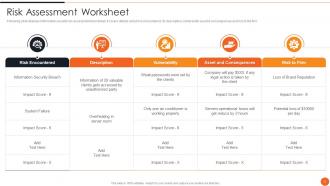
Slide 31: Following slide displays information security risk assessment worksheet.
Slide 32: This slide shows title for topics that are to be covered next in the template.
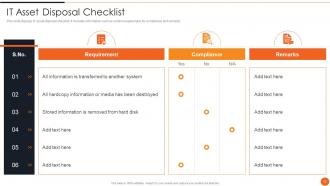
Slide 33: This slide displays IT asset disposal checklist including information such as system requirement, its compliance and remarks.
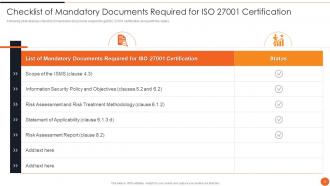
Slide 34: This slide showcases Checklist of Mandatory Documents Required for ISO 27001 Certification.
Slide 35: This slide shows title for topics that are to be covered next in the template.
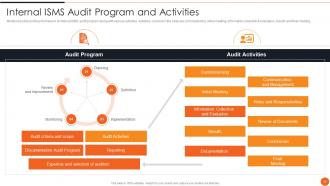
Slide 36: Mentioned slide portrays framework of internal ISMS audit program along with various activities.
Slide 37: This slide shows title for topics that are to be covered next in the template.
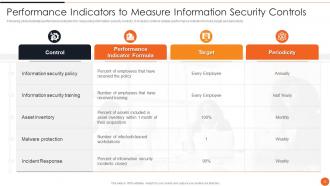
Slide 38: This slide displays Performance Indicators to Measure Information Security Controls.
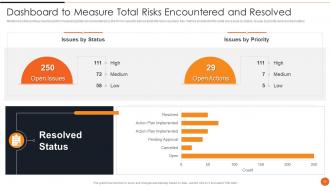
Slide 39: This slide represents Dashboard to Measure Total Risks Encountered and Resolved.
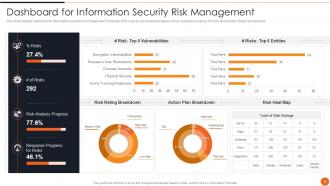
Slide 40: This slide showcases Dashboard for Information Security Risk Management.
Slide 41: This slide shows title for topics that are to be covered next in the template.
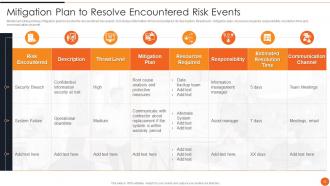
Slide 42: This slide displays Mitigation Plan to Resolve Encountered Risk Events.
Slide 43: This slide displays Icons for ISO 27001 Certification Process.
Slide 44: This slide is titled as Additional Slides for moving forward.
Slide 45: This slide showcases ISO 27001 Certification Journey.
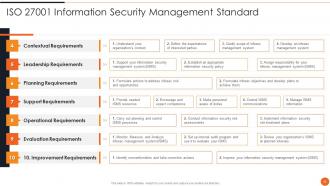
Slide 46: This slide represents ISO 27001 Information Security Management Standard.
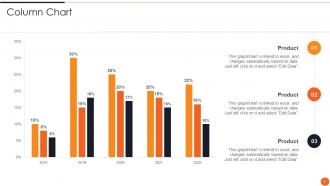
Slide 47: This slide displays Column chart with two products comparison.
Slide 48: This slide provides 30 60 90 Days Plan with text boxes.
Slide 49: This is Our Target slide. State your targets here.
Slide 50: This is a Timeline slide. Show data related to time intervals here.
Slide 51: This slide contains Puzzle with related icons and text.
Slide 52: This slide shows Post It Notes. Post your important notes here.
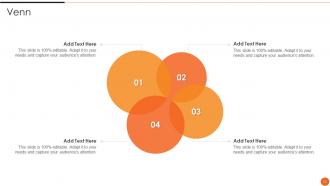
Slide 53: This slide depicts Venn diagram with text boxes.
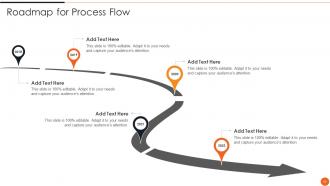
Slide 54: This slide represents Roadmap for Process Flow.
Slide 55: This is a Thank You slide with address, contact numbers and email address.
ISO 27001 Certification Process Powerpoint Presentation Slides with all 60 slides:
Use our ISO 27001 Certification Process Powerpoint Presentation Slides to effectively help you save your valuable time. They are readymade to fit into any presentation structure.











FAQs for ISO 27001 Certification Process
So basically you'll want to set up an ISMS - sounds fancy but it's really just risk assessment, security policies, and controls for your whole org. Three main things to focus on: do a solid risk assessment, implement the right security controls based on what you find, and document absolutely everything (yeah, it's boring but you gotta do it). Management buy-in is huge here. Don't forget employee training and regular internal audits either. Oh, and build in some way to keep improving over time. I'd start by figuring out where you are now security-wise, spot the gaps, then make your plan.
Honestly, start with a gap analysis to see where you stand against ISO 27001 requirements. Document your policies, procedures, and risk assessments - auditors will dig into everything. Your team needs to actually follow what's written down too, since they'll interview people to check. I'd run internal audits first to catch problems early. Oh, and those management review meetings? Yeah, don't skip those. The timeline thing is huge - give yourself 6-12 months minimum. I've watched companies try to rush this and it's painful to see. Short sentences work. But flowing ones help break up the rhythm naturally.
Honestly, the resource crunch hits hardest - management always thinks this'll be way easier than it actually is. Getting people engaged is brutal too, especially when they're already swamped. Risk assessment gets messy quick if you've never done formal risk management before. Documentation pile-up is real, and people burn out fast once audit fatigue kicks in. Oh, and don't even get me started on maintaining momentum halfway through when everyone's over it. My advice? Get a dedicated team from day one and set realistic timelines. Treating this like some side project is a recipe for disaster.
Dude, ISO 27001 basically makes you stop guessing about security risks and actually map them out properly. You'll dig into all your vulnerabilities, figure out what could actually hurt you, then build real controls around them. Most companies are shocked by what they find - I've seen orgs discover they had no idea who had access to what. The whole thing gives you a roadmap for staying on top of threats as they change. Plus clients love seeing that certification. Honestly, just start with a risk assessment first. You'll probably find some scary stuff, but better to know, right?
Oh man, the paperwork is real. First thing - you need an Information Security Policy as your baseline. Risk assessment procedures, incident response docs, and something called a Statement of Applicability (basically just explaining which controls you're using). Training records, audit reports, management reviews - all that proof your system actually functions. The whole thing seems crazy overwhelming initially, but honestly? Most companies are already doing this stuff, just not writing it down. I'd start by figuring out what documentation you already have lying around vs what's actually missing.
Honestly, your ISMS isn't some set-it-and-forget-it thing. Monthly review meetings work way better than quarterly ones - trust me on this. Those internal audits? Actually read them instead of filing them away. Track your security metrics but also listen when employees complain about annoying security stuff (they usually have a point). Don't wait for some massive overhaul either. Small tweaks consistently beat big dramatic changes every time. Keep your team updated on new threats since everything moves so fast these days. Oh, and those surveillance audits aren't just paperwork - they're telling you real problems you need to fix.
Yeah, training is huge for ISO 27001 compliance - auditors always dig into this stuff first. Your team needs to know the security policies, how to handle data correctly, and spot phishing emails. I swear, most data breaches happen because someone clicked the wrong link or left their laptop unlocked at Starbucks. Document everything though - who got trained, when, what topics you covered. A basic spreadsheet works fine if you don't have fancy training software. Just keep it updated when policies change or you'll hear about it during your audit.
Look, don't treat ISO 27001 like some rigid box-checking exercise. It's meant to be flexible - you're supposed to tailor it to your actual business. A tiny SaaS startup doesn't need bank-level physical security, right? Do a real risk assessment first. Figure out what actually threatens your business, then pick controls that make sense for those risks. Honestly, auditors care way more about whether your approach is logical than if you've implemented every single control perfectly. Start with what genuinely protects you - the rest can wait.
Check out GRC platforms like MetricStream or ServiceNow - they're solid for handling ISO 27001 controls and docs. Vanta and Drata are game-changers for automating evidence collection (seriously saves so much headache). You'll need asset management to track your IT stuff, plus vulnerability scanners like Nessus for catching security gaps. SIEM tools are pretty much essential for monitoring and incident response. Oh, and don't try to automate everything at once - that's a recipe for chaos. Map out your priority controls first, then find tools that play nice together.
Okay so technically you're supposed to do it annually, but that's honestly pretty lazy. I'd say quarterly check-ins work way better - just quick reviews of your security stuff, risk assessments, whatever. If something big changes though (new systems, sketchy threats), don't wait around. Review immediately. The yearly one should be your deep dive where you actually look at everything properly. Oh and pro tip - set those calendar reminders now or you'll totally forget. Trust me, I've been there. Those mini-reviews every few months will save you from scrambling during the big annual assessment.
So internal audits are basically your practice run before the real deal - you're catching problems while you can still fix them. ISO 27001 actually requires these at regular intervals, which is smart because nobody wants nasty surprises during certification. You'll check if your security processes are working like they're supposed to and meeting all the requirements. Honestly, I've seen companies skip this step and regret it later. These audits help spot gaps, test how well your controls work, and show auditors you're serious about improving. Just make sure you schedule yours with enough time to tackle whatever issues pop up.
Honestly, you probably already do more security stuff right than you think - just document what's working. Don't try fixing everything at once though, that'll drive you crazy. Do a quick risk assessment first to figure out your biggest weak spots and what assets matter most. Build policies around those instead of downloading some random template online. Getting a consultant for the initial review isn't cheap but it beats screwing up later (learned that one the hard way). Get your team involved from the start too. Oh and write everything down as you go - future you will thank present you.
So ISO 27001 costs are all over the place honestly. Initial certification runs $15K-50K+ - covers gap analysis, controls, docs, the whole audit thing. But the real killer is your internal team's time, nobody warns you about that part. Annual surveillance audits are like $5K-15K after that. Small companies might squeeze by around $20K first year, but big orgs? Easily six figures. Oh and definitely get quotes from multiple certification bodies - prices vary crazy amounts. Also budget at least 20% more time than you think for prep work, trust me on this one.
Oh yeah, ISO 27001 is totally worth it for your rep. Clients see it and immediately think "okay, these guys actually know what they're doing with our data." Big enterprises especially eat that stuff up - half of them won't even talk to vendors without proper certs these days. It really does give you an edge when you're bidding against competitors who don't have it. Trust me, people are so paranoid about security breaches now (can't blame them honestly). Once you get certified, slap that badge everywhere - your website, proposals, email signatures. Makes for great marketing material since it's basically third-party proof you're not gonna mess up their sensitive info.
Here's the thing - most companies bomb ISO 27001 because they think it's just paperwork. Leadership throws it at some poor IT guy without proper resources (been there). Your daily ops have to actually match what you write down, or auditors will call you out instantly. Don't start with everything at once - that documentation load will crush you. Get your executives on board first, then build small. Security has to become part of how people work, not some policy gathering dust. Oh, and nobody should be treating this like it's only one department's problem.
-
Based on my personal experience, I would recommend other people to subscribe to SlideTeam. No one can be disappointed here!
-
Great combination of visuals and information. Glad I purchased your subscription.