

Iso 9001 roadmap to implement iso 9001




Try Before you Buy Download Free Sample Product
 Impress Your
 Audience
 100%
100% Editable
 Save Hours
 of Time


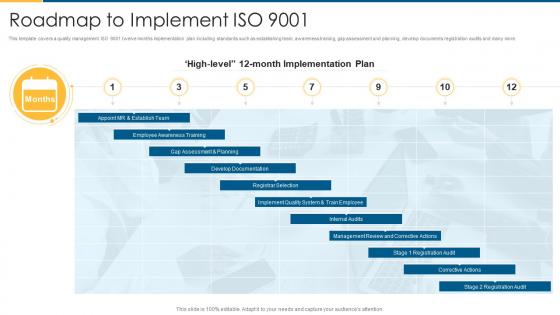
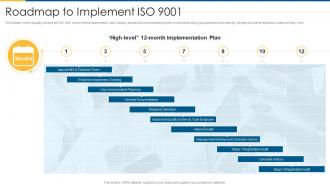
This template covers a quality management ISO 9001 twelve months implementation plan including standards such as establishing team, awareness training, gap assessment and planning, develop documents registration audits and many more.
People who downloaded this PowerPoint presentation also viewed the following :
Iso 9001 roadmap to implement iso 9001 with all 6 slides:
Use our Iso 9001 Roadmap To Implement Iso 9001 to effectively help you save your valuable time. They are readymade to fit into any presentation structure.





FAQs for Iso 9001 roadmap to
So first thing - do a gap analysis to see where you're at right now. Then you gotta build out all your documentation and procedures for the quality management system. Training your team comes next, and honestly? This part always drags on way longer than anyone thinks it will, but you can't skip it. After that, roll out the system company-wide and start doing internal audits to spot problems before the real deal. Finally, book your external certification audit. Oh, and definitely start with that gap analysis - it'll save you so much headache by showing exactly what needs fixing and how long this whole thing's gonna take.
Honestly? Do a gap analysis first - compare where you're at now against what ISO 9001 actually wants. Most companies totally overestimate how ready they are, which is kinda hilarious until audit time hits. Check your quality processes, documentation, management buy-in, and training. The standard has seven main areas: context, leadership, planning, support, operations, performance evaluation, and improvement. Make a simple checklist and color-code everything green, yellow, or red. Mostly yellow/red means you'll need 6-12 months of prep before even thinking about auditors.
Honestly, don't even bother starting ISO 9001 without real leadership backing. I've watched so many companies waste months because their executives just went through the motions. Your leaders need to actually care - not just sign off on budgets but really communicate why quality matters to everyone on the team. Half-hearted attempts are painful to watch and they always fail. The C-suite has to show commitment through actions, allocate proper resources, and weave quality thinking into how people work every day. Seriously though, if your leadership treats this like checking a box, you're setting yourself up for frustration.
Look, you've got to make it personal for them. Show how ISO 9001 actually makes their jobs easier - clearer processes mean way less confusion and redoing work. I'd skip all that corporate BS honestly, people just zone out. Hold team meetings with real examples of problems it solves, like fewer errors between departments. Focus on what they actually care about: better job security, learning new skills, working somewhere they can feel proud of. Oh and definitely let them have input during implementation - nobody likes change forced on them. When people see concrete benefits instead of just management speak, they'll get on board way faster.
Honestly, the worst part is dealing with people who hate change - and trust me, everyone will complain at first. Documentation is a nightmare too, way more than you'd expect. Most companies totally underestimate the time it takes. Here's what worked for me though: get your boss and their boss on board before you do anything else. Then find a few people in each department who actually care and train them up. They'll help sell it to everyone else. Oh, and don't believe everything consultants tell you - half the stuff they say is "required" really isn't.
Yeah, ISO 9001 actually works great with other standards. Think of it as your base layer - you can stack ISO 14001 for environmental stuff or ISO 45001 for safety on top. Medical device companies love pairing it with ISO 13485. Most places I've worked with find the overlap pretty helpful since they all use similar process thinking. Map out what you've already got running first, then see where ISO 9001 fits in. Sometimes it'll replace clunky systems you're using, other times it just makes them better. The documentation frameworks are surprisingly similar across standards, which is honestly a relief.
Don't treat it like checking boxes - that's where most people screw up. Leadership has to actually care, not just pretend to support it. Half the companies I've seen fail because the executives don't really buy in. Also, people go crazy documenting every tiny thing when ISO actually wants you to focus on risk-based stuff now. Never steal someone else's quality manual either (learned that one the hard way). Map out what you're currently doing first. Be honest about it. Then fix what's actually broken instead of just chasing the certification badge.
Honestly, going digital with your ISO docs is a total game-changer. Cloud systems handle all that version control headache automatically - no more "wait, which draft are we on?" moments. Audit management software schedules everything and tracks your corrective actions too. Mobile apps beat the hell out of clipboards during audits, trust me on that one. Everything becomes searchable from anywhere, which is clutch. I'd start with whatever's driving you most crazy - probably document approvals or audit scheduling. Those workflows are usually the biggest pain points. Build out from there once you see how much time it saves.
Track both your processes and outcomes - that's the real trick. Customer satisfaction, defect rates, and how fast you handle complaints are your big winners for outcomes. Process-wise, watch audit findings, how quickly you close corrective actions, and training completion rates. Internal audits are honestly where you'll catch the most surprises - they show what's actually broken vs what you think is working fine. Don't go crazy with metrics though. Pick maybe 5-7 that actually connect to your quality goals and review them monthly with the team.
Honestly, training your people is what makes or breaks ISO 9001. I've seen so many companies where the procedures just sit there doing nothing because nobody gets why they matter. Your team needs to understand the actual benefits, not just "do this because we said so." When they're bought in, they'll spot problems early and even suggest improvements. Short version - explain why you're doing ISO stuff, don't just hand them a manual. Makes all the difference between smooth operations and everyone rolling their eyes at more paperwork.
Honestly, the whole thing is built around that Plan-Do-Check-Act cycle - you're always monitoring stuff and figuring out what's not working. There's gonna be tons of meetings and management reviews at first (fair warning), but your team starts thinking "how do we fix this?" instead of just dealing with problems. The data collection part actually becomes pretty natural once you get going. What really works is picking just one process to focus on initially - don't try to overhaul everything at once. Track real improvements there first, then expand. It sounds overwhelming but it's worth it.
Context is everything with ISO 9001, seriously. A tiny software startup can't use the same approach as some huge factory - totally different worlds. Map out your actual business situation first: what regulations hit you, who your customers are, what risks keep you up at night. I've watched companies try copying other people's quality systems and it's painful to see. Short version: do the context analysis upfront or you'll end up with a system that looks good on paper but doesn't work in real life. Trust me on this one.
So it's usually 6-12 months from start to finish, but depends on your company size and how organized you already are. Smaller places can sometimes do it in 4-6 months if they really hustle. Bigger companies or ones with chaotic systems? You're looking at 12-18 months easy. The documentation part always drags on forever - nobody ever budgets enough time for that. You'll go through gap analysis, system development, implementation, internal audits, then the external certification audit. Honestly, I'd pad your timeline because something unexpected always comes up. Trust me on that one.
Look, I know ISO 9001 sounds like corporate torture, but hear me out. It makes you write down all your processes, which actually helps everything run way better. Customers get consistent quality and fewer screwups. Growth happens because you're more efficient, plus some big clients won't even talk to you without certification - learned that the hard way at my last job. The whole continuous improvement thing is legit too. You'll catch problems you never noticed before. Honestly? Just start by mapping what you currently do. You might be shocked at the mess you uncover.
So once you're certified, your certification body will come back annually for surveillance audits - think of them as lighter check-ups. Every three years though, you get the full recertification audit (ugh, the whole thing again). Meanwhile, you've got daily QMS stuff to handle: document control, internal audits, management reviews, fixing issues when they pop up. Honestly, the trick is making it feel normal instead of some annoying add-on task. Oh, and definitely set up calendar reminders for everything ISO-related. Trust me on this one - way too easy to forget something important otherwise.
-
Easily Understandable slides.
-
Professional and unique presentations.