

Iso 9001 management review and corrective actions





Try Before you Buy Download Free Sample Product
 Impress Your
 Audience
 100%
100% Editable
 Save Hours
 of Time


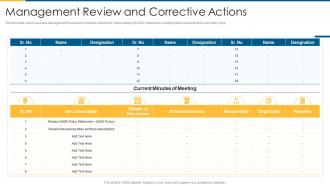
This template covers business Management Review and corrective actions for implementing ISO 9001 standards including initial review remarks and many more.
People who downloaded this PowerPoint presentation also viewed the following :
Iso 9001 management review and corrective actions with all 6 slides:
Use our Iso 9001 Management Review And Corrective Actions to effectively help you save your valuable time. They are readymade to fit into any presentation structure.





FAQs for Iso 9001 management review
Honestly, ISO 9001 is worth it for three big reasons: customers are happier, your operations run way smoother, and you get serious credibility points. Documenting everything helps you catch problems before they blow up - way fewer mistakes and do-overs. The certification itself? Total game changer. Some clients won't even talk to you without it (trust me on this one). But here's the thing - the continuous improvement mindset it creates is what really pays off long-term. My advice? Map out what you're doing now first, then figure out where ISO fits in.
Honestly, ISO 9001 forces you to document everything and stick to your processes - no more winging it. Customers see that certification and know you're legit about quality. The whole system makes you track feedback and actually improve based on what people tell you. You'll spot problems before they hit customers, which is huge for trust. I mean, nobody wants to deal with a company that just makes it up as they go, right? The external audits keep you honest too. Bottom line - it shows customers you take their business seriously enough to have real standards.
Hey! So the biggest thing with ISO 9001:2015 is they're obsessed with risk-based thinking now - you've gotta identify risks in all your processes instead of just checking boxes. They added this "context of organization" piece too, which means considering market stuff and what stakeholders actually want. Good news though - no more management representative requirement (thank god, that was such a pain). Documentation is way less rigid now, so you can set up your QMS however makes sense for you. If you're still stuck on the 2008 version, honestly just start with a gap analysis to see what needs fixing.
Honestly, just start with what you're already doing - most small businesses have decent processes, they just never wrote them down. Map out your main workflows first. Create simple procedures people will actually use instead of some overcomplicated system. Spreadsheets are totally fine at the beginning, don't get sucked into expensive software yet. The biggest thing? Get your team on board from day one. I've watched so many places crash and burn because they treated it like some annoying compliance thing. Yeah, maybe grab a consultant for the weird technical stuff, but you need to own this process. Customer feedback systems are usually the easiest place to start - quick win there.
So ISO 9001 is totally obsessed with continuous improvement - it's literally the whole point. You can't just set up your quality system and forget about it. The standard makes you constantly hunt for ways to improve through reviews, customer feedback, all that data stuff. Honestly, it's kind of exhausting but it works. Map out improvement goals, track your progress, then actually DO something about it. I always tell people to pick that one process that's been driving you crazy lately - you know the one. Start there and figure out how to measure it better.
Honestly, yeah - ISO 9001 is pretty much essential these days. Your competitors probably already have it, which puts you behind from the start. Government contracts won't even look at you without it, and big companies use it as a basic screening tool. The whole certification process is actually helpful too - streamlines how you work and cuts down on waste. I mean, it's not magic, but it does force you to organize better. My advice? Get someone to do a gap analysis first so you know what you're dealing with. Don't go in blind.
So you'll want to start with a gap analysis - basically see where you're at versus what ISO 9001 actually requires. After that comes implementing the quality management system (honestly the most tedious part, but whatever). Internal audits are next to check if your stuff's working. Then you pick a certification body who does their two-stage audit thing. Pass that and boom - certified! Whole thing usually runs 6-12 months depending on how big your company is. Oh, and that gap analysis I mentioned? Do it first - gives you a way better sense of your timeline instead of just guessing.
So internal audits are like your practice run before the real deal - you catch problems before external auditors show up at your door. Basically you're checking if what you actually DO matches what's written down in your QMS docs. Look for gaps and stuff that doesn't line up. Honestly, most companies just go through the motions, but you want real evidence that your system actually works. Schedule them regularly (not just when you remember) and fix whatever you find. That's how you show continuous improvement, which auditors eat up. It's way better than scrambling last minute.
Honestly? Your team's gonna hate you at first - nobody wants new processes dropped on them. Documentation becomes this huge time suck too. You'll be mapping stuff out for weeks, trying to figure out what actually matters vs pointless paperwork. Finding someone to actually run this thing is brutal since they're already swamped with regular work. And don't just assume leadership will stay engaged after they approve the budget - that's where things usually fall apart. My advice: find your process nerds early. Give them real time to work on it, not just "fit it in when you can" BS.
Oh man, you're gonna love this - ISO 9001 and 14001 use the exact same framework structure (Annex SL). So your quality processes can basically piggyback on environmental ones. Documentation, management reviews, risk stuff - it all lines up perfectly. Makes audit season way less of a nightmare, trust me. Your policies and training can pull double duty too. Since you've already got 9001, adding 14001 is honestly a breeze compared to starting fresh. Like, I wish I'd known this earlier - would've saved me so much headache!
Focus on the big three first: customer satisfaction scores, complaint rates, and on-time delivery. Internal audit stuff matters too - how fast you're closing corrective actions (trust me, dragging those out kills morale). Defect rates and rework costs will show if your processes actually work. Don't forget training completion rates either. Honestly, most companies track way too much garbage that nobody looks at. Pick maybe 5-6 metrics that tell the real story of how your QMS is performing, then add more once you've got those running smoothly.
Honestly, your leadership has to actually care about ISO 9001 or it's dead in the water. I've watched so many companies treat it like just another compliance thing to check off. Big mistake. When executives genuinely participate - allocating real resources, talking about quality regularly, showing up for management reviews - that's when employees actually follow the processes. It's kinda obvious when you think about it. Leaders set the vibe for everything else. The standard literally requires top management involvement anyway, so they can't just phone it in. Without real commitment from the top, you're basically setting yourself up to fail.
For ISO 9001 training, check out ASQ or BSI's online courses first - they're solid for covering the fundamentals. In-person workshops work great if your team learns better that way. The ISO website actually has decent free resources (shocking, I know, since most standards docs are terrible). Industry-specific consultants can tailor stuff to your needs too. Start everyone with basic awareness training, then get your key people certified as internal auditors. Oh, and don't sleep on those implementation guides - they're way more readable than you'd expect.
Focus on clauses 4, 6, 8, 9, and 10 first. Start with clause 8 - map out your actual processes since that's what you're already doing anyway. Then work backwards to planning (6) and forwards to measurement (9). Clause 4 helps you understand your business environment, which sounds boring but it's actually pretty useful. And honestly? Clause 10 on improvement is make-or-break territory. I've seen companies completely tank because they ignored this part. Don't try doing everything at once though - you'll just burn yourself out. These five will give you a solid foundation to build on.
Honestly, you've got to get your team to feel like they own this thing instead of having it forced on them. Have them map out the actual workflows - they know way better than management what really happens day-to-day. Give everyone specific jobs documenting stuff and finding what's broken. Training's good, but what really works is showing how fixing processes makes their lives easier and cuts down on all that annoying rework nobody wants to deal with. Oh, and create ways for people to suggest changes and actually use their ideas. Make them partners in building it, not just people following rules someone else wrote.
-
Professional and unique presentations.
-
Best Representation of topics, really appreciable.