

Quality assurance roadmap powerpoint presentation slides





Try Before you Buy Download Free Sample Product
 Impress Your
 Audience
 100%
100% Editable
 Save Hours
 of Time


Formulate quality control policies with our content ready Quality Assurance Roadmap PowerPoint Presentation Slides. Showcase administrative and procedural activities implemented in a quality system. Chart the quality control plan and process using quality management PowerPoint templates. QA Roadmap complete deck contains ready to use slides which will help you implement steps needed to achieve the desired level of perfection. Use these professionally designed quality control timeline PPT slides to ensure product quality. Good quality can increase brand loyalty, a business must aim at continuous improvement of quality in order to keep ahead of their competitors. Implement a good quality system so that the requirement of a product or service will be fulfilled. All templates provided in this presentation are completely editable, users can change color, text and font style as per their convenience. Download this ready to use QMS Roadmap presentation graphics to implement a quality management system. Get folks to deal with irreconcilable differences through our Quality Assurance Roadmap Powerpoint Presentation Slides. Bring an end to any animosity.
People who downloaded this PowerPoint presentation also viewed the following :
Content of this Powerpoint Presentation
Slide 1: This slide introduces Quality Assurance Roadmap. State Your Company Name and begin.
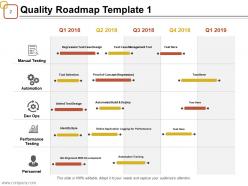
Slide 2: This slide shows Quality Roadmap Template 1 describing- Manual Testing, Automation, Dev Ops, Performance Testing, Personnel.
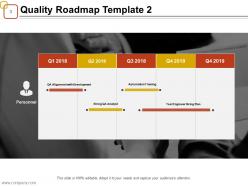
Slide 3: This slide presents Quality Roadmap Template 2 showing personnel.
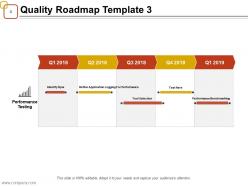
Slide 4: This slide displays Quality Roadmap Template 3 showing performance testing.
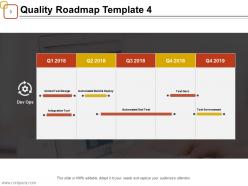
Slide 5: This slide represents Quality Roadmap Template 4 showing Dev Ops.
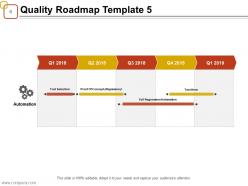
Slide 6: This slide presents Quality Roadmap Template 5 showing Automation. You may add or edit text as per requirement.
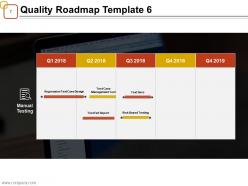
Slide 7: This slide displays Quality Roadmap Template 6 showing manual testing with relative text.
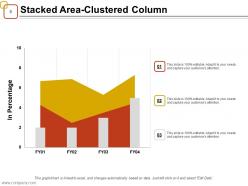
Slide 8: This slide shows Stacked Area-Clustered Column chart with three products comparison.
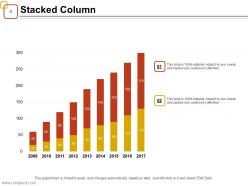
Slide 9: This slide presents Stacked Column chart with two products comparison.
Slide 10: This slide is titled Additional slides for moving forward. You may change the content as per need.
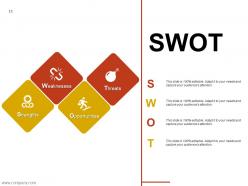
Slide 11: This slide is titled as SWOT. Show your company's Strengths, Weaknesses, Opportunities and Threats here.
Slide 12: This slide is titled as NEWS PAPER with related imagery and text boxes. You can show your company's news or other news related information here.
Slide 13: This is a Puzzle slide with text boxes to show information.
Slide 14: This is a Target slide. State your targets here.
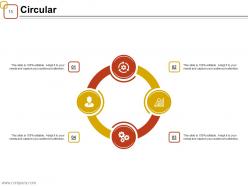
Slide 15: This slide shows Circular diagram with icons and text boxes.
Slide 16: This is a Thank You slide with Address# street number, city, state, Contact Number, Email Address.
Quality assurance roadmap powerpoint presentation slides with all 16 slides:
Indulge yourself with our Quality Assurance Roadmap Powerpoint Presentation Slides. Excite your senses with the variety we offer.





FAQs for Quality assurance roadmap
Honestly, just focus on four main things: assessment, planning, implementation, and monitoring. First, figure out where your QA actually stands right now - what's broken, what's decent, what makes you want to cry (been there). Map out your goals next and pick which fixes will actually move the needle. Rolling out new processes and tools comes third. Oh, and don't skip the monitoring part - you need to know if this stuff is even working. Trust me, do one phase properly before moving on. I know it's tempting to fix everything yesterday, but that's how you end up with an even bigger mess.
Honestly, just start with whatever's on fire right now - like what customers are actually complaining about or what's breaking. Those are your real priorities. After that, think about your next 6 months of business plans. What quality issues could totally mess those up? I learned this the hard way, but don't try fixing everything at once (trust me on that one). Score each problem by how much impact it'll have versus how hard it is to fix. Go for the easy wins first - builds momentum. Oh, and definitely talk to your sales, support, and engineering teams. They all see completely different problems. Just throw it all in a simple roadmap you can actually follow.
Honestly, you can't build a decent QA roadmap without talking to people first. Developers know where the bugs come from, product managers understand business priorities, and support teams hear customer complaints all day. Skip this step and you're basically throwing darts blindfolded. I made that mistake once - built this whole testing strategy that nobody wanted to follow because I didn't ask what they actually needed. Get everyone involved early so they feel ownership over the plan. Yeah, you'll have to balance conflicting priorities, but that's way better than discovering problems after you've already committed to everything. Map out your key people and set up regular conversations throughout the process.
Here's the thing - figure out what your executives actually care about first. Revenue? Customer happiness? Getting stuff shipped faster? Once you know that, work backwards and only test the features that'll move those numbers. Honestly, most QA teams waste time on random testing that doesn't matter to the business. Before planning your next sprint, just ask "will this help us hit our quarterly goals?" If not, skip it. I learned this the hard way at my last job - spent weeks perfecting edge cases while the login flow was broken. Focus on what drives conversions and keeps users around. That's where you'll make the biggest impact.
Honestly, start with Selenium or Cypress for automation - they're both solid. Jira's great for tracking your roadmap, though Azure DevOps works too if that's what your company uses. TestRail handles test case management pretty well. Here's the thing though - methodology matters more than tools sometimes. Agile keeps QA involved from the start instead of dumping everything on you at the end. Risk-based testing is a game changer because you can't test everything equally (learned that the hard way). CI/CD pipelines will automate a ton of your workflow once you get them set up. Don't go crazy buying everything at once - pick one automation tool and one tracker, then expand based on what actually helps your team.
Don't treat your QA roadmap like it's carved in stone - check it every quarter. Look at what's actually breaking in production vs what you planned to test. That gap? That's where you need to pivot. Honestly, some of your original assumptions will just be flat-out wrong (happens to all of us). New features mean different testing approaches. I'd set up regular retrospectives with the dev team to catch emerging patterns. Oh, and definitely set those calendar reminders now or you'll forget. Stay flexible but keep your main quality goals solid.
Honestly, you need to track both the process stuff and the actual results. I'd start with defect detection rates, test coverage, and how long it takes to fix issues - plus customer bugs after release. Team velocity matters too, along with automation coverage (though don't get obsessed with hitting 100% on everything). Customer satisfaction scores are probably the most telling metric since that's what actually counts at the end of the day. Pick maybe 3-4 metrics that match your biggest headaches right now. You can always add more once you've got the hang of it.
Look, here's the thing - don't just tell people what the QA strategy is, get them to help build it with you. Run some workshops where everyone can complain about what's broken and pitch fixes. People buy into stuff they actually helped create, right? Also make sure you're explaining WHY each thing matters for their actual day-to-day work (not just company buzzwords). Quick wins are huge for getting momentum going. Oh and definitely find some champions on different teams who can push back on the inevitable resistance. Give those people real ownership though - can't just be lip service.
Don't try to nail down every detail upfront - your roadmap's gonna change as you figure out what actually works. I've seen way too many that just say vague stuff like "improve test coverage" which tells you nothing. Talk to your devs and PMs while you're building it, not after. Quarterly planning works best, then tweak monthly based on reality. Oh and definitely pad your timelines because something always goes sideways. The generic high-level roadmaps are basically useless, so get specific about what you're actually doing and when.
Your tech stack basically drives everything when you're building a QA roadmap. Start by mapping out what you've got now - tools, automation setup, obvious gaps. That stuff dictates what's realistic timeline-wise. AI testing tools are kind of a game-changer here, might make you prioritize automated regression over manual testing way sooner than you planned. Don't forget your team needs time to actually learn new tools though. I learned that one the hard way! Figure out your current tech situation first, then work backwards from there to build a timeline that won't completely overwhelm everyone.
Start by making a list of everything that could go wrong - like when your test environment crashes or requirements keep changing. I always create a simple risk matrix to figure out which ones actually matter. Focus your energy on the big scary stuff first, honestly. Document it all because you'll forget half this shit in two weeks. Schedule regular check-ins with your team since new risks pop up constantly. The key thing? Don't wait until problems hit to tell your boss. Have backup plans ready and give people a heads up early.
Honestly, having different teams actually talk to each other is a game changer. You'll catch bugs way earlier when dev and support are looping in QA regularly. Product teams know user pain points that testing might miss otherwise. It stops that annoying back-and-forth where bug reports get lost in translation - you know how that goes. Instead of always being in firefighting mode, you're actually ahead of problems. The user journey makes way more sense when everyone's seeing their piece of it. Weekly syncs with the main people from each team work pretty well to start.
Start with role-specific stuff - get your testers trained on new frameworks, devs up to speed on code reviews, managers comfortable with metrics. Cross-functional workshops are clutch since QA impacts everyone (sales always needs reminding they should understand basic testing flows, ugh). Build ongoing programs too. Lunch-and-learns work great. Certification tracks, mentoring pairs between senior and junior people. Don't make it a one-time thing though - that never sticks. Map out what skills each role actually needs first, then create learning paths from there. Way easier than trying to figure it out as you go.
Look, your QA roadmap isn't something you write once and then shove in a drawer. Things move way too fast for that approach. Set up monthly check-ins to review what's actually working and what's falling flat. Build in feedback loops and track real metrics - honestly, this stuff writes itself once you get the rhythm down. Regular retrospectives will show you where the gaps are popping up. The whole point is making your processes better over time instead of letting them get stale. Oh, and base your priority shifts on actual data, not just gut feelings.
Look, customer feedback is like your reality check for QA work. You might think your test coverage is solid, but if users are still bitching about slow pages or weird UI stuff, that's your real priority right there. I learned this the hard way - kept brushing off those "small" interface complaints until our ratings went to shit. Now I track the top 3 customer complaints every month and make sure testing actually tackles those issues first. It's way better than just testing what you think matters, you know?
No Reviews