


Employee Training Plan For Financial Services Sector




Try Before you Buy Download Free Sample Product
 Impress Your
 Audience
 100%
100% Editable
 Save Hours
 of Time


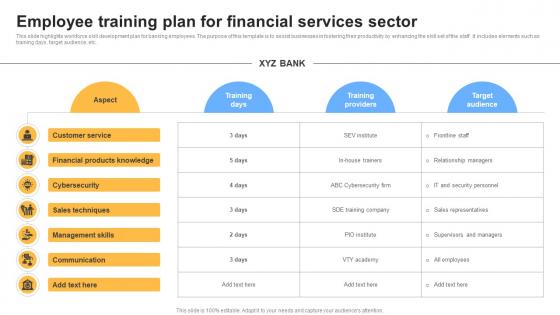
This slide highlights workforce skill development plan for banking employees. The purpose of this template is to assist businesses in fostering their productivity by enhancing the skill set of the staff. It includes elements such as training days, target audience, etc.
People who downloaded this PowerPoint presentation also viewed the following :
Employee Training Plan For Financial Services Sector with all 9 slides:
Use our Employee Training Plan For Financial Services Sector to effectively help you save your valuable time. They are readymade to fit into any presentation structure.








FAQs for Employee Training Plan For
An effective employee training plan includes clear learning objectives, structured curriculum modules, assessment methods, timeline schedules, and resource allocation strategies. These components work together by aligning training with business goals, ensuring skill development meets operational needs, and providing measurable outcomes, with many organizations finding that comprehensive plans significantly enhance employee performance and retention rates.
Organizations can assess employee training needs through performance evaluations, skills gap analyses, employee surveys, manager feedback, and industry benchmarking studies. These assessment methods enable companies to identify specific competency gaps, align training with business objectives, and prioritize development investments, with many organizations finding that systematic needs assessment reduces training costs while significantly improving employee performance and retention rates.
Technology serves as the backbone of modern employee training through learning management systems, virtual reality simulations, AI-powered personalized learning, mobile platforms, and interactive e-learning modules. These digital solutions streamline training delivery, enhance engagement through gamification and real-time feedback, and enable organizations to scale programs efficiently while reducing costs, with many companies finding that technology-driven training ultimately delivers faster skill development and measurable performance improvements.
Businesses measure training effectiveness through performance metrics, skill assessments, employee feedback surveys, productivity analysis, and retention rates. Through data-driven evaluation methods, organizations track knowledge retention, behavioral changes, and return on investment, while many companies find that combining pre and post-training assessments with long-term performance monitoring delivers comprehensive insights into program success.
Engagement strategies include interactive workshops, gamification elements, microlearning modules, peer collaboration activities, and real-world case studies relevant to employees' roles. These approaches enhance retention by incorporating hands-on practice, immediate feedback, and social learning components, with many organizations finding that varied delivery methods and personalized content ultimately deliver higher completion rates and improved skill application.
Training plans can be customized by incorporating visual elements like infographics and videos, auditory components such as podcasts and discussions, and kinesthetic activities including simulations and hands-on workshops. Through adaptive learning platforms and blended approaches, organizations streamline skill development while accommodating diverse preferences, ultimately enhancing retention rates and employee engagement across departments.
Incorporating feedback enhances training effectiveness by identifying knowledge gaps, measuring skill development, and ensuring content relevance to real-world applications. This iterative approach enables organizations to refine programs continuously, boost employee engagement, and maximize training ROI, with many companies finding that feedback-driven training delivers faster skill acquisition and improved performance outcomes.
Employee training programs should be updated annually at minimum, with critical skills and compliance training revised quarterly or as regulations change. Organizations increasingly find that rapid technological advancement, evolving industry standards, and shifting market demands require more frequent revisions, with many companies implementing continuous learning frameworks that enable real-time updates, ultimately delivering enhanced employee performance and sustained competitive advantage.
Effective onboarding practices include structured orientation programs, role-specific skill development, mentorship assignments, clear performance expectations, and ongoing feedback mechanisms. These approaches streamline integration by reducing time-to-productivity, enhancing employee confidence, and building stronger team connections, with many organizations finding that comprehensive onboarding programs significantly improve retention rates and accelerate career development.
Organizations ensure training aligns with business goals by conducting strategic needs assessments, mapping skill gaps to performance objectives, establishing clear metrics, and linking learning outcomes to company priorities. Through regular stakeholder collaboration and data-driven evaluation, companies in sectors like healthcare, finance, and manufacturing streamline workforce development, ultimately delivering enhanced productivity, reduced turnover, and measurable competitive advantage.
Common pitfalls include lack of needs assessment, one-size-fits-all approaches, insufficient leadership support, poor timing coordination, and absence of measurable outcomes. These challenges can undermine training effectiveness by creating irrelevant content, low engagement, and wasted resources, with many organizations finding that strategic planning, stakeholder buy-in, and continuous evaluation ultimately deliver higher ROI and employee performance improvements.
Leaders promote continuous learning by modeling curiosity themselves, providing regular learning opportunities, celebrating knowledge-sharing, and integrating skill development into performance goals and team meetings. Through mentorship programs, cross-training initiatives, and learning stipends, organizations like tech companies and consulting firms create environments where professional growth becomes part of daily workflow, ultimately enhancing team adaptability and competitive advantage.
External training resources offer specialized expertise, diverse perspectives, industry best practices, and cost-effective scalability, while in-house programs provide customized content, cultural alignment, and immediate application to specific workflows. Many organizations find that a strategic combination delivers optimal results, with external resources enhancing technical skills and industry knowledge, while in-house programs strengthen company-specific processes and team cohesion.
Mentorship programs enhance formal training by providing personalized guidance, real-world application of concepts, and ongoing support that structured courses cannot deliver alone. Through one-on-one relationships, employees gain industry-specific insights, accelerated skill development, and cultural integration, while organizations benefit from improved retention, knowledge transfer, and leadership pipeline development, ultimately creating more comprehensive workforce development.
Employee training progress metrics include performance assessments, productivity measurements, skill competency evaluations, behavioral observations, and knowledge retention tests. These tracking methods enable organizations to measure training ROI through improved output quality, reduced error rates, and enhanced customer satisfaction scores, with many companies finding that systematic progress monitoring ultimately delivers better employee engagement and measurable business outcomes.
-
Awesome presentation, really professional and easy to edit.
-
Professional and unique presentations.