


Evaluation Matrix For Staff Training And Development Plan




Try Before you Buy Download Free Sample Product
 Impress Your
 Audience
 100%
100% Editable
 Save Hours
 of Time


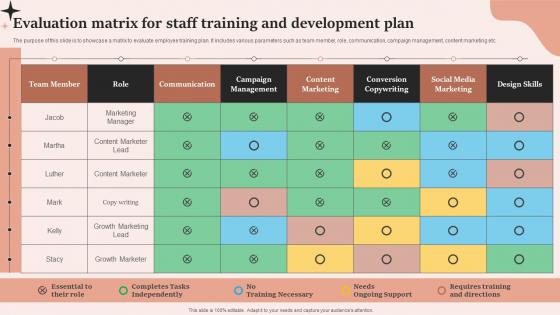
The purpose of this slide is to showcase a matrix to evaluate employee training plan. It includes various parameters such as team member, role, communication, campaign management, content marketing etc.
People who downloaded this PowerPoint presentation also viewed the following :
Evaluation Matrix For Staff Training And Development Plan with all 9 slides:
Use our Evaluation Matrix For Staff Training And Development Plan to effectively help you save your valuable time. They are readymade to fit into any presentation structure.








FAQs for Evaluation Matrix For Staff Training
Key components include evaluation criteria, weighting systems, scoring scales, stakeholder perspectives, and performance indicators aligned with project objectives. These elements work together by establishing clear benchmarks, quantifying subjective assessments, and enabling systematic comparison of alternatives, with many organizations finding that well-structured matrices streamline decision-making processes and enhance project outcomes.
Evaluation criteria are determined by identifying key decision factors relevant to your specific objectives, stakeholder requirements, budget constraints, timeline considerations, and strategic priorities. Organizations typically establish these through stakeholder consultations, industry benchmarking, and regulatory requirements, with sectors like healthcare focusing on patient outcomes while financial services prioritize compliance, ultimately ensuring comprehensive assessment alignment.
Evaluation matrices are most effectively utilized when comparing multiple options against established criteria, such as vendor selection, project prioritization, investment decisions, and strategic planning initiatives. Organizations particularly benefit from this structured approach in complex scenarios like technology implementations, hiring decisions, and resource allocation, where multiple stakeholders need transparent, objective comparisons that minimize bias while ensuring comprehensive analysis.
Quantitative criteria in evaluation matrices use measurable, numerical data like cost, time, ROI, and performance metrics, while qualitative criteria assess subjective factors such as user experience, brand reputation, strategic alignment, and cultural fit. Through strategic combination of both approaches, organizations enhance decision-making accuracy by capturing hard data alongside nuanced insights, ultimately delivering comprehensive evaluations that balance analytical rigor with practical business considerations.
Stakeholders can be involved through collaborative workshops, surveys, and feedback sessions to identify key criteria, weightings, and performance indicators that matter most to their perspectives. This inclusive approach ensures the evaluation matrix reflects diverse viewpoints from customers, employees, partners, and investors, ultimately delivering more comprehensive assessments and stronger buy-in across organizational levels.
Weighting enhances evaluation matrix effectiveness by prioritizing criteria based on their relative importance to decision objectives, ensuring critical factors influence outcomes proportionally. This strategic approach enables organizations to make more accurate assessments across projects, vendors, or investments, with many finding that properly weighted matrices deliver significantly better resource allocation and competitive advantage.
When conflicts arise during matrix evaluation, facilitate structured discussions by revisiting scoring criteria, encouraging evidence-based justifications for each team member's ratings, and identifying root causes of disagreements. Through transparent dialogue sessions, teams often find that conflicts stem from different interpretations of criteria rather than fundamental disagreements, ultimately leading to refined evaluation processes and stronger consensus-building capabilities.
**INPUT**: What tools or software can facilitate the creation of an evaluation matrix? **OUTPUT**: Tools for creating evaluation matrices include Microsoft Excel, Google Sheets, Smartsheet, Airtable, and specialized decision-making platforms like DecisionLens or Expert Choice. These platforms streamline matrix development by automating calculations, enabling real-time collaboration, and providing customizable templates, with many organizations finding that cloud-based solutions enhance team coordination while delivering faster, more accurate evaluation processes.
Evaluation matrices adapt across industries by incorporating sector-specific criteria, compliance requirements, performance indicators, and stakeholder priorities relevant to each field's unique challenges. Healthcare matrices emphasize patient outcomes and regulatory compliance, education focuses on learning effectiveness and accessibility, while technology prioritizes innovation metrics and scalability, with organizations finding that customized frameworks deliver more accurate assessments and strategic insights.
Common pitfalls include using vague criteria, assigning equal weights to all factors, lacking stakeholder input, creating overly complex matrices, and failing to align with strategic objectives. Organizations often overlook bias in scoring, insufficient data validation, and unclear measurement definitions, ultimately compromising decision quality and stakeholder buy-in across evaluation processes.
Ensuring evaluation matrix objectivity requires establishing clear, measurable criteria, involving diverse stakeholders in development, and using standardized scoring methods across all evaluations. Organizations achieve this by implementing blind review processes, regularly calibrating reviewer assessments, and incorporating multiple perspectives from different departments, with many finding that structured frameworks and documented rationale significantly reduce subjective bias while enhancing decision-making credibility.
Best practices for evaluation matrix clarity include using consistent scoring scales, clear criteria definitions, logical grouping of related factors, and strategic color coding for quick visual interpretation. These enhancements streamline decision-making processes by eliminating ambiguity, reducing cognitive load during presentations, and enabling stakeholders to quickly identify top-performing options, ultimately delivering faster consensus-building and more confident strategic choices.
Visual elements like color coding, icons, heat maps, progress bars, and charts can be integrated into evaluation matrices to enhance data interpretation and decision-making speed. These visual cues help stakeholders quickly identify patterns, performance gaps, and priority areas, with many organizations finding that well-designed visual matrices reduce analysis time while improving strategic alignment across teams.
Successful evaluation matrices include risk assessment frameworks in construction projects, vendor selection matrices in IT procurement, employee performance scorecards in HR management, and investment evaluation grids in financial services. These tools streamline decision-making by standardizing criteria, weighting factors, and scoring systems, with many organizations finding that structured matrices reduce bias, accelerate approvals, and ultimately deliver more consistent, defensible outcomes across complex projects.
Evaluation matrices should be reviewed at major project milestones, typically every 3-6 months or when significant scope changes occur, with criteria weights and metrics adjusted based on evolving priorities. Through regular updates, project managers can maintain alignment with stakeholder expectations, adapt to market changes, and ensure accurate performance measurement, ultimately delivering more successful outcomes and strategic value.
-
Great templates that you can use in your next keynote or conference. They are perfect for quick and visually-engaging delivery.
-
The designs are very attractive and easy to edit. Looking forward to downloading more of your PowerPoint Presentations.