

Employee Training Program Effectiveness Evaluation Form





Try Before you Buy Download Free Sample Product
 Impress Your
 Audience
 100%
100% Editable
 Save Hours
 of Time


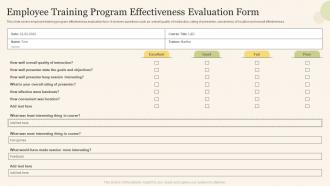
This slide covers employee training program effectiveness evaluation form. It involves questions such as overall quality of instruction, rating of presenter, conveniency of location and overall effectiveness.
People who downloaded this PowerPoint presentation also viewed the following :
Employee Training Program Effectiveness Evaluation Form with all 6 slides:
Use our Employee Training Program Effectiveness Evaluation Form to effectively help you save your valuable time. They are readymade to fit into any presentation structure.





FAQs for Employee Training Program
Look, you need to track four things if you want to know whether your training actually worked. Pre/post assessments show if people learned anything - basic but necessary. Then check if behaviors changed on the job after 30-90 days. Most companies totally blow this part off, which is dumb because that's where you see real impact. Business metrics matter too - productivity, fewer errors, sales bumps, whatever applies. Finally, crunch the ROI numbers by comparing what you spent versus what you gained. It's not rocket science, but you'd be surprised how many places just... don't bother measuring anything beyond "did they show up?"
Honestly, I'd start simple - just grab feedback right after training sessions and maybe again in a month or two. Anonymous surveys work best since people actually tell the truth that way. Managers can also chime in about what they're seeing on the job. Focus groups are solid too, though they take more time to set up. The trick is actually doing something with the feedback you get - people notice when you ignore their input. I'd probably skip trying to do everything at once and just pick one method that feels manageable. You can always add more later.
Look, you need to know where people actually start before training them. Otherwise you're just guessing if they improved or if they already knew everything. I learned this the hard way - thought my workshop was amazing until I realized half the people were experts already. Quick assessments upfront let you spot real skill gaps and set realistic goals. Then when you compare before/after results, you'll actually know if your training worked. It's annoying extra work but honestly? Way better than assuming everyone starts at zero and patting yourself on the back later.
Honestly, most companies mess this up by jumping straight into designing training without figuring out what they actually need first. Talk to your department heads - find out which skill gaps are genuinely hurting the business, not just what sounds nice to train on. Then build your program around those specific problems. Here's the thing that drives me crazy: people measure completion rates instead of real impact. If you're trying to keep customers happy, track satisfaction scores after training, not how many people finished the modules. It all comes down to whether it's moving the needle financially.
Don't just test people right after training - that's pretty useless tbh. Space it out over months instead. I'd do follow-up quizzes at 30, 60, and 90 days to see what actually sticks. Track the real stuff too: can they apply it on the job? Get managers to observe changes, ask peers for feedback, look at performance metrics. Job shadowing works great for this. Oh and seriously - set those calendar reminders RIGHT NOW or you'll completely forget to follow up. I've seen so many companies skip this step and then wonder why their training didn't work.
Look, when people are actually paying attention during training, they learn way more - which shows up big time in your evaluation results. But if they're zoning out or scrolling their phones (honestly happens in like 90% of webinars), they retain nothing. Your test scores will be trash, and they won't change how they work afterward. Track participation while it's happening - ask questions, make it interactive. Otherwise you can't tell if your training sucks or people just weren't engaged. It's kinda obvious but most places don't bother measuring this stuff during the actual session.
Honestly, most people mess this up by overthinking it. Hit them with a quick survey right after training while it's fresh, then do a knowledge check within the week. Track if they're actually using what they learned at 30, 60, and 90 days - manager check-ins work great for this. Keep surveys short though, nobody fills out those monster forms. Here's what really matters: ask what's stopping them from using their new skills. Those barriers they mention? That's where you'll find the real insights, way better than just asking "did you like the training" for the hundredth time.
Honestly, qualitative data is where you'll find the real gold. Survey numbers are fine, but when people actually tell you stories about using new skills or what barriers they hit? That's pure insight right there. You get context that ratings can't give you - like gaps in your content or applications you never thought of. Open-ended questions are a must. I know it's tempting to skip reading all those responses, but don't. The quotes alone make your reports way more compelling to leadership. Trust me on this one.
Honestly, just pick one good LMS like Moodle or TalentLMS and stick with it - they'll automatically track completion rates, quiz scores, all that stuff. Google Forms is actually perfect for feedback surveys (way better than people give it credit for). If you're doing live sessions, most video platforms have polling built right in, which is super handy. Analytics dashboards can pull from multiple sources if you want the full picture. But here's the thing - don't go crazy with five different tools. Pick one main platform and actually use its reporting features consistently. That's where most people mess up.
So here's what works: check in right after training (catches the obvious stuff), then again at 3-6 months to see if anyone retained anything, and finally 6-12 months out for actual behavior changes. I know the immediate feedback feels pointless, but trust me on this one. The real magic happens in those later check-ins - that's where you find out if people are actually doing things differently or if you just wasted a bunch of money. Oh, and set those calendar reminders NOW because you'll 100% forget otherwise. We all do.
Oh man, virtual training evaluation is such a pain. People can have their cameras off scrolling TikTok and you'd never know. Plus they can Google answers during assessments which makes measuring actual learning pretty useless. Technical problems mess everything up too - like, did someone bomb because they didn't get it or because their internet died halfway through? I've found you really need to add more interactive check-ins throughout and maybe follow up with quick one-on-ones afterward. Otherwise you're just guessing if anyone actually learned anything. Way more work than the old in-person days honestly.
So basically you compare what you spent on training vs what you got back. Add up all your costs - materials, instructor fees, employee time away from work, whatever. Then figure out the dollar value of improvements like better productivity or fewer mistakes. Some companies track turnover reduction too since replacing people is expensive. Calculate it like: (benefits minus costs) divided by costs, times 100. That gives you the ROI percentage. Honestly, the hardest part is measuring soft skills stuff - like, how do you put a number on better communication? I'd stick with metrics you can actually track reliably and check results over months, not just right after training ends.
Focus on these four things: knowledge retention (did they actually learn?), skill application (can they do the job), behavior change (applying it at work), and measurable business results. Engagement matters too - nobody learns when they're bored out of their minds. The behavior change part gets ignored a lot but it's honestly the most important piece. Test them right after training AND again at 30-90 days to see if it stuck. Oh, and create consistent rating scales so different trainers aren't all over the place with their scoring.
Honestly, peer evaluations are where you'll see the real impact. Traditional tests can't tell you if someone's actually collaborating better or sharing knowledge with teammates. Managers miss this stuff since they're not working side-by-side daily. Your coworkers notice when you start applying new skills or changing how you handle things - that's the gold. Just make sure the evaluation forms ask for specific examples, not vague "Sarah improved" feedback. Set it up maybe 30-60 days after training so people have time to actually show changes. A simple 360 approach works great for capturing what's really happening in the trenches.
Dude, managers are like the reality check for training programs. They're watching whether people actually use what they learned or just collected another certificate. Without them, you're flying blind on whether training worked. I mean, they see the daily grind - if someone took that communication workshop, managers know if they're really talking to clients better now. The tricky part? You've got to actually follow up with managers after sessions. Get their real take on who's changing and who isn't. Trust me, they'll give you the unfiltered truth about performance gaps way better than any survey.
-
“One of the best experiences with SlideTeam for my presentation.Everything on time, communication is efficient and price is reasonable. All good in one place.”
-
“I've always gotten excellent slides from them and the customer service is up to the mark.”