

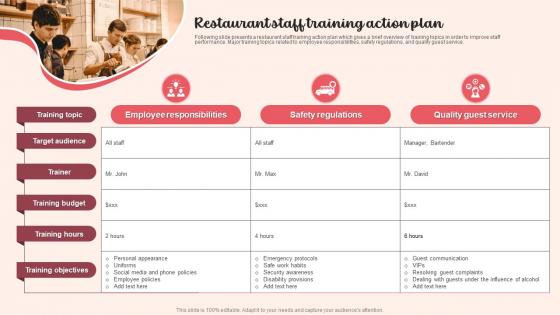
Restaurant Staff Training Action Plan




Try Before you Buy Download Free Sample Product
 Impress Your
 Audience
 100%
100% Editable
 Save Hours
 of Time


Following slide presents a restaurant staff training action plan which gives a brief overview of training topics in order to improve staff performance. Major training topics related to employee responsibilities, safety regulations, and quality guest service.
People who downloaded this PowerPoint presentation also viewed the following :
Restaurant Staff Training Action Plan with all 6 slides:
Use our Restaurant Staff Training Action Plan to effectively help you save your valuable time. They are readymade to fit into any presentation structure.





FAQs for Restaurant Staff
Focus on four things: food safety, customer service, menu knowledge, and how to work the POS system. Don't just lecture them to death though - make it hands-on. Role-play the nightmare customers (you know the ones). Have them shadow someone experienced first before you throw them to the wolves. Menu training is huge - I've seen servers completely bomb wine recommendations because nobody taught them properly. Keep doing refresher sessions too since people forget. Oh, and definitely have them practice taking actual orders instead of just talking about it.
You should totally set up different training for each team since they deal with completely different stuff. Front-of-house needs the customer service scenarios, wine basics, complaint handling - you know the drill. Kitchen staff should focus more on food safety and prep efficiency. But here's the thing - cross-training is honestly a game changer. Servers who get kitchen timing don't overpromise on food times. Even your cooks benefit from basic people skills since they're always dealing with delivery drivers anyway. I'd shadow both sides first to see what's actually breaking down day-to-day, then build training around those specific problems.
Look, onboarding is honestly make-or-break for your whole training thing. Get people properly oriented on day one - your culture, what you expect, basic systems - and they'll actually absorb the technical stuff later. Rush through it though? You're basically guaranteeing everyone gets frustrated. People stick around longer when they feel connected and confident right off the bat. I'd start with a solid first-week plan that covers what they're doing AND why it matters. Trust me, that "why" part makes a huge difference. Short sentences work. But also give them the bigger picture of how everything connects in your operation.
Honestly, going digital with training is a game changer. Your staff can knock out modules on their phones during slow periods instead of sitting through those awkward group sessions where everyone zones out. E-learning keeps everything consistent too - no more having different managers give conflicting info during onboarding. When you roll out new menu items or change protocols, just update the content instantly. No reprinting anything or hunting down who missed the memo. The data tracking is clutch since you'll actually know who's trained on what instead of digging through random paperwork. I'd start simple with one platform and build from there.
Honestly, the worst part is watching new people quit halfway through training - it's brutal. Your team will also forget half the stuff you teach them, especially when it gets crazy busy and they're juggling ten things at once. Oh, and if you've got people who speak different languages, that adds another layer of fun. Here's what actually works though: don't dump everything on them day one. Break it into small chunks they can handle. Skip the boring presentations and let them practice with real plates and real orders. Make some quick reference sheets they can peek at when they're lost. But seriously, pair them with your best people right away. That buddy system thing isn't just corporate BS - it genuinely saves you so much stress.
Dude, cross-training is a game changer. Your servers learn expo, cooks pick up some front stuff - suddenly you're not screwed when someone calls out. And trust me, someone always calls out at the worst possible time. Plus your team stays way more interested in their job instead of getting bored doing the exact same thing forever. I'd start simple though - maybe servers learn food running first, or teach hosts basic serving stuff. Honestly wish more places did this because it saves so much stress down the line.
Honestly, track the stuff that actually moves the needle. Customer satisfaction and complaint rates are obvious ones, but don't sleep on table turnover times and average check size - those tell you a lot. Staff retention is probably the biggest one though, because training new people constantly is expensive as hell. Order accuracy and food waste matter too. Oh, and how fast new hires get up to speed. Pick maybe 3-4 metrics that make sense for your place and check them monthly. Just make sure you measure everything before you start the training so you can actually see if it's working.
Role-playing is honestly the best way to do this. Get your staff to practice different scenarios - complaints, menu questions, busy rushes, whatever problems you deal with most. They can switch between being the customer and server. Trust me, everyone feels awkward at first but then it gets fun. Focus on your restaurant's actual issues, like maybe Friday night chaos or getting people to order appetizers. The whole point is letting them screw up during practice so they won't freeze when real customers are there. It's way better than just telling them what to do.
Honestly, training's a game-changer for keeping people around - nobody wants to feel stuck in the same spot forever. Your customer service gets way better, plus staff won't freak out when something weird happens. Cross-training is clutch too because you won't be totally screwed when someone calls out (and they will). New menu rollouts become actually manageable instead of pure chaos. I'd do like 30-minute sessions monthly - sounds small but people really notice when you invest in them. Oh, and fewer mistakes obviously saves you money in the long run.
Dude, proper training is huge for keeping people around. Your staff won't be constantly freaking out about screwing up orders when they actually know what they're doing. Nobody sticks around somewhere they feel like they're drowning, you know? It also shows people there's room to grow - like, maybe they start busing tables but could eventually run shifts or whatever. Here's the thing though: don't just do some half-hearted first-day walkthrough. Keep training them as you go. Trust me, you'll save way more on turnover than you spend on actually teaching people properly.
So the trick is making training feel like they're actually growing, not just checking boxes. Get your star employees to mentor the newbies - it's a win-win since both sides buy in more. Celebrate the little stuff publicly too, like when someone nails a tricky skill or gets awesome customer reviews. Keep sessions short and hands-on because honestly, those long lecture-style things are brutal and nobody remembers them anyway. Oh, and make sure you're doing the same training across all shifts so nobody feels left out. Ask your team what's working though - they'll tell you straight up what sucks and what doesn't.
Honestly, just ask your people what's working and what sucks. Do surveys, grab coffee with them, whatever feels natural. New hires especially will tell you straight up what confused them their first week - they remember that panic! Your staff usually has way better ideas than management anyway (learned that the hard way). Mix up how you collect feedback though. Some people won't speak up in meetings but they'll be brutally honest in anonymous surveys. Then actually use what they tell you to fix your training. Sounds obvious but you'd be surprised how many places ask for feedback then ignore it completely.
Honestly, just watch your team during a busy shift first - you'll spot the gaps pretty quick. Ask them straight up what they're struggling with too. Customer complaints are gold for this stuff. Your managers probably see issues you don't, so definitely pick their brains. Also check if there's new menu items or regulations coming down the pipeline that need coverage. High turnover in certain positions? That's usually a dead giveaway something's missing in training. Once you've got all that figured out, tackle the biggest problems first - no point training on garnish techniques if people can't work the POS system, you know?
Dude, make that training mandatory and keep it going - can't be a one-time deal. Get everyone solid on food handling and safety during onboarding. Honestly, places that cheap out on this always pay for it later. Do refresher sessions every quarter, especially when regulations shift. Skip the boring video-only approach. Make them actually practice the stuff hands-on. Document who showed up and their scores - you'll need that paper trail. Oh, and assign someone to track local health code changes so they can update the team right away. Trust me on this one.
Honestly, start with de-escalation - teach them to really listen and stay calm before jumping into problem-solving mode. Role-playing is your best friend here, way better than just lecturing about it. They need clear scripts for the usual complaints, but don't make it too rigid or it sounds robotic. Set boundaries about what crosses the line and when to call you over. Oh, and this is huge - debrief after the really tough customers. I can't stress this enough because that's when they actually learn something useful, plus they won't feel like they're dealing with jerks alone.
-
Innovative and creative templates with high-quality designs. Helped me with my presentation as the slides were easy to edit.
-
Appreciate the research and its presentable format.