


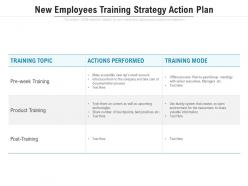
New employees training strategy action plan





Try Before you Buy Download Free Sample Product
 Impress Your
 Audience
 100%
100% Editable
 Save Hours
 of Time


Decide on the detailing with our New Employees Training Strategy Action Plan. They assure you customized assistance.
People who downloaded this PowerPoint presentation also viewed the following :
New employees training strategy action plan with all 2 slides:
Get the display you desire with our New Employees Training Strategy Action Plan. They can be easily customized.
FAQs for New employees training
Key elements include welcome messaging, company culture overview, role-specific responsibilities, team introductions, system access guides, training schedules, and performance expectations. These components streamline the integration process by reducing first-day anxiety, accelerating productivity timelines, and establishing clear communication channels, with many organizations finding that structured onboarding templates improve employee retention rates and deliver faster time-to-contribution across departments.
Visual storytelling enhances onboarding by simplifying complex information, increasing engagement, and improving knowledge retention through infographics, videos, and interactive presentations. Companies across industries, from tech startups to healthcare organizations, find that visual narratives streamline policy explanations and cultural integration, ultimately reducing training time while delivering more memorable and impactful employee experiences.
Common onboarding presentation mistakes include information overload, generic content lacking role-specific relevance, poor visual design, and lengthy sessions without breaks. Organizations should avoid one-size-fits-all approaches, ensuring presentations are interactive, digestible, and tailored to specific departments, with many companies finding that personalized, engaging formats significantly improve new hire retention and accelerate productivity.
Onboarding templates can be customized by tailoring content sections, role-specific workflows, departmental resources, compliance requirements, and success metrics to each function's unique needs. Sales teams might emphasize CRM training and client interaction protocols, while IT departments focus on security clearances and technical system access, with many organizations finding that department-specific customization significantly improves employee engagement and reduces time-to-productivity.
Key onboarding metrics include time-to-productivity, employee retention rates, engagement scores, training completion rates, and manager satisfaction assessments. These measurements enable organizations to streamline their integration processes, identify bottlenecks early, and enhance new hire experiences, with many companies finding that comprehensive tracking ultimately delivers faster ramp-up times and significantly improved long-term retention.
Multimedia elements can be incorporated through interactive videos, animated process flows, clickable infographics, audio narrations, and embedded simulations that demonstrate actual workflows. These dynamic components enhance engagement by providing visual learning pathways, hands-on practice scenarios, and multi-sensory experiences, with many organizations finding that multimedia-rich onboarding reduces training time while improving knowledge retention.
Company culture serves as the foundation for onboarding presentation design, influencing content structure, communication style, value emphasis, and interactive elements that reflect organizational personality. Through cultural alignment, companies create presentations that resonate authentically with new hires while reinforcing core values, behavioral expectations, and team dynamics, ultimately delivering stronger employee engagement and faster cultural integration across diverse organizational environments.
Compliance-focused onboarding information includes tax documentation, employment eligibility verification, background check disclosures, company policies on harassment and safety, confidentiality agreements, and industry-specific regulatory requirements. These components streamline legal obligations while protecting organizational interests, with companies in healthcare, finance, and manufacturing finding that comprehensive documentation reduces compliance risks, accelerates regulatory audits, and ultimately delivers stronger workforce protection.
Onboarding presentations address remote and hybrid work challenges by incorporating interactive virtual elements, clear communication protocols, digital collaboration tool training, and structured check-in schedules. These approaches streamline remote integration by establishing consistent touchpoints, enhancing digital literacy, and fostering team connections, with many organizations finding that comprehensive virtual onboarding ultimately delivers stronger employee engagement.
Best practices for presenting complex information in onboarding include breaking content into digestible modules, using visual aids and interactive elements, providing step-by-step guidance, offering multiple learning formats, and creating clear progress indicators. These approaches streamline knowledge transfer by reducing cognitive overload, enhancing retention, and enabling new hires to absorb critical information more effectively, ultimately delivering faster productivity and improved employee confidence.
Employee feedback directly influences onboarding refinement by identifying content gaps, highlighting confusing procedures, and revealing timing issues within training materials. Through regular surveys, focus groups, and exit interviews, organizations streamline documentation, enhance digital resources, and adjust pacing, with many companies finding that feedback-driven improvements reduce time-to-productivity and increase new hire retention rates significantly.
Technologies for interactive onboarding presentations include virtual reality simulations, augmented reality overlays, gamification platforms, interactive video modules, and AI-powered chatbots. These technologies enhance engagement by creating immersive experiences, personalizing learning paths, and enabling real-time feedback, with many organizations finding that interactive onboarding reduces training time while significantly improving new hire retention rates.
Onboarding templates facilitate smoother international transitions by standardizing visa documentation processes, cultural integration modules, compliance requirements, and local workplace protocols. These structured frameworks enable HR teams to address timezone coordination, banking setup, and regulatory obligations systematically, while international hires receive consistent support and clear expectations, ultimately reducing adjustment time and enhancing early productivity across global operations.
Effective onboarding engagement strategies include interactive training modules, mentorship programs, regular check-ins with managers, goal-setting sessions, and social integration activities. These approaches streamline the transition process by building connections, providing clear expectations, and creating supportive learning environments, with many organizations finding that structured engagement ultimately delivers higher retention rates and faster productivity gains.
Data visualization improves onboarding clarity by transforming complex processes into intuitive charts, interactive timelines, progress indicators, and step-by-step flowcharts that reduce cognitive load. These visual elements enable new employees to quickly grasp organizational structures, workflow dependencies, and role expectations, while many companies find that visual onboarding reduces time-to-productivity and enhances retention rates.
No Reviews