

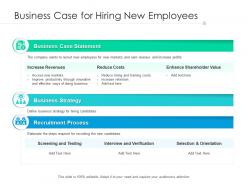
Business case for hiring new employees





Try Before you Buy Download Free Sample Product
 Impress Your
 Audience
 100%
100% Editable
 Save Hours
 of Time


Our Business Case For Hiring New Employees are topically designed to provide an attractive backdrop to any subject. Use them to look like a presentation pro.
People who downloaded this PowerPoint presentation also viewed the following :
Business case for hiring new employees with all 2 slides:
Use our Business Case For Hiring New Employees to effectively help you save your valuable time. They are readymade to fit into any presentation structure.

FAQs for Business case for
Honestly, diversity pays off in three big ways. First, you get way better decisions because different perspectives kill that groupthink BS. Fresh ideas are the second thing - I swear, the coolest solutions always come from someone who thinks totally differently than the rest of us. Oh, and companies with diverse teams just make more money. That's been proven over and over. If you want stronger teams, maybe check where your hiring might be too narrow? You could be missing some amazing people without realizing it.
Look, good hiring = people who actually stick around. Here's the thing - when you're super upfront about what the job really involves (including the crappy parts), candidates won't bail after two weeks going "wait, this sucks." I'd honestly start with your job descriptions. Make them brutally real about both the cool stuff AND the headaches. Then during interviews, really dig into whether someone meshes with your vibe, not just their resume. Yeah, it takes more time upfront, but you'll stop cycling through people every few months. Trust me, rushing to fill seats backfires every time.
Dude, good hires literally pay for themselves. They're way more productive, customers actually like dealing with them, and they don't screw up projects left and right. The turnover thing alone will save you a fortune - nobody wants to keep training new people every six months. Quality employees stick around longer and actually come up with solutions instead of just complaining about everything. I learned this the hard way at my last job. Sure, it costs more upfront to find the right person, but trust me - hiring cheap always bites you in the ass later.
Oh man, cultural fit is everything when you're hiring. I've watched incredible candidates bomb because they just didn't vibe with the team's communication style. Meanwhile, someone with okay skills will absolutely crush it if they click with everyone. But watch out - don't let "culture fit" turn into hiring people who are carbon copies of your existing team. That's a trap. Focus on work styles instead. How do they handle feedback? What's their approach to conflict? Those questions actually matter. You want someone who shares your professional values, not necessarily your weekend hobbies.
Ask behavioral questions - stuff like "tell me about a time you dealt with a difficult coworker" or when they had to adapt fast. I always want specific examples, not those vague answers everyone gives. Watch how they actually communicate during the interview too. Are they listening? Asking good questions? Their body language says a lot about emotional intelligence, honestly. Oh and try some role-playing scenarios that match what your team actually deals with - you'll see how they'd really handle things. Way better than just talking hypotheticals.
Honestly, data-driven hiring is a game changer. No more hiring someone because they seemed "nice" in the interview, you know? The numbers actually show you what makes people successful in specific roles. Your whole process gets faster too - I was shocked how much quicker decisions became once I stopped overthinking every little thing. Bias drops way down since you're looking at real metrics instead of just vibes. Oh, and start simple with tracking time-to-hire and where your best candidates come from. You can always get fancier later, but those basics will already make a huge difference.
Honestly, good onboarding is a game changer - it's the difference between setting people up to win vs just dumping them into chaos. I've watched so many talented people bail within their first month because nobody bothered explaining basic stuff. Your new hires figure out their role faster, they're not constantly stressed about what they should be doing, and they actually build connections with their team. The numbers are pretty wild too: companies that do this right see 70% better productivity and way less turnover. My old manager used to say the first two weeks make or break everything, and she wasn't wrong. Invest in structured training upfront and you'll see the payoff for months.
So internal hiring is clutch when you need someone who already knows your company inside and out. Perfect for leadership spots or roles where you really need that institutional knowledge, you know? Plus it's honestly so much faster than going through the whole external recruiting mess. Your team will love seeing actual advancement opportunities too - major morale boost. Downside though? You might get stuck in the same thinking patterns and miss out on fresh ideas. I'd say go internal for management roles and company-specific stuff, but definitely look outside when you need someone to shake things up or bring specialized skills.
Dude, the hiring game is changing fast right now. Skills matter way more than degrees - finally! Remote work isn't going anywhere, so embrace that. AI screening tools are everywhere now, which honestly saves time but feels kinda weird still. Top candidates won't sit through your 5-round interview marathon anymore. Speed it up or lose them. Work-life balance is non-negotiable for most people these days. Oh, and salary transparency laws keep spreading, so you might have to post ranges soon anyway. Start by looking at your current process. Where's it dragging? What can you make more flexible?
Think of it like this - when you've got a solid reputation as an employer, people actually come to YOU. Top talent starts following your company on LinkedIn and applying before you even have openings. It's honestly way better than constantly posting jobs and hoping someone decent responds. Good candidates know which companies treat people right, offer real growth, not just empty promises. You end up spending less on recruiting too since people already want in. Oh and definitely put actual employee stories on your website - not the generic corporate stuff, but real stories from your team.
Honestly, blind resume reviews are a game changer - just remove names and personal info before anyone sees them. Use the same interview questions for everyone too, no exceptions. I'd also get diverse people involved in making the final call instead of leaving it to one person. Oh, and post jobs publicly! I know referrals feel easier, but they basically just clone your current team. You should track who you're hiring though - the patterns might surprise you. Having documented steps that everyone follows makes a huge difference in keeping things fair.
So basically, instead of just throwing job posts out there and crossing your fingers, you're actually making your company look like somewhere people *want* to work. Build up your employer brand on social media, get your current employees to share what it's really like there - that stuff works way better than generic job descriptions. Think of it like marketing but for talent instead of customers. Your careers page needs to not suck either (seriously, some companies' are terrible). When candidates Google you, what comes up? Start there. Good recruitment marketing gets you better candidates faster, which honestly saves everyone time.
Honestly, most people obsess over time-to-fill and cost-per-hire, but quality of hire matters way more (even though it's annoying to measure). Your offer acceptance rate tells you a lot too. I'd definitely track how many new hires stick around after 90 days and a year - that's huge. Oh, and candidate experience scores if you can swing it. Diversity metrics are pretty much mandatory now. But here's the thing - don't go crazy tracking everything. Pick maybe 3-4 that actually move the needle for your situation. Start with time-to-fill and retention rates. Those two alone will show you what's really happening.
Dude, flexible work is huge for getting good people to apply. Most candidates won't even look at jobs without remote or hybrid options anymore - it's wild how fast that shifted. People care way more about work-life balance now than they used to. Plus you can hire from anywhere if it's remote, so you're not just stuck with whoever lives nearby. I've seen companies lose great candidates just because they required everyone in the office five days a week. Honestly feels pretty outdated at this point. Make sure you're advertising the flexibility upfront or you'll miss out.
Honestly, rushing hiring is such a trap. You'll miss obvious red flags and end up with people who just don't fit your team vibe. Then boom - they're gone in six months and you're back to square one. Bad salary calls happen too when you're panicked, like way overpaying someone or losing a great candidate because you lowballed them. I learned this the hard way at my last job, ugh. Do at least two interview rounds and actually call their references. Trust me, it's worth the extra week or two upfront.
-
Awesome use of colors and designs in product templates.
-
Content of slide is easy to understand and edit.
-
Nice and innovative design.
-
Perfect template with attractive color combination.
-
Content of slide is easy to understand and edit.
-
Informative presentations that are easily editable.