


Business case for hiring additional staff




Try Before you Buy Download Free Sample Product
 Impress Your
 Audience
 100%
100% Editable
 Save Hours
 of Time


Our Business Case For Hiring Additional Staff are topically designed to provide an attractive backdrop to any subject. Use them to look like a presentation pro.
People who downloaded this PowerPoint presentation also viewed the following :
Content of this Powerpoint Presentation
The workforce or staff is one of the strongest pillars of an organization as it is the main interactive element that connects with the product or service you are offering. To cater to the requirements of any project or plan, you need some personnel by your side.
However, determining the actual number of employees required to complete any project is subjective and fairly tough. You can take the help of project planning to determine staff requirements but even that can fail as a plan is drafted using theory (past experiences, intuitive feelings, and case studies).
When you execute the plan, you may feel the need to add or hire some additional staff for smooth operation and timely completion of the project. However, the management may not always side with your demand for additional staff. You need to make a strong case to prove your side. And, we can help you do the same.
Using SlideTeam’s 100% customizable template of a business case for hiring additional staff, you can enlighten the management about the need for additional staff using strong and valid reasons. So, check out the template below and justify your requirements with ease.
Looking for a way to represent your staff requirements? Take the help of this template that shows some extensive steps to justify the hiring of some additional staff with ease.
Template 1: Business Case for Hiring Additional Staff
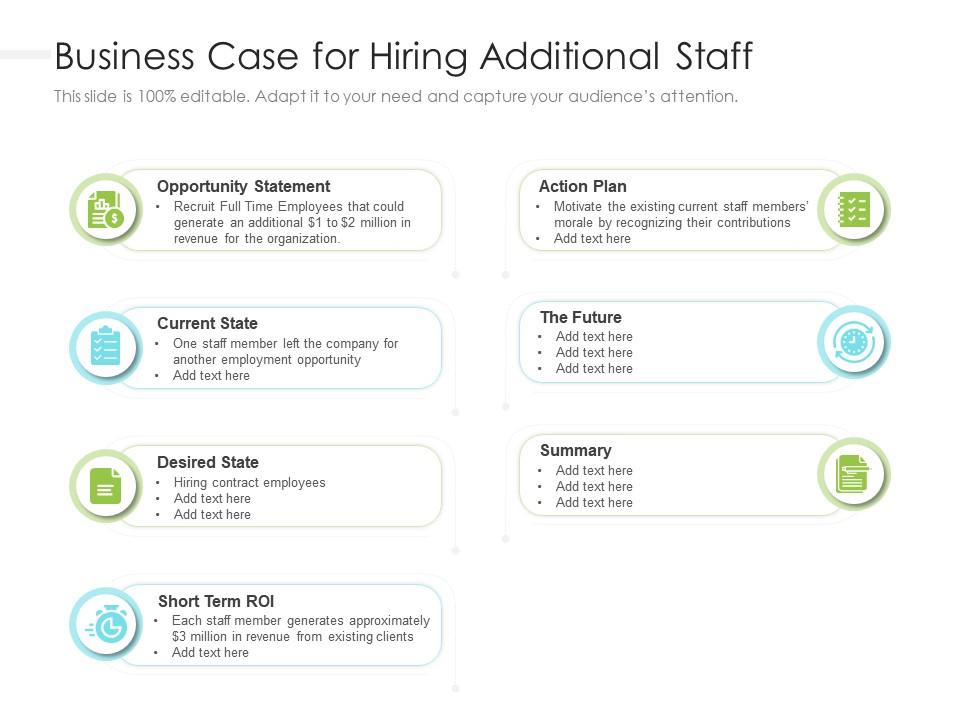
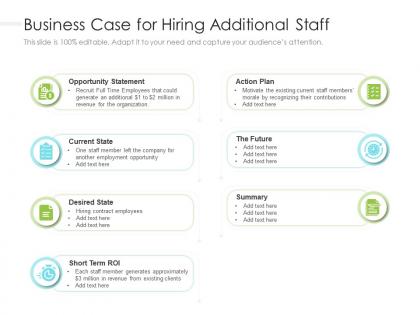
The template allows you to showcase the Opportunity Statement, an Action Plan, the Current State, the Future State, the Desired State, a Summary, and the Short Term Return on Investments. Within the Opportunity Statement Box, you can state that employing an additional staff will bring in revenue of $1 million to $2 million. This will help you grasp the attention of your audience. Similarly, you can also showcase some details in the Action Plan box stating what will be your plan of action with the additional staff to offer a clear picture.
Here’s the perfect template for the business case for hiring new staff that will help you gain the required human capital with ease.
Justify Your Side and Hire Additional Staff with Precision
It's not as easy to awe the management and make them agree to offer you some additional staff. The main reason behind this is the possibility of a sudden increase in expenditure and usage of spare resources. However, if you can justify that your requirements are genuine and beneficial for the organization as a whole, then you won’t have a hard time convincing the management. The above template will help you do the same by laying out some details for a better understanding of your audience.
Still looking for an alternative? Try this PPT template on Hiring Additional Staff to provide extensive and detailed information to the management about your additional staff requirements, its benefits, and more.
Business case for hiring additional staff with all 2 slides:
Use our Business Case For Hiring Additional Staff to effectively help you save your valuable time. They are readymade to fit into any presentation structure.
FAQs for Business case for
Okay so first thing - document concrete examples where you're already missing deadlines or stretched too thin. That vague "we're swamped" stuff doesn't work with executives. Map out your growth timeline and show exactly when current headcount won't cut it anymore. Here's what managers always forget: include the cost of NOT hiring. Burnout, quality drops, missed opportunities - that's real money. I learned this the hard way at my last job. Focus on business impact, not just "more hands would be nice."
Honestly, hard numbers beat gut feelings every time when you're asking for more staff. Pull historical data showing workload spikes, productivity gaps, whatever proves you're swamped. Executives eat up those forecasting charts - seriously, they love that stuff. Compare your team size to industry standards too. If you can tie headcount directly to business results, you're golden. Track things like completion times, error rates, customer scores. Oh and benchmark against competitors if you can find that data. Makes the whole argument way more convincing than just saying "we're busy."
Honestly, turnover is your best weapon here. You can literally put dollar signs on how much it's costing them - recruiting fees, training new people, lost productivity when someone quits. Your team's probably burning out which just makes more people leave. It's like a nightmare cycle. I've watched whole departments fall apart because they kept running on fumes instead of hiring properly. Calculate everything - temp coverage, the time you spend training replacements, all of it. Then show them how adding staff actually saves money long-term. Sometimes the numbers are the only thing that gets through to management.
Here's the thing - you've gotta connect those staffing requests directly to business wins. Map each role to what actually matters to leadership. Like, don't just say "we need more developers." Show them how those devs will build features that boost revenue or stop customers from bailing. I've watched so many requests die because they were too fluffy. Numbers work better: "Two new analysts cut reporting time by 30%, so managers can actually focus on Q3 expansion." Honestly, executives love clear ROI. Frame headcount as investing in results, not just handling more work.
Honestly, the worst thing companies do is get caught up in tasks instead of results. Like they'll say "we need someone to answer phones" when they should be thinking "we need coverage to hit our 90% customer satisfaction target." Plus everyone lowballs the real cost - salary's just the start, then there's benefits, training, all that overhead stuff. I've seen it blow budgets so many times. Oh and the vague job descriptions kill me. "Support business growth" means absolutely nothing. You gotta get specific about what you actually need and tie it to real numbers. Be upfront about costs from day one or you'll regret it later.
Look, use your sales data - that's your strongest weapon here. Pull up those holiday rushes, back-to-school madness, whatever your busy seasons are. Show them the actual numbers instead of just complaining you're swamped. Market changes matter too - new competition opening up, economic stuff affecting how much people shop. I always think the revenue angle works best though. Like, "we're missing sales because customers are waiting too long" hits different than "we're tired." Tie everything back to either making more money or keeping service decent. Managers love seeing concrete proof of when you actually need bodies on the floor.
Dude, weak staffing justifications can seriously screw you over legally. Employees will claim discrimination or wrongful termination if your reasoning doesn't hold up. Short, inconsistent explanations? That's basically asking for a lawsuit. Regulatory agencies love sniffing around companies that seem shady with their staffing moves too. Document everything properly - and I mean everything. Your justifications need solid business reasons behind them, not just "we're broke so someone's gotta go." Trust me, "cost cutting" alone won't save you in court if things go sideways.
Honestly, workforce analytics tools are a lifesaver for this stuff. They'll automatically pull your headcount data and calculate those workload ratios executives always want to see. Real-time dashboards are where it gets interesting - no more frantically updating spreadsheets when leadership changes their mind (which happens way too often). Some platforms actually write the justification documents for you, which feels like cheating but whatever works. I'd start by figuring out what part of your process takes forever, then find tools that fix those specific problems. The whole thing beats doing it manually.
Focus on workload-to-capacity ratios first - that's your strongest play. Pull together utilization rates, overtime hours, and show how many requests are sitting in limbo. If customer satisfaction scores are tanking, even better (sounds harsh but it's true). Revenue per employee is solid too, especially when you're under industry benchmarks. Don't forget turnover costs - leadership absolutely hates seeing those replacement numbers. Make everything concrete: "We're at 140% capacity and blowing 30% of our deadlines." Then map out 2-3 scenarios showing how new hires would fix these issues in 3-6 months. Numbers don't lie.
Look at what the job actually needs first. Does someone have to be there for meetings, using specific equipment, or meeting clients face-to-face? Then yeah, make it onsite. Most jobs these days? They could honestly go either way if we're being real about it. Remote work cuts overhead costs and works fine for independent stuff or anything digital. But here's the thing - whatever you pick, tie it back to actual results. How does the location choice affect productivity and getting shit done? Don't just go with "we need people in the office" without backing it up.
Honestly, your team's feedback is gold for getting more hires approved. When they tell you about being swamped, missing deadlines, or working crazy overtime - document all of that with specific examples and dates. That stuff carries way more weight than just going "hey we're busy." Your staff sees skill gaps you might miss from up top too. I learned this the hard way at my last job. Connect their complaints directly to how it's hurting the business. Way better than generic "we need bodies" requests.
Benchmarks are honestly your secret weapon here. Pull data on competitor ratios and industry standards for team sizes - it beats going in with just "trust me, we need more people." HR will actually listen because you've got real numbers backing you up. Nobody wants their company looking understaffed compared to the competition, so this angle usually works. Just double-check you're comparing similar companies though - same size, industry, that whole thing. Otherwise leadership will poke holes in your argument. Check industry reports first, or hit up your network if you know people at similar companies. Way more convincing than guessing.
Honestly, data is everything here. Show them the numbers - current workload vs what your team can actually handle. Then connect those gaps directly to problems they're already stressed about. I've watched so many requests get shot down because they sounded whiny instead of strategic. Don't just say "we're swamped." Show charts if possible - visuals hit different than walls of text. Frame it around solving their headaches, not yours. Oh, and definitely come with backup plans or ways to phase it in. Nobody wants to hear just one expensive option. Give them something they can actually say yes to.
Startups are way more chill about hiring - you just point to obvious problems like "we're drowning in support tickets" or need someone to hit revenue goals. Done. Big companies? Total nightmare honestly. You'll need formal business cases, ROI spreadsheets, approvals from like five different departments. Everyone wants proof the hire makes financial sense and fits some long-term strategy. The whole process takes forever. So yeah, startups care about urgency and quick wins, while corporate wants data and following their endless procedures. Just match your pitch to whatever environment you're dealing with.
Honestly, temp staff always gets the axe first because leadership sees it as low-hanging fruit. You'll spend forever re-justifying those roles every quarter - super draining. Permanent hires are different but scarier for them since it's a real commitment. Build bulletproof business cases with solid workload data and ROI numbers. Here's the thing though - temps often do critical work but somehow get labeled as "expendable." Kinda backwards if you ask me. Document everything your temp workers accomplish. Tie their output to actual revenue or metrics you can wave around later when budget discussions get heated.
-
Easily Understandable slides.
-
Professional and unique presentations.
-
Designs have enough space to add content.
-
I discovered this website through a google search, the services matched my needs perfectly and the pricing was very reasonable. I was thrilled with the product and the customer service. I will definitely use their slides again for my presentations and recommend them to other colleagues.
-
Commendable slides with attractive designs. Extremely pleased with the fact that they are easy to modify. Great work!
-
Good research work and creative work done on every template.
-
Use of different colors is good. It's simple and attractive.
-
Illustrative design with editable content. Exceptional value for money. Highly pleased with the product.