


Business case for hiring new staff




Try Before you Buy Download Free Sample Product
 Impress Your
 Audience
 100%
100% Editable
 Save Hours
 of Time


Our Business Case For Hiring New Staff are topically designed to provide an attractive backdrop to any subject. Use them to look like a presentation pro.
People who downloaded this PowerPoint presentation also viewed the following :
Content of this Powerpoint Presentation
In times of artificial intelligence, business and corporate hiring is likely to be under pressure for some time. Hence, companies and HR managers will need to have a business case for hiring new staff to ensure that only people with the relevant skillset makes it through their hallowed doors.
A business case for hiring new staff must take the shape of plan and a deliverable from the hiring to really be of some use to the enterprise.
At SlideTeam, we are aware that this is not within the comfort for most businesses, and have curated an expert-level slide to make their job easier. Listed on the slide are factors that go into the business plan for hiring, the position and the variables that must be kept in mind.
Get the best techniques on outlining a business case here.
The end goal is to ensure hiring is relevant, timely and serves broader business goals of achieving value from the new entry into the team.
Master business case study summaries with a click here.
Each template is 100% editable and customizable. Let’s explore!
Template 1 Making a Strong Business Case for New Hiring
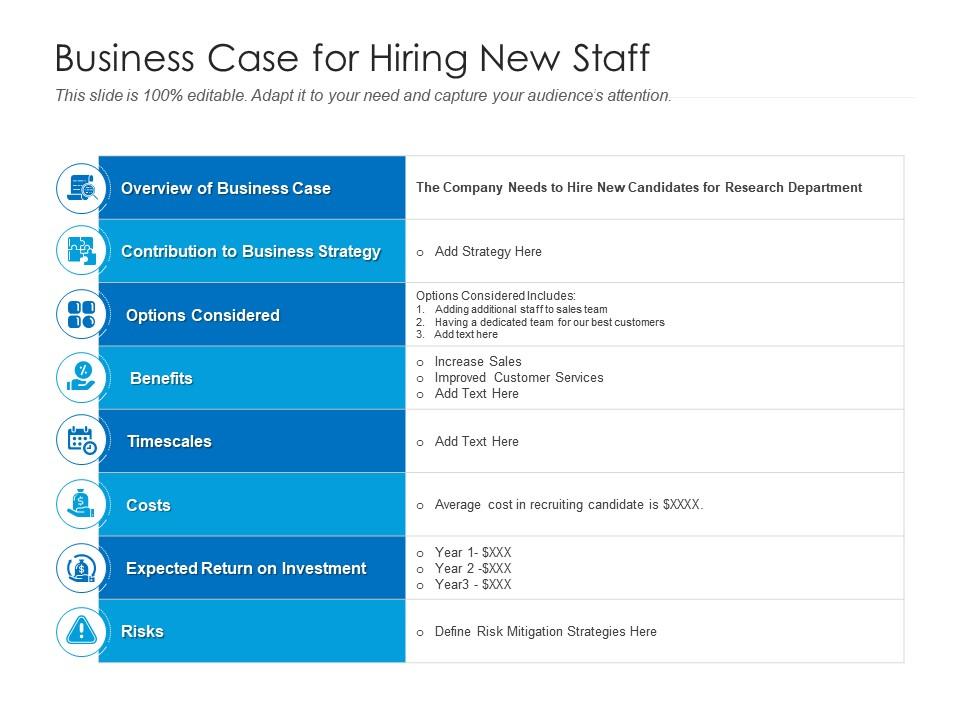
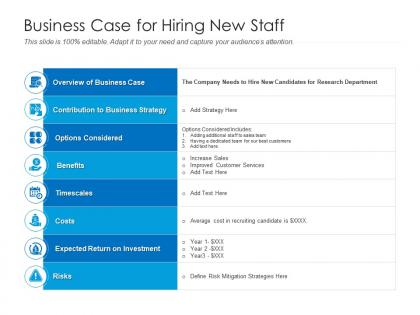
This PPT Template is for companies that need to hire new candidates, and it takes as an example the research department. The slide will benefit the company in making the correct decision, as it lists the parameters and inputs that should go into the business case for hiring new staff.
The prominent among the nearly a dozen factors to be considered are the new hiring’s contribution to business strategy, after an overview of the business case. Another input that must be part of the thought process when hiring staff is the options considered or the benefits. This PowerPoint Template lists these as adding additional staff to another team, instead of a researcher. In the benefits column, you can list the better products and quality of interaction with the customer. The timescale of hiring will vary according to the organizational structure and HR Process followed. The costs, the expected return on investment and risks, if any, associated with the hiring complete the template. Get it now.
HIRING BUSINESS CASE CRITICAL
No one can deny that without a business case for hiring, companies can end up having too many people on rolls. With the dynamic and changeable business environment usually demanding a change in skillset and hiring processes very frequently, it becomes important to have a business case for hiring. Our templates are the best in this regard. Download, use and reap manifold benefits from this product template and at least a thousand more like these here.
PS Find a world-class Project management business case template here.
Business case for hiring new staff with all 2 slides:
Use our Business Case For Hiring New Staff to effectively help you save your valuable time. They are readymade to fit into any presentation structure.
FAQs for Business case for
Honestly, I'd start with your deadline and work backwards from there. Figure out what you actually need to deliver, then think about who has the right skills for each piece. Sarah might be amazing at this stuff, but if she's drowning in other work, you're screwed. Budget's gonna limit your options too, obviously. Map out the complexity - can junior people handle some of it or do you need the heavy hitters? Sometimes I forget to check people's actual availability first and then scramble later. Timeline's everything though. Once you know your must-have dates, the rest kinda falls into place.
Mix up your approach - interviews alone won't cut it. Do behavioral questions ("tell me about a time when...") but also throw in skills tests, especially for tech stuff. I'm honestly shocked how many people skip reference checks, but former managers will spill details you'd never hear otherwise. Short sentences work. Longer ones help you dig deeper into their actual problem-solving process. Make a scoring system upfront so you're not just going with gut feelings later. The magic happens when you combine everything instead of banking on one method.
Honestly, culture fit is everything when you're hiring. I've watched so many "dream candidates" totally flop because they just didn't vibe with the team - even though their resumes looked amazing. During interviews, throw in some behavioral questions about how they deal with conflict or feedback. That stuff tells you way more than their technical skills do. Oh, and make sure your job posts actually reflect what it's like to work there. Don't oversell it. Hire people who match your values AND have the chops. Trust me, it'll save you from constantly replacing people who bail after three months.
Dude, start with the boring stuff first - automate resume screening and interview scheduling. AI tools can filter through applications way faster than you ever could. The time savings are actually insane, like some places cut hiring time in half. Get an applicant tracking system too, it'll keep you organized and show you which job boards are worth your money (spoiler: probably not all of them). Digital onboarding handles the paperwork headache. Once you've got those basics running, you can add more fancy features. Trust me, your future self will thank you.
Honestly, start with your job posts - ditch any biased language and throw them on different boards, not just LinkedIn. Build interview panels with different people because groupthink is real. Yeah, you'll need to train managers on unconscious bias (ugh, I know), but focus on actual skills tests instead of that vague "culture fit" nonsense. That's usually code for "reminds me of myself." Track where diverse candidates drop off in your process too. But here's the thing - none of this matters if you don't create an inclusive workplace afterward. Otherwise you're just spinning your wheels.
Honestly, staffing agencies are a lifesaver. They'll do all the grunt work - screening candidates, background checks, the whole nine yards. No more drowning in resumes (seriously, who has time for that?). They've already got people lined up and can fill spots super quick. Way faster than posting jobs yourself and waiting around. They know what people actually make in your field too, so salary negotiations aren't weird. Oh, and the paperwork stuff gets handled for you. Most offer temp-to-perm deals if you're not sure about someone yet. Find one that knows your industry though - makes a huge difference.
Honestly, referrals are pretty solid for hiring - your current people basically do the initial screening for you. Quality tends to be better too since candidates get the real scoop on company culture beforehand. They usually stay longer as a result. But here's the thing that bugs me about referral programs - you can accidentally create this echo chamber where everyone refers people exactly like themselves. Diversity takes a hit. I'd say track how well your referrals actually work out and maybe throw some extra incentives at people when they refer from underrepresented groups. Keeps things more balanced.
Look, staffing isn't about playing it safe - it's about matching what you actually need. Temps work great for projects, busy seasons, or when you need someone with specific skills fast. No long-term headaches. But for your core stuff? Go permanent. You don't want to keep training the same role over and over (trust me on this one). Most companies do best with a mix - solid permanent team as your foundation, then bring in temps when things get crazy. Start by figuring out which roles are must-haves versus the ones that come and go with your business cycles.
Time-to-fill and cost-per-hire are your bread and butter metrics. Quality of hire matters way more though - I'd track 90-day performance scores and retention rates. Offer acceptance rates tell you if your process sucks or if you're lowballing people. Honestly, most companies don't realize how much turnover actually costs them until they do the math. Manager satisfaction surveys are clutch since they deal with your hires daily. Pick maybe 3 metrics that match whatever's driving you crazy right now. You can always add more once you've got a system down.
Honestly, people bail when they feel stuck or undervalued - rarely because of the actual work. Start talking growth in month one, don't wait for those useless annual reviews. Competitive pay that matches market rates is obvious but mentorship programs? That's where you really hook them. I've seen companies totally nail this by mapping out career paths early and celebrating wins publicly. Regular feedback keeps people engaged too. The whole point is showing new hires they've got a real future there, not just some dead-end position. Training investment pays off big time.
Honestly, remote work changes everything about hiring. Your talent pool isn't just local anymore - you can literally hire from anywhere, which is huge. Tech companies figured this out years ago, but obviously some jobs like healthcare still need people physically there. The tricky part? Figuring out what actually needs to be done in person versus what you're keeping in-office just because "that's how we've always done it." Time zones matter too, depending on the role. I'd start by looking at each position and asking yourself: does this really require someone sitting in our office, or are we just being stubborn about it?
Oh man, you're basically trying to drink from a fire hose while blindfolded. Quality goes out the window when you're rushing, and bad hires are SO expensive later. Plus candidates get a terrible experience when you're juggling hundreds of people. Here's what actually works: create scorecards for screening so you're not winging it every time. Batch your phone calls together - way more efficient. Let your ATS handle the boring scheduling stuff. One thing though - don't skip reference checks even when you're slammed. I've seen that bite people hard.
Dude, seriously - good onboarding makes such a huge difference. Like, companies see 50% better retention when they actually put effort into those first few weeks. New people need clear expectations and proper training, obviously, but honestly? The buddy system works wonders too. Nobody wants to feel completely lost on day one. Poor onboarding is basically lighting money on fire because people will just leave within 90 days. Oh, and make them feel like they belong before they start second-guessing the job. Those first weeks are everything - don't cheap out on them.
Look, market trends are basically running the show when it comes to staffing decisions. Remote work isn't going anywhere, AI's automating tons of jobs, and good luck finding decent Python developers these days - everyone's after them. Your hiring strategy has to completely adapt to all this chaos. Plus there's demographic shifts happening, whole industries getting disrupted left and right. Employees want flexibility now, better benefits, the works. Honestly, building flexibility into your staffing approach is the only way you'll survive the next curveball. Whatever's coming next, you gotta be ready to pivot fast.
Honestly, continuous development programs are a game-changer for retention. People actually stay when you invest in their growth - saves you from constantly recruiting, which is honestly such a pain. You're building this internal talent pipeline where folks are ready to jump into bigger roles. Way better than starting from zero every time someone leaves. The trick though? Make sure the training actually matches what people want career-wise AND what your business needs. Otherwise you're just burning money on stuff that doesn't really help anyone. My old company did this wrong for years - total waste.
-
Understandable and informative presentation.
-
Helpful product design for delivering presentation.
-
Great designs, Easily Editable.
-
Really like the color and design of the presentation.