


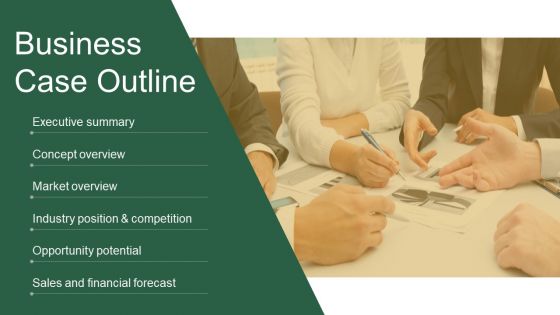
Business case outline presentation powerpoint example





Try Before you Buy Download Free Sample Product
 Impress Your
 Audience
 100%
100% Editable
 Save Hours
 of Time


Impress folks with your business acumen through our Business Case Outline Presentation Powerpoint Example. It helps appeal for crowd funding.
People who downloaded this PowerPoint presentation also viewed the following :
Business case outline presentation powerpoint example with all 5 slides:
Our Business Case Outline Presentation Powerpoint Example convey your convictions. They stress the reality of your views.


FAQs for Business case outline
So for your business case, you'll need the usual suspects: exec summary, problem statement, your solution, and financial breakdown with ROI. Timeline and risk stuff too, obviously. Here's the thing though - stakeholder impact is where most of these either crash and burn or get approved, so don't skimp on that part. Success metrics are crucial so everyone's on the same page about what good looks like later. Each section needs enough detail for people to actually decide something, but not so much they fall asleep reading it. Honestly, if your problem statement sucks, nothing else matters anyway.
So basically, you gotta match each group to the parts of your outline that solve their specific headaches. Finance people? They want ROI numbers and costs right away - don't bury that stuff. Operations folks are worried about how messy implementation will be and what resources they'll need. Leadership cares about strategy and staying competitive, though honestly half the time they just don't want things to explode. Structure it so each group can jump straight to their section without scrolling through irrelevant info. Use headings that actually speak their language instead of boring corporate jargon.
Look, the financial piece is what actually gets your business case approved - executives live and die by those numbers. You've gotta show costs, projected revenue, ROI, payback period, all that stuff. Without it? Your brilliant idea is just fluff on paper. Include one-time costs AND ongoing expenses, then map out realistic revenue for 3-5 years. Oh, and definitely run different scenarios - best case, worst case, most likely outcome. I learned this the hard way once. Seriously though, don't rush this part because it's literally what determines if you get funding or not.
Look, market analysis is basically your proof you're not just throwing darts at a board. You need solid data on market size, what customers actually want, how competitors are doing - that kind of stuff. Without it, your revenue projections sound like wishful thinking. Plus it helps you catch problems before they bite you in the ass. I'd say grab 2-3 good sources minimum. The whole thing shows you actually did your homework instead of just winging it. Makes a huge difference when you're trying to convince people you know what you're talking about.
Just be honest about what could go wrong without making it sound like the apocalypse. Group risks by type - financial stuff, operations, market changes. Get specific though! Don't just throw around vague terms like "economic downturn" (seriously, that drives me crazy). What exactly happens if the economy tanks? How likely is it really? For your big risks, show how you'd handle them. Percentages help if you're not pulling them out of thin air. Honestly, stakeholders respect transparency way more than someone trying to sugarcoat everything.
Okay so first thing - pull up your company's latest strategic plan before you even start writing. Trust me on this one, it'll save you tons of revisions later. Map every section of your business case to specific company goals. Like if they're all about digital transformation right now, show exactly how your project pushes that forward. Your problem statement needs to call out strategic gaps, not just random issues. Solutions should tie directly to their objectives, and honestly your success metrics better match their KPIs or leadership won't care. The whole point is making them instantly see how your project fits their bigger picture. It's way more convincing than just hoping they connect the dots themselves.
Mix financial stuff with operational metrics - ROI, cost savings, revenue bumps, plus things like efficiency gains and customer satisfaction scores. Leading indicators are clutch since they show movement faster than the usual lagging ones. Pick maybe 3-5 that actually connect to what your business cares about. More than that and everyone zones out during presentations (learned this the hard way). Just make sure you can track them with what you've got, or you'll need to buy new tools. Oh, and throw in some time-to-market improvements if they apply - executives love that stuff.
Look, the exec summary is make-or-break time. Most senior people won't read past those first few paragraphs, so you've got one shot to hook them. I learned this the hard way watching great proposals die because someone buried the ask in corporate speak. Lead with your bottom line right away - what do you want, why should they care, what's the payoff? Honestly, I'd spend twice as much time on this section as any other. These folks are swimming in paperwork all day. Don't make them hunt for your point.
Lead with your recommendation immediately - executives hate digging for answers. Here's how I structure it: state what you're recommending, explain why it beats other options, list the key benefits, then cover risks and how you'll handle them. Honestly, a simple comparison table showing your choice vs. the runner-up saves everyone time and makes the decision obvious. This whole section answers "what should we do?" as clearly as possible. Don't get all analytical here like the rest of your business case - keep it punchy and focused on the actual decision they need to make.
Dude, visuals are everything for business cases. Executives will literally zone out if you just throw numbers at them, but show a clean ROI chart? Suddenly they're paying attention. I learned this the hard way after bombing a presentation once - way too much text, zero graphics. Your charts should tell the story even if someone misses half your speech. Simple is better than fancy here. Pick consistent colors, maybe throw in a timeline so your plan doesn't sound completely unrealistic. Honestly, a good infographic beats paragraphs of explanation every single time.
Honestly, the worst mistake is diving into tiny details right off the bat - people zone out before you even get to your point. Put the money stuff and timeline up front, not buried on page 3. Your problem statement needs to be super clear too, no fancy department jargon that makes everyone else confused. I've seen people list like 10 different benefits trying to oversell it... just pick the 3-4 that actually move the needle. Oh, and always include what happens if you do nothing - managers love seeing that comparison. Start with your exec summary first, then build everything around that main message. Makes the whole process way easier.
Get stakeholder input right from the beginning - seriously, don't wait until you've already built your whole case. Interview people early to figure out what's bugging them and what they actually care about. Finance teams especially hate surprises, so loop them in ASAP. Their feedback will help you nail the problem statement better and spot risks you probably missed. Oh, and document who you talked to and how it changed your approach. Makes you look thorough when presenting, plus people feel heard. I've watched so many good ideas die because someone skipped this step.
Look, execs basically want to know when they'll stop bleeding money and start seeing results. Your timeline shows them exactly that. It also proves you didn't just wing this whole thing together over lunch - you actually mapped out the steps. Honestly, without those milestone dates, your business case looks half-baked. Stakeholders need concrete deadlines to evaluate if it's worth the investment. Plus it helps manage everyone's expectations so they're not bugging you every week asking "are we there yet?" Just make sure you factor in delays because something always goes sideways.
Make a simple comparison chart with the same criteria for each option - cost, timeline, risk, how well it fits your strategy. Operational impact is huge too since that's where things usually blow up later. Weight everything based on what your stakeholders actually care about, then score each alternative. Always include a "do nothing" option as your baseline - people forget that one. Be upfront about your assumptions and trade-offs. Document why you picked your recommendation so leadership can actually follow your thinking instead of just nodding along.
So governance is basically the committee that decides if your project gets funding or not. You'll present to some steering board who'll pick apart your financials and risk stuff. Honestly, they can be pretty brutal with questions. Your ROI numbers better be bulletproof because they'll definitely challenge your assumptions. Think of it like the final exam you actually studied for - except with more spreadsheets and less mercy. They want to see how your project fits the company's bigger goals too. Oh, and resource requirements. Don't wing the prep on this one.
-
Great experience, I would definitely use your services further.
-
Wonderful templates design to use in business meetings.