

Steps To Justify Hiring Additional Staff




Try Before you Buy Download Free Sample Product
 Impress Your
 Audience
 100%
100% Editable
 Save Hours
 of Time


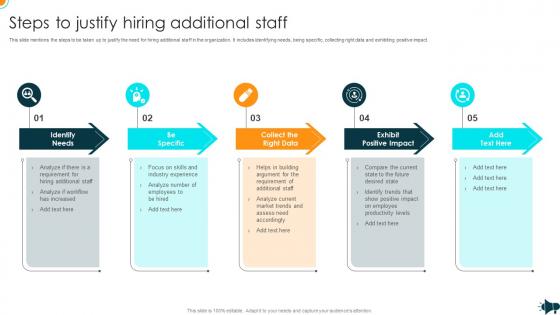
This slide mentions the steps to be taken up to justify the need for hiring additional staff in the organization. It includes identifying needs, being specific, collecting right data and exhibiting positive impact.
People who downloaded this PowerPoint presentation also viewed the following :
Steps To Justify Hiring Additional Staff with all 6 slides:
Use our Steps To Justify Hiring Additional Staff to effectively help you save your valuable time. They are readymade to fit into any presentation structure.





FAQs for Steps To Justify
Look, justification is what makes people actually believe you instead of just pretending to listen. You can't just throw out claims and expect anyone to care - they need proof. Back up your points with real data or solid reasoning, kinda like showing your work in math but way more important. Without it, even brilliant ideas sound like random opinions. I learned this the hard way in college presentations, honestly. Your audience is always thinking "okay but why should I believe this?" So give them that answer upfront. Build your whole argument around evidence they can't ignore.
So basically, when you actually explain WHY you're saying something, people don't just sit there thinking "yeah right." They can follow your thinking. It's kinda like showing your work in math - except not terrible. People trust you more because they see how you got there. The cool thing? Good justification actually answers their doubts before they even have them. Don't save all your evidence for the end though - sprinkle it throughout as you make each point. Way more convincing that way.
Don't attack the person making the argument - go after their actual point instead. Also watch out for straw man stuff where you twist what they're saying to make it easier to argue against. False dichotomies are annoying too - like when someone acts like there's only two choices when there's obviously more options. Oh, and correlation doesn't equal causation (I learned that one the hard way in college). Cherry-picking data is tempting but you'll get called out. Honestly, anecdotal evidence feels convincing but it's pretty weak for proving broader trends. Get someone to review your arguments beforehand and let them tear it apart.
Honestly, visuals are a game-changer for making your point stick. Raw data just sits there looking boring, but throw it into a chart or graph and suddenly people can actually see the patterns. Images help turn those abstract ideas into something concrete - like, your brain processes visuals way faster than text anyway. People get distracted so easily now (guilty as charged), so anything that keeps their eyes on your argument is worth it. Just don't go overboard with random pretty pictures. Each visual needs to actually back up what you're saying, not just fill space.
Dude, you've gotta know your audience before you even start building your case. Executives? They only care about money and ROI. Engineers want to know if it'll actually work without breaking everything. Users just want to see how it helps them personally - honestly, they're probably the hardest to convince sometimes. So figure out what keeps your specific people up at night, then speak their language. Don't waste time on generic arguments that sound good but miss the mark. Research their pain points first. Then build your whole "why" around what actually matters to them.
Totally! But here's the thing - emotional stuff should back up your logic, not replace it. Data by itself is boring and honestly doesn't make people act. Mix in some real stories or examples that show how your idea affects actual humans. I always think the best presentations feel like a conversation, not a lecture. Just don't go overboard with the feels - keep it tied to solid evidence. Build your case with facts first, then add the emotional hook so people actually remember what you said.
Oh man, culture plays such a huge role in this! Like in Japan or Korea, you've got to be way more subtle and focus on relationships when explaining yourself. But Germans? Americans? They just want the straight facts, no fluff. Some places think giving lots of reasons shows respect, while others see it as being defensive (which honestly can be super confusing). Power distance is wild too - in really hierarchical cultures, bosses barely justify anything to their teams. My advice? Just watch how people in that culture do it and copy their style instead of sticking to what feels natural to you.
Don't pretend the controversy doesn't exist – call it out right away. People respect honesty more than dodging. Back up your points with solid data because emotions get messy fast on touchy topics. Walk them through your thinking process, including where you might be wrong. I've watched so many people bomb by trying to sidestep the drama instead of tackling it directly. Look for stuff everyone can agree on, even if it's small. Oh, and definitely end with concrete next steps – gives people something to focus on besides their disagreements.
Grab recent data from solid sources - that's your foundation. But here's the thing: don't just dump numbers on people. Actually explain what they mean for your argument. I've seen so many presentations where someone uses stats that sound related but don't actually prove their point. Pick your strongest data points instead of showing everything you found. Charts work great since people get them faster than reading paragraphs. Oh, and definitely cite your sources so people can fact-check you. You'll look way more credible that way.
Don't just ignore the obvious objections - tackle them head-on. It actually makes you look way more credible. Present their points fairly (no strawman BS), then explain why your approach is still better. I like using "critics argue..." or "some people think..." to introduce the opposing side. Honestly, dedicating a whole section to counterarguments works really well. Shows you've actually thought this through instead of just pushing your agenda. The trick is acknowledging their valid concerns while proving your position is stronger. Trust me, it makes your main argument so much more convincing.
Okay so first thing - always lead with the actual facts and data. That's your solid ground. Then when you're adding your own spin on it, just be super obvious about it. Like literally say "this is just my take, but..." or "I think..." People skip this step way more than you'd think! After that, walk them through how you got from those facts to your opinion. Show your work basically. Oh and definitely give people the raw info so they can make up their own minds too - some folks hate when you don't do that. The whole point is letting people follow your thought process even if they end up disagreeing with you.
Stories make your arguments way more convincing because they turn boring abstract ideas into something people can actually picture. Instead of just throwing logic at someone, you're showing them real consequences and getting them emotionally invested. Plus they're perfect for shutting down counterarguments - just tell a story about how the other approach totally backfired. Think of them as case studies but actually interesting to listen to. The trick is picking stories that genuinely back up your point, not just random entertaining stuff. You want people thinking "oh damn, that's exactly why this matters" not "cool story bro."
Think of ethics like having a good friend looking over your shoulder while you make decisions. They're constantly asking "wait, is this actually fair to everyone involved?" You can't just grab any reason that sounds good - you gotta check if it respects people's basic rights and won't screw things up long-term. Honestly, the worst justifications fall apart when you ask "what if everyone did this exact thing?" Build these reality checks right into your thinking process instead of trying to slap some moral reasoning on top afterward. Makes the whole thing way more solid.
Honestly, the biggest thing is breaking your topic into smaller pieces first. People's brains just can't handle massive chunks of info. I use examples they actually know - like comparing data flow to water through pipes or whatever clicks for them. Visual stuff helps tons too, especially flowcharts. Oh and start with your main point, then work backwards showing how everything supports it. That "because X, so Y" structure keeps people following along instead of getting completely lost. Also try to guess what they'll push back on and tackle those objections early. Saves you from awkward questions later.
Dude, structure makes or breaks your argument - seriously. Start with your best point right off the bat, then build from there. Don't jump around like my brain does when I've had too much coffee lol. I've watched people completely tank solid arguments because they buried their main point in the middle somewhere. Each reason should flow into the next one naturally. Oh, and your ending? Tie it back to that opening punch. Before you even start, jot down your three strongest points and actually stick to them. Trust me on this one.
-
Appreciate the research and its presentable format.
-
Editable templates with innovative design and color combination.