


Restaurant Business Risk Management Action Plan




Try Before you Buy Download Free Sample Product
 Impress Your
 Audience
 100%
100% Editable
 Save Hours
 of Time


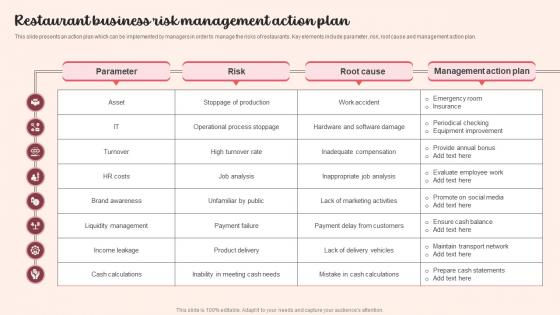
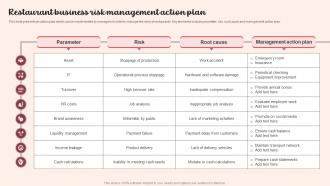
This slide presents an action plan which can be implemented by managers in order to manage the risks of restaurants. Key elements include parameter, risk, root cause and management action plan.
People who downloaded this PowerPoint presentation also viewed the following :
Restaurant Business Risk Management Action Plan with all 6 slides:
Use our Restaurant Business Risk Management Action Plan to effectively help you save your valuable time. They are readymade to fit into any presentation structure.





FAQs for Restaurant Business Risk
So basically you want to spot risks early, figure out how likely they are and what damage they'd do. Then pick your move - dodge them completely, reduce the impact, pass them off to someone else, or just roll with it. Don't make it a one-time thing though, build it into your regular planning stuff. Everyone needs to know which risks are theirs to handle. Most companies go way overboard when they're starting out - I've seen teams spend months on fancy frameworks when they could've just started tracking the obvious stuff. Keep it simple at first. Regular check-ins are clutch so you can pivot when things shift.
First thing - get everyone together and map out your whole operation. Different departments will catch stuff you'd never think of. I like asking "what could go wrong?" at every step (yeah, feels doom-and-gloom but whatever). Pull from past disasters and do some good old brainstorming sessions. Rate each risk as high/medium/low for both how likely it is and how bad it'd be. Honestly, a simple scale works fine - you can get fancy later. The hardest part is just starting, but once you make it routine, it gets way easier.
Honestly, you can't do risk management well anymore without solid tech backing you up. AI and machine learning catch patterns way before problems actually hit you. Real-time alerts ping you the second something goes sideways. Instead of relying on hunches (which, let's face it, can be pretty terrible), analytics platforms give you real numbers to work with. Your team can check risk metrics from anywhere with cloud dashboards. Oh, and don't create more headaches - pick tools that play nice with what you already have running.
Look, you've gotta bake risk awareness into everyone's day-to-day work instead of keeping it locked away in some corner office. Train people to actually notice and flag risks as they go - most don't even realize they're constantly making these calls anyway. Then connect it to their performance reviews and team targets so they care about it. I swear, regular "what could blow up" conversations in meetings work wonders for normalizing this stuff. The big thing? Reward people for catching problems early rather than shooting the messenger. Show them that raising red flags is exactly what good employees do.
First thing - map out every risk you can think of. Financial stuff, operations going sideways, regulatory headaches, whatever. Put them on a simple matrix based on how likely they are vs. how much damage they'd do. Honestly, the best part is getting people from different teams involved because they'll spot things you totally missed. Focus on the high-impact, high-probability ones first and figure out how to handle each. Write it all down, assign someone to watch each risk. Oh, and actually review this thing every few months - most companies create these plans then forget they exist.
Legal stuff sets your minimum bar for risk management - you can't skip it. Build everything around compliance reports, risk assessments, and whatever documentation they want. Honestly, it's a total maze when regulations overlap (happens more than it should). But they actually help structure things and catch stuff you'd probably miss. Oh, and track regulatory changes in your industry - they shift way more often than you'd expect. I learned that one the hard way.
So risk management and business continuity planning basically go together like peanut butter and jelly. First, you figure out what could go wrong through risk assessment - that's your heads up system. Then BCP is your actual game plan for when shit hits the fan and you need to keep the lights on. Honestly, trying to do continuity planning without knowing your risks first is like planning an escape route blindfolded. Map out your biggest threats, then focus your continuity plans on the ones that'd actually kill your business. The smaller stuff can wait - you don't have unlimited time or budget anyway.
Honestly, I'd start simple - pick maybe 3-5 metrics that actually matter for your biggest risks and track them monthly. Compare incidents before vs after you put your strategies in place. Response times are huge too - how fast are you catching and dealing with problems? The really telling stuff is comparing your actual losses to what you predicted. If you're constantly way off, that's a red flag your assessment process is broken. I know it's not exciting, but audit results and compliance rates tell you a lot. Oh, and don't ignore what stakeholders are saying - they see things you might miss. Cost savings from dodged incidents make great ammunition when budget time rolls around.
So there are basically four ways to handle risks. You can just avoid them completely - don't do the risky thing at all. Or reduce the chances something bad happens with safety measures and backup plans. Insurance is huge for transferring risk to someone else (honestly saved my butt more times than I can count). Sometimes you just accept certain risks if fixing them costs more than it's worth. The key is figuring out which approach makes sense for each situation based on what you can afford and how much risk you're comfortable with.
Look, you can't just grab some generic risk framework off the shelf. Healthcare companies obsess over patient data breaches and HIPAA stuff. Manufacturing? They're worried about factory accidents and supply chain nightmares. Financial services live in constant fear of credit disasters and market swings. Here's what works: pick your industry's top 3-5 nightmare scenarios first. Then build your framework around those instead of trying to fit into some cookie-cutter template. Map the usual categories - operational, strategic, financial, compliance - but make them actually relevant to what your CEO loses sleep over. Trust me, it's way more effective than pretending every industry faces identical risks.
Dude, bad risk management will absolutely destroy your profits. Unexpected losses hit hard, then you're dealing with regulatory fines and your insurance costs go through the roof. Operations get disrupted constantly which kills productivity. Legal fees are honestly the worst part though - companies blow millions on lawsuits they could've prevented with basic planning. Your reputation gets trashed too, so customers bail and good luck getting decent financing after that. Start doing regular risk assessments now before everything falls apart and costs ten times more to clean up.
Data analytics can catch risk patterns before they blow up into real problems. Look at your historical data, market trends, operational stuff - you'll spot threats early and actually know how bad they might get. Real-time dashboards are seriously amazing for this, giving you instant visibility into key indicators. Predictive models let you run different scenarios and stress-test strategies against various "what-if" situations. Track the right KPIs and set up automated alerts when things hit certain thresholds. I'd probably start with your biggest risk areas first, then expand from there. Makes the whole process way more manageable.
Risk models go stale crazy fast - what worked last quarter is probably useless now. New risks pop up before you can even spot them, and everything's so connected that one tiny change screws up your whole assessment. Your data's always behind reality too, so you're basically making educated guesses. Plus honestly, trying to predict this stuff sometimes feels impossible when everything changes overnight. Build some flexibility into whatever framework you're using and update things more often, even if it means less detailed reports. Better to be roughly right than perfectly wrong, you know?
Look, you can't predict what disaster hits next - nobody saw 2020 coming! Instead of guessing, build stuff that works for multiple crisis types. Get your team cross-trained, set up solid remote work systems, and map out backup suppliers. Cash reserves are boring but they'll save your ass. The companies that made it through recent chaos? They'd already invested in digital infrastructure and weren't putting all their eggs in one basket. Do some scenario planning sessions - sounds fancy but it's just "what if this breaks?" Start with your biggest weak spots and work backwards from there.
Communication is like the backbone of risk management - without it, everything falls apart. You've got to set up clear ways for people to report problems upward and keep teams in the loop. Honestly, bad communication creates more risks than it solves. People miss stuff, responses get delayed, everyone works in their own bubble. Regular check-ins help a ton. Skip the corporate jargon too - just use normal language so people actually understand what's going on. Oh, and make sure folks feel comfortable speaking up early when they spot issues. Map out who needs what info and when.
-
Very unique and reliable designs.
-
I was never satisfied with my own presentation design but SlideTeam has solved that problem for me. Thank you SlideTeam!