


Restaurant Business Feasibility Study Templates For Different




Try Before you Buy Download Free Sample Product
 Impress Your
 Audience
 100%
100% Editable
 Save Hours
 of Time


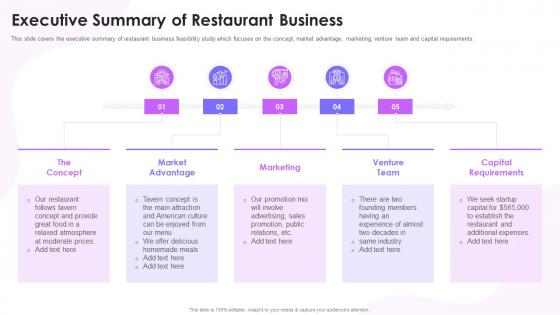
This slide covers the executive summary of restaurant business feasibility study which focuses on the concept, market advantage, marketing, venture team and capital requirements.
People who downloaded this PowerPoint presentation also viewed the following :
Restaurant Business Feasibility Study Templates For Different with all 6 slides:
Use our Restaurant Business Feasibility Study Templates For Different to effectively help you save your valuable time. They are readymade to fit into any presentation structure.





FAQs for Restaurant Business Feasibility Study
Okay so you'll need four main sections: market analysis, financial stuff, operations, and risk assessment. Market research is honestly the most boring part but you gotta dig into your target customers and check out competitors. Financial projections come next - startup costs, revenue forecasts, break-even analysis, all that fun accounting stuff. Don't skip the operational details like location needs, staffing, supply chain logistics. Risk assessment wraps it up. I'd make each section super specific with prompts so you won't forget anything important when you're actually working through it.
Look, market data is what separates your feasibility study from wishful thinking. Without solid numbers on local demographics, competitor sales, and foot traffic, you're basically asking investors to trust your gut - which they won't. Get recent local data, not some generic industry report from three years ago. Demographics, spending patterns, how busy similar spots actually are. Honestly saved my cousin from opening right next to two other pizza places he somehow didn't notice. You'll catch oversaturated markets or find gaps you'd totally miss otherwise. Hard numbers make your case bulletproof.
So for your restaurant feasibility study, you need five main financial projections. First up - startup costs covering equipment, build-out, permits, all that fun stuff. Revenue forecasts are next, base those on seat turnover and what people typically spend. Operating expenses matter too - food costs, labor, rent, utilities. Honestly, cash flow projections might be the most critical since restaurants burn through cash like crazy. Finally, do a break-even analysis so you know when you'll stop bleeding money. I'd map these out monthly for year one, then quarterly for years two and three.
Honestly, location is everything with these studies. Your foot traffic, rent, customer base - it all depends on where you set up. Downtown vs some random strip mall? You're looking at totally different numbers, like 50-70% swings in projections. Demographics matter too, plus competition and even stupid stuff like parking. I'd run the numbers for each spot separately because - and I learned this the hard way - an amazing concept can completely tank in the wrong location. It's wild how much geography affects everything.
Honestly, tracking industry trends is like having a heads-up on whether your restaurant idea will actually work. Look at what people are eating now, how they're ordering, what tech they expect - all that stuff matters. If you're planning a steakhouse but everyone's going plant-based, you'll want to know that before dropping cash, right? Consumer behavior shifts can make or break you. I'd definitely add a trends section to your feasibility study covering the next 2-3 years. It helps validate there's real demand and shows you what obstacles might pop up later.
Honestly, just make it visual - investors hate reading walls of text. Do a competitor matrix first with pricing, menu style, location, all that stuff. Spreadsheets are perfect for this. Then create profiles for each competitor with photos and their strengths/weaknesses. Don't skip the location map either, proximity is huge in restaurants. A SWOT analysis at the end shows where you actually fit in. I learned this the hard way - make everything scannable with charts and bullet points. They'll absorb that way better than paragraphs, and you'll clearly show why you're different.
Dude, the biggest thing I see people mess up is being way too rosy with their revenue numbers. Restaurant margins are brutal - like, seriously thin. You can't just guess and hope for the best. Location research is huge too; I've seen great concepts die because they picked the wrong spot. Hidden costs will destroy you - permits, equipment breaking down (and it will break down), staff constantly quitting. Actually spend time studying your competition instead of just peeking through their windows once. Timeline? Double whatever you're thinking. Be stingy with income projections, generous with expense estimates, and make sure you've got real data backing everything up.
Dude, you HAVE to nail the demographic analysis - seriously can't stress this enough. Who's gonna eat at your place? What do they spend on food? Are there even enough of these people around to keep you afloat? This stuff drives literally everything else - your prices, where you set up shop, how you market. I'm telling you, investors will pick this apart with a fine-tooth comb. Oh and don't rush it either, because honestly? Every major decision you make will come back to what you discover here. Trust me on this one.
Honestly just start with Excel or Google Sheets - they're perfect for this stuff and you can customize everything. LivePlan's pretty good if you want restaurant templates already built out. Smartsheet's nice too when you're collaborating with other people (though I always forget to update shared docs lol). ProjectionHub has decent templates but costs more. Excel's your best bet to start - way cheaper and once you figure out what actually works for your workflow, then maybe upgrade to something fancier. Most people overcomplicate this part anyway.
Don't just slap your SWOT analysis into one section and call it done. Spread those insights throughout the whole study. Got "experienced chef" as a strength? Work that into your competitive positioning and financial projections. Threats and opportunities should shape your market analysis - that's where they actually matter. I've seen so many people just list out their SWOT points like a grocery list, which is honestly pretty useless. Let those findings drive your risk planning and go-to-market strategy instead. Your weaknesses should inform what contingencies you're building too.
For your feasibility study, map out both digital and old-school marketing that actually reaches your crowd. Social media, local SEO, and managing Google reviews are non-negotiable - people stalk restaurants online before stepping foot inside. Community partnerships and event booths work great too, plus word-of-mouth incentives (honestly, nothing beats a good referral program). Budget around 3-5% of what you think you'll make in revenue. Don't forget your grand opening strategy and a realistic promo calendar. Just make sure whatever you pick connects with those customers from your market research - no point spending money on tactics that miss your target completely.
Dude, this is huge - your seating and staffing numbers need to actually work with your money projections. Like, if you can only fit 40 people but need 80 customers a night to break even? That's math that doesn't work. Staffing's tricky too. Too few people and your service tanks, too many and you're bleeding money on labor costs. I swear, I've watched so many restaurant dreams crash because someone didn't think through the kitchen workflow first. They budgeted for 3 cooks but actually needed 6. Walk through your space and really figure out how many bodies you need before you commit to those profit numbers.
Look, break-even analysis is seriously your best friend here. It shows you how many customers you need daily just to not lose money. Skip this and you're basically gambling with your life savings - I've watched friends learn this the hard way. You can test if your concept actually works at your location with realistic prices. Plus investors want to see you know your numbers inside out. Calculate it early, then use it to gut-check every big choice you make. Trust me on this one.
Make sure you've got a whole section just for risks - both the stuff you can control and what you can't. Location problems, hiring issues, supply chain mess, economic crashes, customers changing their minds. Don't sugarcoat anything because honestly, that just screws you over later. Rate each risk by how likely it is and how bad it'd hurt, then write out your game plan for the big ones. Oh, and build in some financial padding for when things go sideways. Investors want to see you've actually thought about what could tank this thing and aren't just being overly optimistic.
Dude, cash flow is everything - I can't stress this enough. Restaurants look profitable but then can't pay rent, it's wild. Track your revenue per seat and food costs first (aim for 28-35% of revenue). Labor costs and average ticket size matter too. Don't ignore the customer stuff either - repeat customers, reviews, table turnover. Your break-even point is huge those first months. Set up something simple to check weekly, not monthly - things move too fast when you're starting. Oh and honestly? Table turnover can make or break you during busy nights.
-
Awesome presentation, really professional and easy to edit.
-
Great designs, Easily Editable.