


Restaurant cafe business idea powerpoint presentation slides




Try Before you Buy Download Free Sample Product
 Impress Your
 Audience
 100%
100% Editable
 Save Hours
 of Time


A thriving cafe house requires three elements to turn visitors into regulars selection, quality, and seasonality by keeping the markets most popular products. Planning these stages on an excellent start asks you to answer a few questions such as how costs will be funded, how much money you expect to make, etc. Check out our efficiently designed Restaurant Café Business Idea template that focuses on giving something that makes you unique and taking advantage of seasonal phenomena. The purpose of this is to serve you knowledge of maintaining a high level of food and service quality and let you achieve maximum customer base in the first 2 yrs. Businesses can showcase their executive summary, challenges, solutions, USPs, financial projections, and more to meet specific customer expectations. Using tables, charts, and infographics, one can even display their start-up summary with statistics and team details. The restaurant business plan template guides firms to mention the key takeaways that not just help them in presenting service sourcing but, at the same time, ask them to exhibit their location in the world map with proper restaurant layout and design. Talk to our expert team for all your queries and customize this 100 percent editable template with our research analysts based on specific needs. Book a free demo.
People who downloaded this PowerPoint presentation also viewed the following :
Content of this Powerpoint Presentation
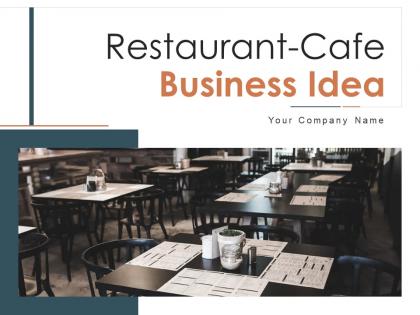
Slide 1: This slide introduces Restaurant-Cafe Business Idea. State Your Company Name and begin.
Slide 2: This is an Agenda slide. State your agendas here.
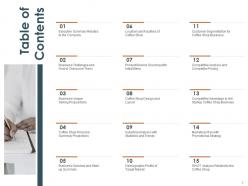
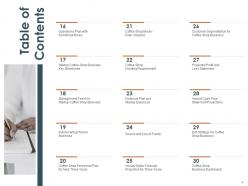
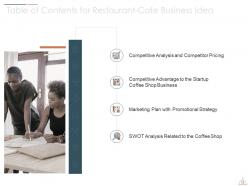
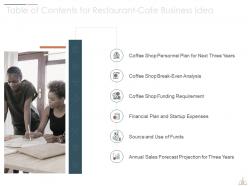
Slide 3: This slide shows Table of Content for the presentation.
Slide 4: This is another slide continuing Table of Content for the presentation.
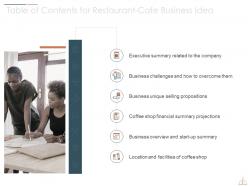
Slide 5: This slide presents Table of Content highlighting Cafe Business Idea.
Slide 6: This slide displays the executive summary of the company which includes overview, services, mission, etc.
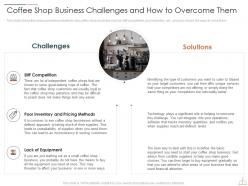
Slide 7: This slide represents the various problems related to new coffee shop business such as stiff competition, poor inventory, etc.
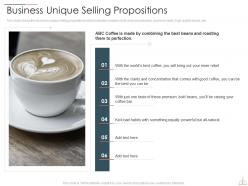
Slide 8: This slide showcases the business unique selling propositions which includes created clarity and concentration, premium taste, high quality beans, etc.
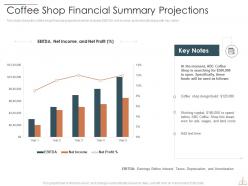
Slide 9: This slide shows the coffee shop financial projections which includes EBITDA, net income, and net profit along with key notes.
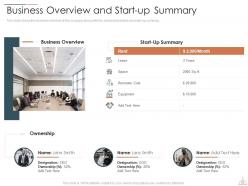
Slide 10: This slide presents the business overview of the company along with the ownership details.
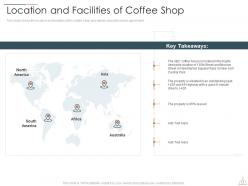
Slide 11: This slide displays the location and facilities of the coffee shop and details about the lease agreement.
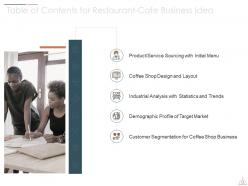
Slide 12: This slide represents Table of Content for the presentation.
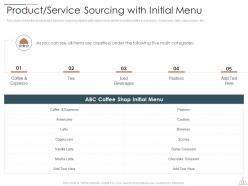
Slide 13: This slide showcases the product and services sourcing details with initial menu which includes coffee & espresso, Americano, latte, cappuccino, etc.
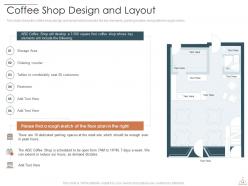
Slide 14: This slide shows the coffee shop design and layout which includes the key elements, parking location along with the rough sketch.
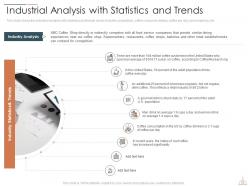
Slide 15: This slide presents the industrial analysis with statistics and trends which includes competition, coffee consumer details, coffee per day consumptions, etc.
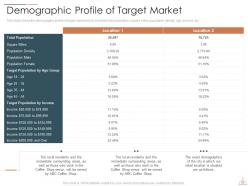
Slide 16: This slide displays the demographic profile of target market which includes total population, square miles, population density, age, income, etc.
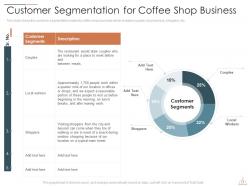
Slide 17: This slide represents the customer segmentation related to coffee shop business which includes couples, local workers, shoppers, etc.
Slide 18: This slide showcases Table of Content for the presentation.
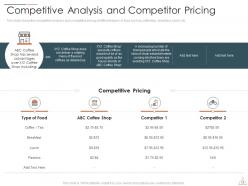
Slide 19: This slide shows the competitive analysis and competitive pricing of different types of food such as coffee/tea, breakfast, lunch, etc.
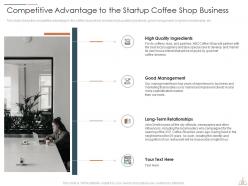
Slide 20: This slide presents the competitive advantage to the coffee shop which includes high quality ingredients, good management, long-term relationship, etc.
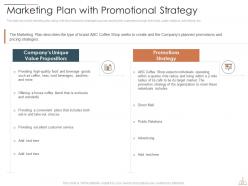
Slide 21: This slide displays the marketing plan along with the promotional strategies such as reaching the customers through direct mail, public relations, advertising, etc.
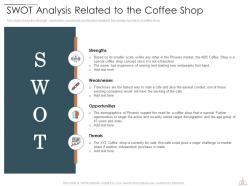
Slide 22: This slide represents the strength , weakness, opportunity and threats related to the startup business of coffee shop.
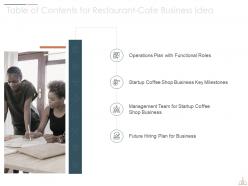
Slide 23: This slide showcases Table of Content for the presentation.
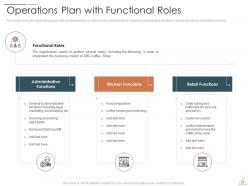
Slide 24: This slide shows the operational plan with functional roles in coffee shop business which includes administrative functions, kitchen functions and retail functions.
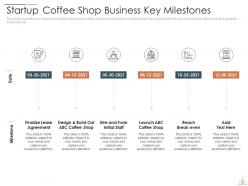
Slide 25: This slide presents Startup Coffee Shop Business Key Milestones.
Slide 26: This slide displays the management team for startup coffee shop business which includes the names, designations, etc.
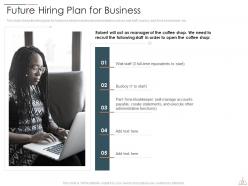
Slide 27: This slide represents the hiring plan for business which includes personnel details such as wait staff, busboy, part-time bookkeeper, etc.
Slide 28: This slide showcases Table of Content for the presentation.
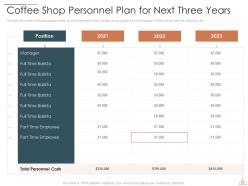
Slide 29: This slide shows the coffee shop personnel plan for next three years which includes various positions such as manager, full time barista, part time employee, etc.
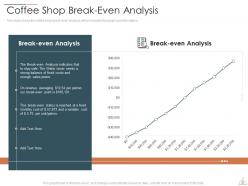
Slide 30: This slide presents the coffee shop break-even analysis which includes the graph and description.
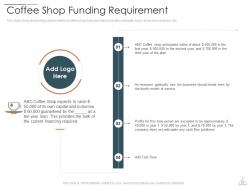
Slide 31: This slide displays the funding requirements of coffee shop business which includes anticipate sales, break even analysis, etc.
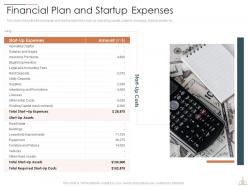
Slide 32: This slide represents the financial plan and startup expenses such as operating capital, salaries and wags, startup assets, etc.
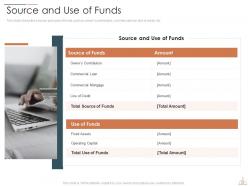
Slide 33: This slide showcases the sources and uses of funds such as owner’s contribution, commercial loan, line of credit, etc.
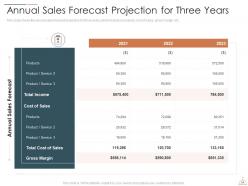
Slide 34: This slide shows the annual sales forecast projection for three years which includes products, cost of sales, gross margin, etc.
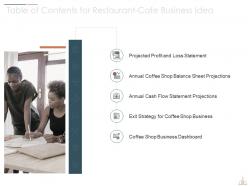
Slide 35: This slide presents Table of Content for the presentation.
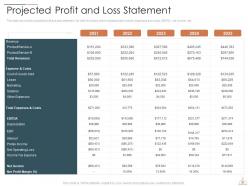
Slide 36: This slide displays the projected profit and loss statement for next five years which includes total revenue, expenses and costs, EBITDA, net income, etc.
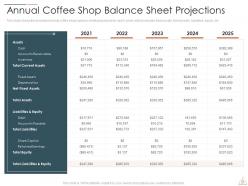
Slide 37: This slide represents the projected annual coffee shop balance sheet projections for next 5 years which includes total assets, fixed assets, liabilities, equity, etc.
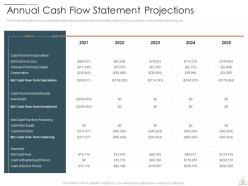
Slide 38: This slide showcases the annual cash flow statement projections which includes cash flow from operation, investments, financing, etc.
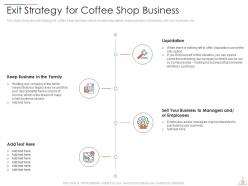
Slide 39: This slide shows the exit strategy for coffee shop business which includes liquidation, keep business in the family, sell your business, etc.
Slide 40: This slide presents Icons for Restaurant-Cafe Business Idea.
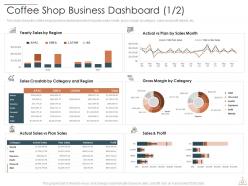
Slide 41: This slide displays the coffee shop business dashboard which includes sales month, gross margin by category, sales and profit details, etc.
Slide 42: This slide represents the coffee shop business dashboard which includes profit by state, average sales by month, profit, sales by product type, etc.
Slide 43: This slide is titled as Additional Slides for moving forward.
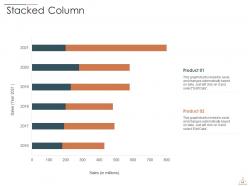
Slide 44: This slide shows Stacked Column with two products comparison.
Slide 45: This is About Us slide to show company specifications etc.
Slide 46: This is Our Mission slide with related imagery and text.
Slide 47: This slide shows Venn diagram with text boxes.
Slide 48: This slide presents Post It Notes. Post your important notes here.
Slide 49: This slide displays Circular Diagram with related icons and text.
Slide 50: This slide represents Mind Map with related imagery.
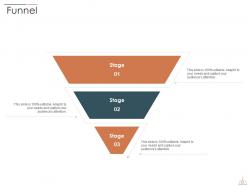
Slide 51: This slide shows Funnel with additional textboxes.
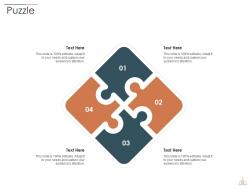
Slide 52: This slide showcases Puzzle with related icons and text.
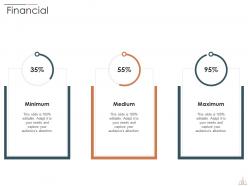
Slide 53: This is a Financial slide. Show your finance related stuff here.
Slide 54: This is a Thank You slide with address, contact numbers and email address.
Restaurant cafe business idea powerpoint presentation slides with all 54 slides:
Use our Restaurant Cafe Business Idea Powerpoint Presentation Slides to effectively help you save your valuable time. They are readymade to fit into any presentation structure.



FAQs for Restaurant cafe business idea
Honestly, narrow it down to three key things: know your customers, watch those food costs like a hawk, and don't overestimate your kitchen. Quick breakfast crowd vs leisurely brunch people need totally different approaches. Food costs will destroy you faster than anything else - I can't stress this enough. During rush hours, can your team actually handle the menu you're planning? Also, resist the urge to go crazy with options right away. Too many new places launch with these overwhelming 40-item menus that just confuse people and bog down the kitchen. Maybe start with like 15-20 things you can absolutely crush, then build from there based on what's actually moving.
Honestly, local sourcing is a game changer for cafés. Customers are obsessed with that farm-to-table vibe right now - you can literally put the farm names on your menu and people eat it up. The taste difference is crazy too, especially with milk and produce that hasn't been sitting in trucks for days. Yeah, it'll cost you more upfront, but you can totally charge premium prices when you're telling that local story. I'd start hitting up farmers markets this weekend to make connections. Oh, and your regulars will love feeling like they're supporting the whole community, not just your business.
Honestly, start with your neighborhood first - that's where your regulars will come from. Get involved with local businesses and community stuff. Instagram's a no-brainer since coffee looks amazing in photos, but don't forget Google My Business either (seriously, so many people ignore that). Word-of-mouth is still everything though. Maybe do a grand opening deal or loyalty cards to get people in the door initially. The key is just making your place somewhere people actually want to hang out and tell their friends about. Reviews from those first customers are gold too.
Honestly, your interior design can make or break the whole thing before anyone even tries your coffee. People decide if they want to stay based on vibes alone - cramped and dark? They're out. Comfortable seating with good lighting? Now they're posting on Instagram and coming back next week. I'd focus on creating different spots for different moods - quiet corners for laptop work, bigger tables for meetings, cozy areas just to chill. Don't cheap out on the lighting though, that's huge. Your space is basically doing marketing for you 24/7 without saying a word.
Dude, social media is a game-changer for restaurants. Instagram and TikTok are perfect for food pics - honestly, people decide where to eat based on how good stuff looks online. Post consistently and actually reply to comments, that's what builds loyalty. Facebook's solid for announcing events or new menu items. Don't sleep on Google My Business either, it helps locals find you. The cool thing is you can handle customer feedback right there in real time. Oh, and behind-the-scenes content works really well too - people love seeing the kitchen chaos. Just stay active and engage with followers.
Honestly, just pick a couple things and start there - don't try to do everything at once. Compostable cups and utensils are pretty easy swaps. LED lights will actually save you money (our electric bill dropped like 30% when we switched). Local ingredients are huge if you can swing it, plus customers eat that stuff up. Set up recycling stations that actually make sense. Oh, and track your food waste for like a week - you'll be shocked what gets thrown out. Maybe offer discounts for people bringing their own cups? The whole "perfect green restaurant" thing is overwhelming. People just want to see you're trying.
Honestly, you gotta create experiences people can't get at Starbucks. Live music nights are solid. Coffee cupping classes too. I've seen board game cafés absolutely kill it, and there's this weird place near me where you can adopt plants while drinking lattes - sounds dumb but it's packed constantly. Partner with local artists for rotating gallery walls maybe? Book clubs work well. Oh, and specialty brewing like siphon coffee makes people feel fancy. Just don't try doing everything at once though. Pick 1-2 things your customers would actually care about and nail those first.
Dude, the upfront costs are brutal - equipment alone hits $50K-$150K depending on what you're doing. Plus renovations, permits, inventory, all that jazz. Labor's gonna eat up most of your monthly budget, then there's rent, food costs, utilities. Most places don't make money for like two years, which honestly sounds terrifying. You'll want at least 3-6 months of expenses saved up as a cushion. My cousin opened one last year and said she wished she'd talked to more local owners first - they give you the real numbers, not the fantasy ones online. Definitely do a proper financial plan before jumping in.
Dude, mobile ordering is clutch for restaurants. Customers skip the line entirely - they order and pay on their phone before showing up. No more cash fumbling or waiting around. Your lunch rush becomes way smoother since people just grab and go. Plus everything's digital so you'll get fewer screwed up orders. The data you collect on what people actually order is pretty useful too. Honestly, don't try building your own app from scratch. Just go with one of the big platforms that already exist. Way less headache.
Honestly, skip the boring lectures and just pair newbies with your best people. Hands-on is everything. Cover the basics - food safety, your recipes, POS system (seriously, nothing's worse than watching someone crash during dinner rush). But here's what most places mess up: they don't practice handling angry customers. Do some role-playing, even if it feels weird at first. I'd set up a buddy system for their first week and give them checklists to fall back on when it gets crazy. Your experienced staff will teach them way more than any training manual ever could.
Dude, seasons totally change what people want to eat and drink. Summer's all about cold stuff - iced coffee, salads, smoothies, anything that cools you down. Come winter though? Everyone wants soup, hot sandwiches, and those expensive seasonal lattes (seriously, the syrups cost a fortune but customers go crazy for them). Traffic patterns shift too. Summer brings tourists grabbing quick cold drinks and bouncing. Winter regulars camp out longer with warm food. I'd swap like 30-40% of your menu seasonally - sounds drastic but it works. Stock accordingly and you'll be golden.
Honestly, just talk to your customers directly - that's where you'll get the real gold. Comment cards work too, or those QR code surveys if you want to get fancy. I'd also keep an eye on social media since people can't help posting pics of their lattes anyway. Start with the easy stuff first, like tweaking your menu or fixing timing issues. Maybe keep a simple log so you can spot actual patterns instead of getting hung up on random complaints. Oh, and this is key - let people know you're listening! Put up one of those "you asked, we listened" boards or post about changes online. Pick one method this week and stick with it.
Honestly, just make it worth their while - free drink after 10 visits, birthday stuff, maybe early access to new items. Keep it dead simple though, like a punch card or basic points thing. Nobody needs another app clogging their phone, you know? Track what people actually use vs what they ignore - that's your goldmine right there. Oh and definitely remember their usual order or send offers based on what they normally get. That personal touch goes way further than you'd think. Start with one solid reward and see what brings people back before getting fancy with it.
Okay so everyone's going for that "third space" feel right now - warm colors, tons of plants, seating that works whether you're on a laptop or just chatting. Reclaimed wood and exposed brick are everywhere. Also, I swear people choose cafes based on Instagram potential now, so get some cool neon or murals. Lighting's super important too - those harsh fluorescents will kill the vibe instantly. Oh, and make sure it feels like someone's cozy living room where people actually want to camp out for hours, not just a quick coffee run spot.
Look for businesses with your same customers but who aren't competing directly - gyms, bookstores, coworking spaces work great. Try simple cross-promos like "show your gym receipt, get 10% off coffee" or just swap flyers and business cards. Honestly, I've noticed cafés crush it with this strategy, especially downtown near offices. Event planners are goldmines too since they're constantly referring catering spots. Oh, and don't forget about offering employee discounts to nearby businesses - they'll totally push your lunch specials to their clients. Just make sure both sides actually benefit or it'll fizzle out fast.
-
Attractive design and informative presentation.
-
Colors used are bright and distinctive.