

Business plan for opening a cafe powerpoint presentation slides




Try Before you Buy Download Free Sample Product
 Impress Your
 Audience
 100%
100% Editable
 Save Hours
 of Time


Our Business Plan For Opening A Cafe Powerpoint Presentation Slides are topically designed to provide an attractive backdrop to any subject. Use them to look like a presentation pro.
People who downloaded this PowerPoint presentation also viewed the following :
Content of this Powerpoint Presentation
Slide 1: This is the title slide illustrating the Business Plan For Opening A Cafe.
Slide 2: This is the Agenda slide for the Business Plan for Opening a Cafe.
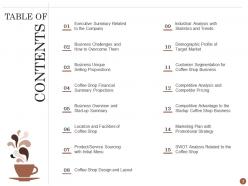
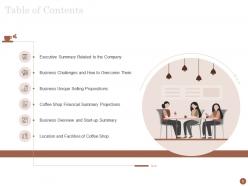
Slide 3: This is a table of contents slide including Executive Summary Related to the Company, Business Challenges and How to Overcome Them, Business Unique Selling Propositions, etc.
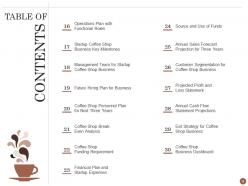
Slide 4: This is a table of contents slide including Operations Plan with Functional Roles, Startup Coffee Shop Business Key Milestones, Management Team for Startup Coffee Shop Business, etc.
Slide 5: This is a table of contents showing the Executive Summary Related to the Company, Business Challenges and How to Overcome Them, the Business Unique Selling Propositions, the Coffee Shop Financial Summary Projections, the Business Overview and Start-up Summary, and the Location and Facilities of Coffee Shop.
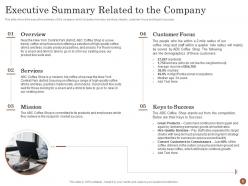
Slide 6: This slide shows the executive summary of the company which includes an overview, services, mission, customer focus, and keys to success.
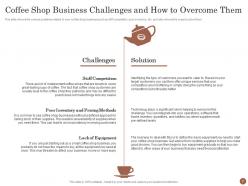
Slide 7: This slide shows the various problems related to the new coffee shop business, such as stiff competition, poor inventory, and also shows the ways to solve them.
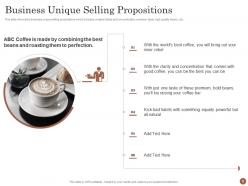
Slide 8: This slide shows the business's unique selling propositions, which include created clarity and concentration, premium taste, high-quality beans, etc.
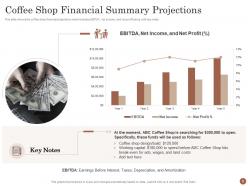
Slide 9: This slide shows the coffee shop financial projections which include EBITDA, net income, and net profit along with keynotes.
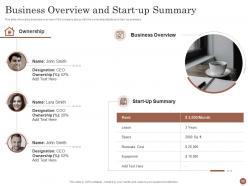
Slide 10: This slide shows the business overview of the company along with the ownership details and start-up summary.
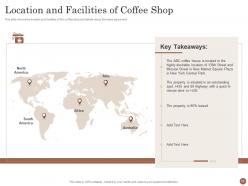
Slide 11: This slide shows the location and facilities of the coffee shop and details about the lease agreement.
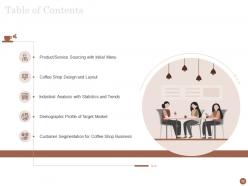
Slide 12: This is a table of contents slide showing the Product/Service Sourcing with Initial Menu, the Coffee Shop Design and Layout, the Industrial Analysis with Statistics and Trends, the Demographic Profile of Target Market, and the Customer Segmentation for Coffee Shop Business.
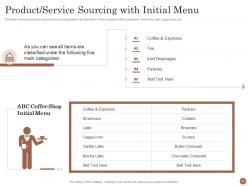
Slide 13: This slide shows the product and services sourcing details with an initial menu which includes coffee, espresso, Americano, latte, cappuccino, etc.
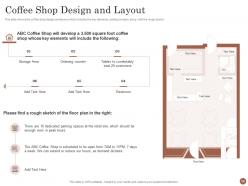
Slide 14: This slide shows the coffee shop design and layout, which includes the key elements, parking location along with a rough sketch, etc.
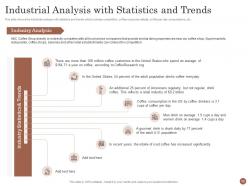
Slide 15: This slide shows the industrial analysis with statistics and trends which includes competition, coffee consumer details, coffee per day consumptions, etc.
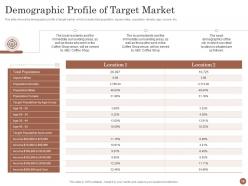
Slide 16: This slide shows the demographic profile of the target market, which includes total population, square miles, population density, age, income, etc.
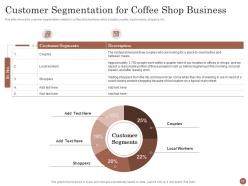
Slide 17: This slide shows the customer segmentation related to the coffee shop business which includes couples, local workers, shoppers, etc.
Slide 18: This is a table of contents slide including Competitive Analysis and Competitor Pricing, Competitive Advantage to the Startup Coffee Shop Business, Marketing Plan with Promotional Strategy, and SWOT Analysis Related to the Coffee Shop.
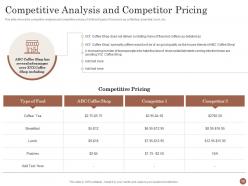
Slide 19: This slide shows the competitive analysis and competitive pricing of different types of food such as coffee/tea, breakfast, lunch, etc.
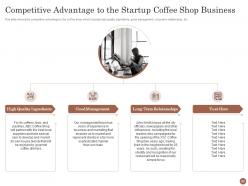
Slide 20: This slide shows the competitive advantage to the coffee shop, which includes high-quality ingredients, good management, long-term relationship, etc.
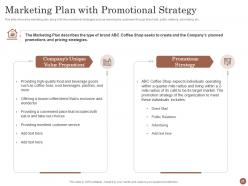
Slide 21: This slide shows the marketing plan along with the promotional strategies such as reaching the customers through direct mail, public relations, advertising, etc.
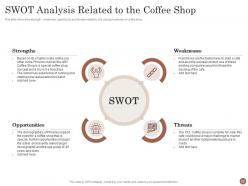
Slide 22: This slide shows the strengths, weaknesses, opportunities, and threats related to the startup business of the coffee shop.
Slide 23: This is a table of contents slide showing the Operations Plan with Functional Roles, Startup Coffee Shop Business Key Milestones, Management Team for Startup Coffee Shop Business, and Future Hiring Plan for Business.
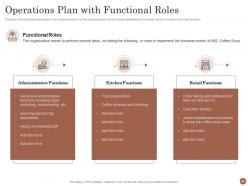
Slide 24: This slide shows the operational plan with functional roles in the coffee shop business, which include administrative functions, kitchen functions, and retail functions.
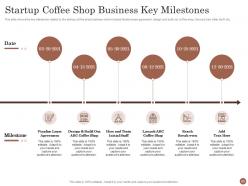
Slide 25: This slide shows the key milestones related to the startup coffee shop business, which include finalizing the lease agreement, designing and building out a coffee shop, hiring and training initial staff, etc.
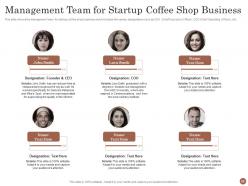
Slide 26: This slide shows the management team for a startup coffee shop business which includes the names, designations such as CEO (Chief Executive Officer), COO (Chief Operating Officer), etc.
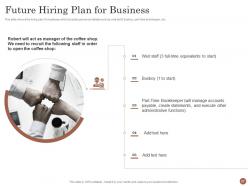
Slide 27: This slide shows the hiring plan for the business which includes personnel details such as wait staff, busboy, part-time bookkeeper, etc.
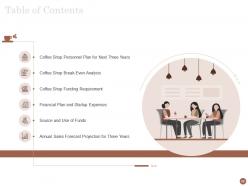
Slide 28: This is a table of contents slide showing the Coffee Shop Personnel Plan for Next Three Years, the Coffee Shop Break-Even Analysis, the Coffee Shop Funding Requirement, the Financial Plan and Startup Expenses, the Source and Use of Funds, and the Annual Sales Forecast Projection for Three Years.
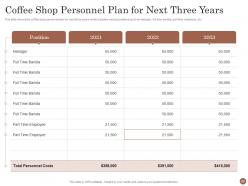
Slide 29: This slide shows the coffee shop personnel plan for the next three years which includes various positions such as manager, full-time barista, part-time employee, etc.
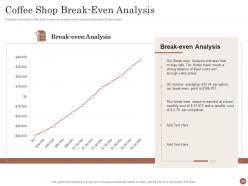
Slide 30: This slide shows the coffee shop break-even analysis which includes a graph and description.
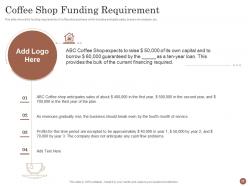
Slide 31: This slide shows the funding requirements of the coffee shop business, which include anticipated sales, break-even analysis, etc.
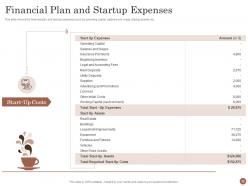
Slide 32: This slide shows the financial plan and startup expenses such as operating capital, salaries, and wags, startup assets, etc.
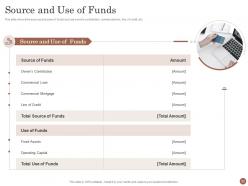
Slide 33: This slide shows the sources and usage of funds such as the owner’s contribution, commercial loan, line of credit, etc.
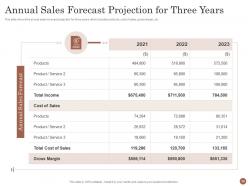
Slide 34: This slide shows the annual sales forecast projection for three years which includes products, cost of sales, gross margin, etc.
Slide 35: This is a table of contents slide showing the Projected Profit and Loss Statement, the Annual Coffee Shop Balance Sheet Projections, the Annual Cash Flow Statement Projections, the Exit Strategy for Coffee Shop Business, and the Coffee Shop Business Dashboard.
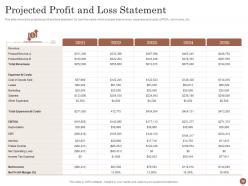
Slide 36: This slide shows the projected profit and loss statement for the next five years which includes total revenue, expenses, costs, EBITDA, net income, etc.
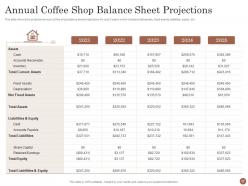
Slide 37: This slide shows the annual coffee shop balance sheet projection for the next 5 years which includes total assets, fixed assets, liabilities, equity, etc.
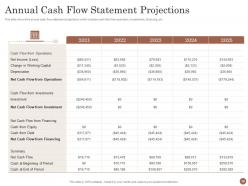
Slide 38: This slide shows the annual cash flow statement projections which include cash flow from the operation, investments, financing, etc.
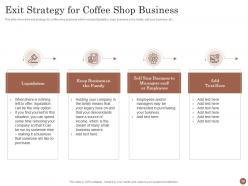
Slide 39: This slide shows the exit strategy for coffee shop business which includes liquidation, keeping business in the family, selling your business, etc.
Slide 40: This is the Icons Slide for Business Plan for Opening a Cafe.
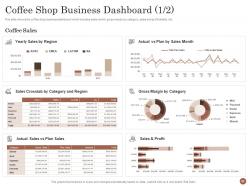
Slide 41: This slide shows the coffee shop business dashboard which includes sales month, gross margin by category, sales and profit details, etc.
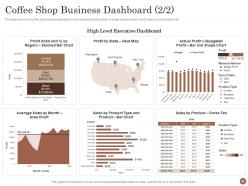
Slide 42: This slide shows the coffee shop business dashboard which includes profit by state, average sales by month, profit, sales by product type, etc.
Slide 43: This slide presents the Additional Slides.
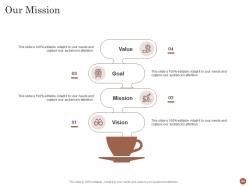
Slide 44: This slide provides the Mission for the entire company. This includes the vision, mission, goal, and value.
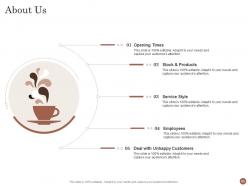
Slide 45: This slide contains the information about the company, aka the ‘About Us’ section. This includes the Opening Times, Stocks and Products, Service Style, Employees, and Deal with Unhappy Customers.
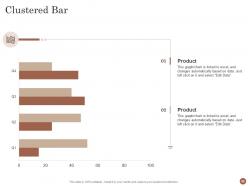
Slide 46: This slide presents the Clustered Bar. It allows direct comparison of two product series in a given category.
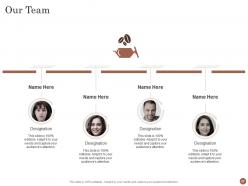
Slide 47: This slide shows the members of the company team with their name, designation, and photo.
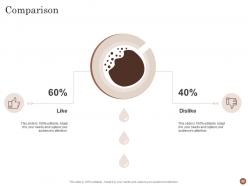
Slide 48: This slide presents the Comparison. It shows the percentage of likes and dislikes.
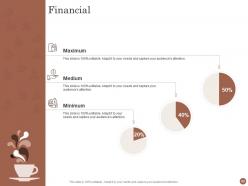
Slide 49: This slide presents the Financial data with the data’s numbers at minimum, medium, and maximum percentage.
Slide 50: This slide provides a Venn diagram that can be used to show interconnectedness and overlap between various departments, projects, etc.
Slide 51: This slide presents a Mind Map. It shows information visually for better analysis and generation of new ideas.
Slide 52: This slide contains Post-It Notes that can be used to express any brief thoughts or ideas.
Slide 53: This slide is a Timeline template to showcase the progress of the steps of a project with time.
Slide 54: This slide presents the overall Target of the company as well as smaller targets within that main Target.
Slide 55: This is a Thank You slide where details such as the address, contact number, and email address are added.
Business plan for opening a cafe powerpoint presentation slides with all 55 slides:
Use our Business Plan For Opening A Cafe Powerpoint Presentation Slides to effectively help you save your valuable time. They are readymade to fit into any presentation structure.
FAQs for Business plan for opening a cafe
Okay so first thing - nail down your target customers and scope out the competition around you. Your concept and menu need to be solid too. Financial projections are honestly the most important part since investors will tear those apart, so don't just guess on startup costs and break-even stuff. Location is everything with cafes - I've seen great concepts fail because of bad foot traffic. Oh and don't skimp on the operational details like staffing and suppliers. Marketing strategy matters but comes after you've got the basics locked down. Start with a killer executive summary that actually makes people want to keep reading.
Dude, you really need to find out who actually wants your coffee - not just who you think does. Survey people around there about their habits and what they'd spend money on. I was honestly blown away when I found out office workers will drop serious cash for good WiFi and a quiet spot to work. Sounds obvious now but totally wasn't at the time! Check out your competition during their rush hours. Look at foot traffic patterns too. Demographics matter, but so does matching what people in that exact area actually need. Don't just copy what works somewhere else.
Foot traffic is everything - you need people walking by all day, not just morning rush. Check if your target customers actually hang out in that area. Parking matters unless you're downtown where everyone walks anyway. The boring stuff counts too: rent, lease terms, whether the space can handle espresso machine plumbing without major work. Honestly, I've seen people blow their budget on buildout costs they didn't expect. Competition isn't always bad - sometimes it just proves the area works for coffee shops. Walk around at different times though. That busy corner at 8am might be dead by noon.
Okay so basically you've gotta find what sets you apart from all those other coffee places nearby. What problem are you actually solving? Maybe everywhere else has crappy wifi, or parents can't bring their kids without getting dirty looks - could be literally anything. Figure out who you're really targeting first though. Are they after lightning-fast service, that cozy vibe, Instagram-perfect foam art, or are you the only spot open late? I swear half the battle is just knowing your "thing." Write down one simple sentence explaining why someone would pick you over the Starbucks down the street.
Okay so you'll need revenue forecasts for like 2-3 years - monthly breakdowns work best. Cash flow statements are crucial too, showing what's actually coming in vs going out. Profit & loss projections obviously. Oh and don't underestimate startup costs - equipment, renovations, inventory adds up fast. Break-even analysis is huge since cafe margins are brutal honestly. I'd be super conservative with revenue estimates, coffee shops are weirdly unpredictable the first year. Factor in seasonal stuff too - my friend's place dies in summer without good AC. Get these numbers dialed in before talking to investors though!
Okay so startup costs - break it down into chunks. Equipment first (espresso machines, grinders, POS stuff) can hit $15K-50K easy. Then you've got build-out costs like renovation, furniture, signage. Don't forget permits, licenses, and initial inventory. Oh and working capital for those first scary months when you're not sure if anyone will actually buy your coffee! Insurance and marketing materials too - the little stuff sneaks up on you. Make a spreadsheet, add 20% buffer because something will go wrong. Get multiple quotes and honestly? Buy some equipment used if you can swing it.
Oh man, the permits are honestly a pain but here's what you need: business license, food service license, and if you're doing drinks then liquor license too. Health department will come inspect your kitchen - that's mandatory everywhere. Signage permits are a thing apparently (who knew, right?). Outdoor seating means sidewalk cafe permits in most places. Playing music? You'll need licensing for that or you could get hit with fees later. Each city does things differently though, so I'd just call your local small business office first. They'll have the actual list for your area instead of you guessing.
First thing - figure out who you're actually trying to attract. Remote workers? Students cramming for exams? Coffee snobs? Instagram's obviously a must since lattes photograph well, but don't sleep on partnering with other local spots. Book clubs and open mic nights work great for building community. A decent loyalty program helps too, though honestly word-of-mouth still beats everything else. You want people walking out thinking "I need to bring Sarah here next week." Make the vibe worth sharing and your customers will basically do the marketing for you.
Dude, plant-based bowls are absolutely crushing it right now - customizable stuff with solid margins. Cold brew's still money, especially with oat milk or weird flavors like lavender (cardamom's cool too). I know everyone roasts millennials but avocado toast literally never dies lol. Grab-and-go is key since people are still crazy busy. Think overnight oats, grain bowls, that kind of thing. Oh and don't go overboard with menu options - your kitchen staff will hate you. Better to absolutely nail like 5-7 items than serve mediocre everything.
Honestly, hire people who actually like talking to customers - you can teach anyone to make coffee, but you can't fix a bad attitude. Training is huge too, especially those awkward role-playing things (they're cringy but they work). Set some basic rules like greeting people in 10 seconds and keeping everything clean. Oh, and get feedback constantly through comment cards or whatever - then actually do something with it! The baristas who genuinely care about service will make or break your whole operation.
Dude, your space is literally selling for you even when you're not there. Bad lighting or cramped seating? People bounce immediately. You want them scrolling Instagram in your spot, not rushing out after 5 minutes. First figure out who you're actually trying to attract - are they coffee-and-laptop types or quick-grab-and-go customers? That'll drive everything from your color scheme to whether you need communal tables or individual seats. Honestly, the best cafes feel like that perfect hangout spot between home and the office. People don't just buy coffee there, they buy the whole vibe.
Honestly, start with a decent POS system - it'll track your sales and inventory without the headache. Mobile ordering is clutch because nobody wants to wait in line for coffee (I mean, come on). You can add loyalty programs later to keep people coming back, and automated inventory stops you from running out of oat milk again. Oh, and don't forget social media helps with the marketing side. I'd say implement one thing at a time though. My cousin tried doing everything at once when she opened her place and it was chaos for months.
Start small with compostable cups and local sourcing - that stuff adds up fast. Energy-efficient equipment is worth it even though it'll hurt your wallet initially. I'd definitely do the reusable cup discount thing, customers love feeling good about themselves lol. Partner with nearby farms and fair trade coffee suppliers if you can swing it. Oh, and donate leftover pastries instead of trashing them - shelters always need food. Don't try everything at once though. Pick maybe 2-3 things that won't break your budget, then build from there as you grow.
Yeah, definitely go with a points system - the classic "buy 10, get one free" works. But honestly? Those boring punch cards are so overdone. Try tiered levels instead - regular, gold, VIP with better perks as they climb up. Random surprises are gold too, like free pastries when it's raining outside. Apps are cool for tracking everything, though there's something nice about physical stamp cards that people actually touch. What really matters is making your regulars feel special rather than just another transaction. I'd test different reward amounts and literally just ask your best customers what they'd want - they'll tell you.
Honestly, most people totally underestimate startup costs - like equipment breaking down when you least expect it or permits costing way more than Google said they would. Plus you're probably not gonna hit those revenue numbers right away, maybe not for months. Location can make or break you too, I've literally watched amazing food concepts die because they chose some random strip mall. Oh and don't half-ass the market research - figure out what people in your area actually want, not just what you think is cool. Save up at least 6 months of expenses as backup and be super conservative with your projections.
-
very good keep it up
-
Best Representation of topics, really appreciable.
-
Understandable and informative presentation.
-
Designs have enough space to add content.
-
Enough space for editing and adding your own content.
-
Graphics are very appealing to eyes.