


Business model canvas partner restaurant ppt powerpoint presentation icon examples




Try Before you Buy Download Free Sample Product
 Impress Your
 Audience
 100%
100% Editable
 Save Hours
 of Time


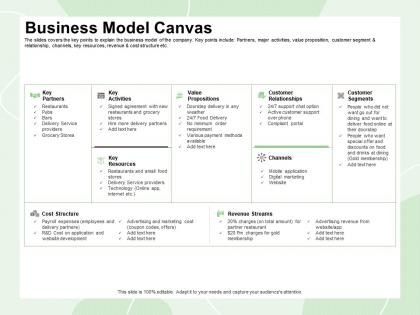
The slides covers the key points to explain the business model of the company. Key points include Partners, major activities, value proposition, customer segment and relationship, channels, key resources, revenue and cost structure etc.
People who downloaded this PowerPoint presentation also viewed the following :
Content of this Powerpoint Presentation
What are operations without a roadmap or process? It is akin to sailing a ship without a compass, a chaotic journey destined to be aimless and directionless. The contributing factor to a failing business is the lack of planning and execution. Most start-up owners of restaurants fail to combat the battle between selling for less or losing excess stock. The perennial struggle of any restaurant is survival, and the game's name is profit. The fundamental belief behind any company is not to make but to mint money. People do not run successful organizations but rather operate on processes and systems. As the famous mantra for business goes, ‘The system is always bigger than any individual.’
Automating a business requires 3Ps, planning, placement of proper individuals, and patience. Any good business runs on automated systems and process-driven individuals. Operations aren't only restricted to employees and their responsibilities as the whole nine yards extend beyond what meets the eye. To get to a point where an organization no longer necessitates a founder's direct involvement would take a good chunk of their time. One of the primary aspects of starting a business lies in its planning. A proper well-structured plan put on paper not only eliminates the gruesome hours of improper execution but helps in its automation.
Once a business plan is prepared and it covers all the facets involved in running the business, the execution part becomes as easy as one, two, and three. Success lies in the craftsmanship of both planning and execution. Whereas planning is the blueprint and execution is the masterpiece.
A business model is used as a framework that covers all bases of what a company aims to achieve, how it will operate, and how it will succeed in the market.
Given below are the most ideal editable, and easily accessible PPT Templates of a business plan for relatively new restaurants. The template is 100% editable and customizable, giving you a starting point, the much-needed structure and the capability to tailor each presentation to the audience profile you need to present to. Let’s explore!
Template 1 Business Model Canvas

This business model is tailor-made for restaurant owners seeking to formulate their resources into one structured presentation slide. This slide includes the design pattern split into five vertical columns. In the lower half, both sides of the slide has small sections that are divided horizontally. In the first portion of the vertical slide, it states key business partners, such as delivery providers, pubs and bars your restaurant is tied up with, and other key partners are mentioned in the first vertical slide making it presentable and evident.
The second column mentions key activities and resources. In a business model, key activities embrace aspects that contribute to a stable and successful operation. The crux of business lies in the key activities that involve performing to create, deliver and capture value. These roles fluctuate depending on the nature of the business, and these might encompass functions such as product development, manufacturing, marketing and sales, and operations management. In a restaurant model, it may involve conducting and filing the documentation of partners, restocking of goods, etc. Use the lower half of the PPT Template to depict the key resources of the business. These are the major factors that provide impetus to running any business. It highlights the essentials that help in stabilizing and running major operations. For example, one of the major resources for running a business is its online tie-ups. The presence of it online helps it reach a larger audience and, hence, the possibility of more sales. This portion helps you summarize resources at the helm of your businesses.
The third column is tailored for value propositions. When considering a restaurant business model, the value proposition is the unique advantages or offerings for its customers that set it apart from its competitors, bringing in the patrons. This may comprise items such as the type and standard of food, the feel and mood of the restaurant, the level of service offered, special offers, convenience factors like location or delivery options and any other features that the customer sees as valuable. You could use it to your liking by adding your USP to identify the differentiators in your model.
Under the head of customer relationships and channels, the slide helps great businesses like you depict the two most viable and prudent features of your business. The customer relationship is the department that oversees support and queries and is the most crucial element as they are in direct talks with customers. Channels are used to represent the available platforms your restaurant uses for marketing, with website, digital marketing, and mobile applications already the most wide-spread and popular.
In the customer segmentation domain, understand that segmentation of customers and understanding they categories they fall into helps you address their needs better. It enables the distribution of resources more effectively, providing a higher level of customer satisfaction and making companies more competitive in the market. It helps in the mentioning of target marketing, customization, and improved customer experience. This customer segmentation allows your business to personalize marketing efforts, product offerings, and customer experiences to the specific needs and preferences of customer groups.
The bottom horizontal portion of the slide represents the total monthly expenses of the business. It is provided to you to identify the fixed expenses of running your business, such as the payroll, advertising costs, and logistics. The cost structure is a key element of a business model as it helps streamline your expenses and make arrangements to meet them.
The template also depicts an analysis of the revenue your business would be making. It could involve membership charges, commissions on partners, and many more.
The employment of such a diverse business model helps you reduce time, energy, and other tasking components. The segregation of it summarized into a singular slide helps you identify the most crucial facets of running your restaurant business more seamlessly. Hence, not only does it save you time but it also helps in running your business smoothly. This time-saving template is something you work on as it is editable and easily accessible, too.
IMPLEMENTATION IS THE FLAVOR
The implementation of the business model canvas that SlideTeam provides is critical in managing challenges in the food industry. As with a recipe done right, our templates provide a fusion between suitable convenience and creativity, which makes the navigation of the successful journey a teatime affair. So, with SlideTeam, your teaser will look like the real deal. A public presentation that is finger-licking good, leaving your audience pining for more. SlideTeam is the new presentation superpower for businesses. Download our products and create a positive difference to your brand perception.
Business model canvas partner restaurant ppt powerpoint presentation icon examples with all 2 slides:
Use our Business Model Canvas Partner Restaurant Ppt Powerpoint Presentation Icon Examples to effectively help you save your valuable time. They are readymade to fit into any presentation structure.

FAQs for Business model canvas partner restaurant ppt powerpoint
So the Business Model Canvas has nine sections that all connect together. Start with your value proposition - that's the problem you're solving. Then you've got customer stuff on the right: who they are, how you reach them, relationships, revenue streams. Left side is your operations - partners, key activities, resources, costs. Honestly, I'd just focus on the value prop first since everything else flows from that. Like, your activities should support what you're promising customers, which then drives how you make money. It's pretty logical once you map it out. Don't overthink the order too much.
Start with Value Propositions, but honestly don't even try filling it out alone. Work on Customer Segments at the same time - your value prop is basically meaningless without knowing who you're targeting. I get a little obsessed with this connection, not gonna lie. After that, tackle Customer Relationships and Channels so you know how you'll actually get that value to people. The real breakthrough happens when you can nail down what problem you're solving and for who in one sentence. Try this: "We help [customer segment] achieve [desired outcome] by [unique solution]."
Honestly, customer segmentation is where everything starts with your Business Model Canvas. Pick 2-3 specific groups instead of trying to please everyone (learned that the hard way). Once you know exactly who you're targeting, the rest falls into place - your value props, how you'll reach them, pricing, all of it. It's like trying to buy a gift without knowing the person, you know? Doesn't work. Focus on understanding what makes each segment tick. Then you can actually build something they'll want to pay for.
Don't just create your Business Model Canvas and call it done – that's where most people mess up. Market changes? Hit your Value Props and Customer Segments first since those get wrecked the fastest. Then see how everything else shifts around them. Quarterly reviews are your friend here, and honestly make it a group thing so someone catches what you're missing. I swear, companies that ignore this stuff for months wonder why they're suddenly behind. Activities, partnerships, revenue streams – they all need tweaking when the market moves.
Don't try to solve everything for everyone - that's startup suicide. Be crazy specific about the problem you're tackling. I see people spend forever perfecting their canvas when honestly? It should be messy at first. Skip the fancy business buzzwords too, they just make you sound like every other pitch deck out there. Your customer segment can't be "millennials who like coffee" or whatever. Get specific! Draft something rough, show it to real people (not your mom), then fix what's broken. The whole point is iteration, not perfection from day one.
Honestly, ditch the sticky notes next time. Miro and Canva let your whole team jump in and edit stuff live, which is clutch if you're working remotely. The real game-changer though? You can actually link sections to real data - like connecting your value props to survey results or revenue streams to your financials. Strategyzer has some solid templates too, though I haven't used all their features yet. Trust me, going digital saves so much time and you won't be squinting at someone's terrible handwriting anymore.
Honestly, the Business Model Canvas is pretty genius for this. When you map out your value props next to customer segments, you start seeing money-making opportunities everywhere. Like, suddenly you're thinking about subscription models or freemium stuff you never considered before. What's cool is how it pushes you beyond the obvious revenue sources - your partnerships and resources sections can spark totally new ideas. Oh, and here's a weird tip that actually works: fill one out for a competitor first. It's good practice and you might steal some inspiration for your own setup. The visual layout really makes everything click.
Honestly, just start by talking to people - way cheaper than building something nobody actually wants. Customer interviews and surveys are your best bet initially. Once you've got some insight, try creating small MVPs or even just landing pages to test if there's real demand. I sometimes do this thing called "fake door testing" where you pretend a feature exists to see if people click on it. Sounds sketchy but it works! Focus on your riskiest assumptions first rather than testing everything. Quick, cheap experiments will save you tons of headaches later.
So basically the canvas forces your whole team to look at the same picture - literally. You fill out those nine boxes together and suddenly everyone's arguing about the same stuff instead of talking past each other. Which is actually progress, weird as that sounds. The boxes keep you from forgetting obvious things like "wait, who's our customer again?" When people disagree, you can just point at the section and hash it out. Honestly, the sticky note approach works best - gets people off their phones and actually participating.
Start with the canvas at the beginning of your planning cycle - it's like taking a snapshot of how everything actually works right now. All nine blocks mapped out visually. When you're brainstorming new strategies, you can see exactly what'll get impacted. Honestly, it's kind of brutal how it exposes everyone's assumptions, but that's what makes it so good. I'd use it during quarterly reviews too. Helps you catch the gap between what you planned vs reality. Way better than those endless strategy meetings that go nowhere - this keeps things focused and you actually walk away with clear next steps.
Honestly, the Business Model Canvas is like a cheat code for spotting problems before they wreck you. You'll see right away if your partnerships can actually handle 10x growth or if your costs will spiral out of control when you scale up. Does your value prop even work for bigger markets? The visual layout makes it so obvious which parts are gonna break first - maybe your customer channels are already maxed out, or your operations will need a complete overhaul. I always tell people to use it for figuring out what to tackle immediately versus what can wait. Saves so much headache later.
Dude, the Business Model Canvas is SO much better than those massive business plans nobody wants to read. You just map everything out on one page using nine blocks - way less overwhelming. Traditional plans are like 50 pages of boring text that take forever to write. With the canvas? You can sketch it on a napkin during lunch, honestly. It focuses on the core stuff - how you actually make money and deliver value - instead of getting lost in endless financial projections. I used it last month for a side project and it saved me hours. Just try it once and you'll get why everyone's obsessed with it.
Yeah, totally works for nonprofits! Just swap out a few sections. Instead of revenue streams, think funding streams - grants, donations, fundraising events, that whole thing. Your "customers" become the people you're helping, plus you've got donors and volunteers as key players too. The value prop shifts from profit to actual social impact, which honestly feels way more rewarding. Key partnerships and activities? Those stay pretty much the same. Oh, and definitely map it out on paper - seeing your nonprofit's whole model laid out like that is super helpful for spotting gaps or opportunities you might've missed.
Quarterly reviews are usually good for most businesses, but honestly? Tech moves so fast I'd check monthly if that's your world. Don't be rigid about it though - major stuff like new competitors or market changes should make you update right away. I learned this the hard way when I waited too long once. Make it part of your regular strategy meetings and set actual calendar reminders. The whole point is keeping it fresh, not letting it collect dust. Short sentences work. Longer ones help you capture the nuances of what's actually happening in your business.
Dude, visual canvases are seriously awesome for meetings. Everyone literally sees the big picture at once instead of digging through boring docs. Your team will catch connections way faster when it's all mapped out. I've watched teams spot huge blind spots they'd totally missed for months! Also keeps people from going off on random tangents - you know how meetings get. Put it on a whiteboard so people can actually point while they're talking. Way easier to find gaps or weird inconsistencies too when everything's right there on one page.
-
Excellent design and quick turnaround.
-
Excellent products for quick understanding.
-
Thanks for all your great templates they have saved me lots of time and accelerate my presentations. Great product, keep them up!
-
Graphics are very appealing to eyes.