


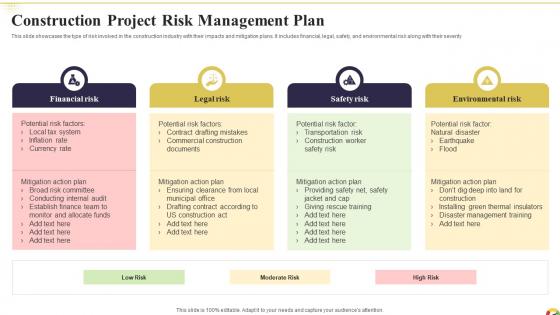
Construction Project Risk Management Plan




Try Before you Buy Download Free Sample Product
 Impress Your
 Audience
 100%
100% Editable
 Save Hours
 of Time


This slide showcases the type of risk involved in the construction industry with their impacts and mitigation plans. It includes financial, legal, safety, and environmental risk along with their severity
People who downloaded this PowerPoint presentation also viewed the following :
Construction Project Risk Management Plan with all 6 slides:
Use our Construction Project Risk Management Plan to effectively help you save your valuable time. They are readymade to fit into any presentation structure.





FAQs for Construction Project
Okay so basically you've got four main things: figuring out what could go wrong, assessing how bad it'd be, planning your responses, and keeping tabs on everything. Map out all the potential disasters - yeah, even the weird unlikely ones that make you feel paranoid. Then rate each one for how likely it is vs how much it'd suck if it happened. After that, decide your game plan for each risk. You can avoid it, pass it off to someone else, reduce the damage, or just roll with it. Oh and don't forget to actually check back on this stuff regularly - otherwise it's just busywork.
Honestly, brainstorming with your team is probably the best starting point - everyone spots different problems. Look at what went sideways on similar projects before, and definitely interview your stakeholders since they know stuff you don't. SWOT analysis works great too for thinking through everything systematically. Map out each project phase and ask yourself what could totally screw things up at that point. External stuff matters - market changes, new regulations, whatever. Dependencies are huge too. I'd throw it all in a risk register so you don't lose track of anything later.
So risk assessment is where you figure out what could actually screw you over and how bad it'd be. You're basically playing detective with all the stuff that might go wrong - catalog the threats, see how likely they are, then decide what deserves your attention first. Honestly, most people treat it like a one-and-done thing but that's backwards. Your business changes constantly, so you've got to keep revisiting this stuff regularly. Without doing the legwork upfront, you're just throwing darts blindfolded at security problems.
Start with a quick qualitative pass to spot your biggest risks - way faster than crunching numbers on everything upfront. Then drill down with quantitative analysis on just the stuff that actually matters. Honestly, I've seen too many teams waste weeks calculating probabilities for risks that barely register. The qualitative piece gives you context and helps prioritize, while quantitative backs up your hunches with real data. Works like a charm together. Just ran this approach on my last project and it saved us tons of time. Try the two-stage thing - you'll probably love how much clearer everything becomes.
Honestly, just make a simple matrix - probability vs impact. Plot your risks on there and tackle the high-impact, high-probability stuff first. But don't only think about money! Reputation hits and regulatory headaches can be way worse sometimes. I learned this the hard way at my last job lol. Score each risk for how likely it is and how bad it'd be, then multiply those numbers. That gives you your priority list. Oh and consider how fast you can actually fix things - sometimes it's smart to handle a few easy ones first while you figure out the bigger messes.
Risk management totally depends on your industry - like, what are you even protecting against? Finance bros are all about market crashes and credit defaults, so they're running stress tests and building crazy mathematical models. Healthcare's different - they're obsessing over patient safety and keeping medical records secure. Construction? Hard hats and safety protocols because people can literally get hurt. It's kinda wild how different the approaches are, but the basic idea's the same everywhere. You figure out what'll mess up your business, then build systems to stop it from happening.
So for risk tracking - if you've got the budget, ServiceNow GRC or MetricStream are solid. RSA Archer too. But honestly? I've seen teams do just fine with Monday.com or even SharePoint lists (I know, I know) paired with Power BI dashboards. Way less fancy but people actually use them. Before you pick anything though, figure out what risks you're tracking and how often you need reports. Then just grab whatever fits that workflow. The best tool is the one your team won't ignore after two weeks.
Look, forget those boring annual trainings - nobody remembers that stuff anyway. Get your managers talking about screw-ups and close calls in regular meetings. People copy what they see leadership doing. Also, don't punish someone when they flag a problem (obviously). Maybe run some hands-on workshops using real situations from your workplace - way better than generic scenarios. Oh, and this is crucial: actually reward the people who speak up about risks, not just the ones who stay quiet and avoid issues. Creates a totally different vibe when people know you've got their back.
Honestly, the worst thing companies do is treat it like some one-time paperwork thing instead of something you actually revisit. Don't just look at what's happened before either - that stuff can totally blindside you. Most places get so focused on the obvious risks they miss how everything connects together (which is usually where the real problems are). Oh, and avoid those massive committee meetings where nobody actually owns the outcome. Update your assessments regularly and actually DO something with them instead of shoving reports in a drawer somewhere.
So scenario planning is basically running "what if" drills before stuff actually goes sideways. You map out different futures - best case, worst case, the messy stuff in between. Then figure out how you'd handle each one. Honestly, most teams skip this and just wing it later (bad idea). The cool part is spotting early warning signs that tell you which scenario is actually happening. Like having a heads up before things get chaotic. Just start with your biggest 3 risks and think through how they could unfold over the next year. Way better than scrambling when crisis hits.
Look, regulatory compliance is basically your risk management foundation now. It sets your minimum standards and shapes how you spot and track risks. You really can't split these two apart anymore - I learned that the hard way at my last job. Build regulatory requirements into your framework from day one instead of jamming them in later. This impacts everything: your risk appetite, controls, reporting, the whole deal. The good news? Strong compliance integration actually makes your risk management way more solid. Map your current regulatory stuff against what you've already got to find the gaps.
Dude, AI and blockchain are changing risk management in crazy ways. You can use AI to predict fraud by catching weird patterns before they become actual problems. Blockchain creates these permanent records that nobody can mess with - super helpful for transparency stuff. The tech moves so fast it's honestly hard to keep up sometimes. But watch out because they bring their own headaches too: privacy issues, systems crashing, hackers going after new vulnerabilities. My advice? Pick one small area where either tech could help your current setup and just test it out first.
Honestly, reputation stuff is all about staying ahead of the game. Set up Google alerts so you catch problems before they blow up. Build solid relationships with people now - way easier than trying to fix things later when you're already in hot water. Draft a crisis plan with messaging ready to go, because when shit hits the fan, you don't want to be scrambling. Train your team on what not to post online. One dumb tweet can ruin everything. When issues pop up, respond fast and be straight with people. Going quiet just makes you look guilty. Oh, and do a reputation check every few months to spot blind spots.
Honestly, the key is knowing your audience. Executives just want the big picture - costs and major impacts. Meanwhile, your ops teams need all the nitty-gritty details about what'll actually break. Skip the jargon and use visuals like risk matrices. I can't tell you how many risk reports I've seen that nobody reads because they're written like contracts or something. Don't just dump a list of risks on people either. Tell them what it means for their specific world and what they should do about it. Oh, and send regular quick updates instead of those monster quarterly reports.
Honestly, major global events just blow up everything you thought you knew about risk management. COVID was perfect proof - suddenly all these supply chain vulnerabilities nobody bothered mapping came crashing down. Same with 2008 showing how weirdly connected everything was. These curveballs force you to think way beyond your typical "what could go wrong" lists. You've got to stress-test scenarios that sound completely nuts... until they actually happen. The whole framework needs way more flexibility than most people realize. I'd say build in regular check-ins and don't ignore those crazy "impossible" situations when you're planning.
-
“As you have innovative ideas and they are all customizable, this saves a huge chunk of your time to prepare well-read presentations.”
-
“Thanks to SlideTeam. Now I can make smart presentations in a fraction of time without any hassle.”