


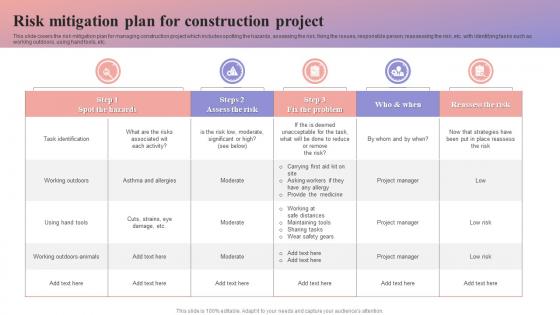
Risk Mitigation Plan For Construction Project




Try Before you Buy Download Free Sample Product
 Impress Your
 Audience
 100%
100% Editable
 Save Hours
 of Time


This slide covers the risk mitigation plan for managing construction project which includes spotting the hazards, assessing the risk, fixing the issues, responsible person, reassessing the risk, etc. with identifying tasks such as working outdoors, using hand tools, etc.
People who downloaded this PowerPoint presentation also viewed the following :
Risk Mitigation Plan For Construction Project with all 6 slides:
Use our Risk Mitigation Plan For Construction Project to effectively help you save your valuable time. They are readymade to fit into any presentation structure.





FAQs for Risk Mitigation Plan
Okay so you basically need four things for a decent risk plan. First, figure out what could actually go wrong - and trust me, there's always more than you think lol. Then assess how bad each scenario would be if it happened. After that, create specific strategies to either prevent these risks or at least minimize the damage. Assign someone to own each one with deadlines. The last part is setting up regular check-ins to see if your strategies are working. Oh and definitely document everything clearly - otherwise your team won't know what they're supposed to do when things get crazy.
Get everyone together for a risk brainstorming session first - what could blow up your project? Tech failures, budget cuts, market shifts, you name it. Plot each one on an impact vs probability grid so you're not wasting energy on random worst-case scenarios. Focus your money and attention on the high-impact stuff that's actually likely to happen. Honestly, I've watched too many teams stress about crazy edge cases while missing obvious red flags. Pick your top 5-7 risks, write down how you'll handle them, assign someone to own each one. Then just check in on them every week during meetings.
Honestly, good communication can make or break the whole thing. People need to actually know what's going on and what they're supposed to do when stuff hits the fan. I've seen so many plans completely fall apart just because someone didn't get the memo or was working with old info. Regular check-ins help a ton. Map out who needs what info and how often - sounds boring but it actually works. Your communication channels have to function in real life, not just look good in some manual nobody reads.
Honestly, tech can be a game-changer for managing risks. AI and machine learning are insane at catching patterns we'd totally miss - they'll predict problems before they even happen. Real-time monitoring gives you instant alerts when something's off. Data analytics help you figure out which risks actually matter most (instead of just panicking about everything). Cloud platforms make disaster recovery way less stressful too. My advice? Figure out where you're most blind to potential issues first, then find tools that'll give you better visibility there. Oh, and faster response times are clutch.
Look, people think risk mitigation means wiping out every possible problem - but that's not realistic at all. You're just trying to make risks manageable. Also, don't do that thing where you identify risks once at kickoff and call it done. That's like... checking your bank account in January and never looking again, you know? Risks change constantly as your project moves along. Having a fancy risk register sitting there doesn't actually protect you either. You've got to stay on top of it - review stuff regularly, update your plans. Treat it like an ongoing thing with your team.
Honestly, it depends completely on your industry. Healthcare's all about patient safety and staying compliant with regulations. Tech companies lose sleep over data breaches and when their systems crash. Manufacturing is way more intense physically - equipment failures, worker injuries, that kind of stuff. Financial firms are constantly paranoid about market swings and fraud (can't blame them). Construction? Weather screws everything up, plus site safety issues and delays. You really just need to figure out what disasters could actually hit your specific field and build your risk plan around those. Makes way more sense than some generic approach.
Set up risk check-ins every week or two - depends how fast things move on your project. Track everything in a risk register and get alerts when stuff hits critical levels. Most teams (myself included) totally forget about risks after planning, so put reminders in your calendar. Tools like Jira work great for seeing trends over time. Your team's gonna spot problems first, so make sure they can easily flag new risks. Oh, and throw it into sprint retros - makes it way less likely to slip through the cracks.
Look, you can't just create a risk plan and call it done. Build in flexibility from day one. Quarterly reviews are your friend - actually sit down and reassess what threats you're facing based on what's happening in your industry. I've watched too many companies crash because they stuck with strategies that were five years out of date, honestly. Monitor your key indicators constantly, not just when it's planning season. Cross-train people so they can shift gears fast when something new pops up. Think of it like a living doc that grows with your business.
Look, you've gotta focus on three big things: fairness, being honest about what's actually going on, and figuring out who gets stuck with the bill. Don't dump risks on people who can't handle them or have no clue what's happening - that's just shady. Be straight up about the real risks and how you're dealing with them, especially when people are making big decisions. Sometimes the "safest" route screws over certain groups, which honestly isn't worth it. Bottom line? Always ask who wins and who loses with your strategy.
Honestly, having your team involved in risk stuff is a game changer. You'll catch way more problems early when everyone's throwing in their two cents. Plus different people see different angles - like maybe Sarah gets the tech side while Mike knows how customers will react. I mean, trying to handle all that alone just sounds exhausting. Regular check-ins where people can actually speak up about concerns work pretty well. That way someone's not stuck owning every single piece of the plan, and you get way better solutions when everyone's brainstorming together.
Track both types of metrics - leading and lagging. Leading ones show if you're being proactive (training rates, risk assessments done, mitigation plans rolling out). Lagging measures what actually happened - incidents, severity, financial hits, recovery times. Honestly, I find the leading indicators way more helpful day-to-day since they catch problems early. Don't forget tracking how fast you update your risk register and respond to new threats. Dashboard combining both types works best - you'll see trends and can actually prove your work matters.
Oh man, you're so right about this. Different cultures handle risk completely differently - some want every detail planned out while others just wing it and figure things out as they go. I saw this firsthand working on projects in Japan versus Brazil, and wow, night and day difference. Communication styles matter too, plus how decisions get made and who has authority. Something that works great in one place can totally bomb somewhere else. Honestly, you've gotta really get to know your team's background first. Then tweak your whole approach to match what actually makes sense for them culturally.
Dude, skipping risk planning is honestly asking for trouble. Financial hits, operations falling apart, your reputation taking a beating - basically everything you don't want happening to your business. Small issues turn into massive headaches that could've been avoided with some basic prep work. Think of it like not having car insurance (which reminds me, I should probably check if mine is up to date lol). You might coast for a while, but when disaster strikes, you're totally screwed. Just pick your biggest 3-5 risks and make simple backup plans. Nothing fancy needed.
Look, lessons learned are like having cheat codes for your next project. Document what risks actually hit, which fixes worked, and what blindsided you completely. I can't tell you how many teams I've watched struggle with stuff that was already figured out by someone else three months ago - it's honestly painful to watch. Just throw it all in a spreadsheet or simple database that people can actually search through later. When you're planning your next project, make reviewing similar past ones part of your routine risk check. Trust me, your future self will thank you.
Ditch the boring PowerPoint stuff - nobody remembers that anyway. You want scenario-based training where people actually practice with real situations they'll encounter. Workshops and tabletop exercises work way better than theory dumps. Build a culture where folks aren't scared to speak up about potential problems. Oh, and skip those marathon annual sessions - shorter, regular refreshers stick better. One thing that really helps is having risk champions in each department. They become your go-to people when questions pop up and keep reinforcing what everyone learned during the actual training sessions.
-
Their professional templates are very impressive, even my manager was curious about the source. I am very grateful.
-
Such amazing slides with easy editable options. A perfect time-saver.