


Risk Treatment Plan For Effective Project Management




Try Before you Buy Download Free Sample Product
 Impress Your
 Audience
 100%
100% Editable
 Save Hours
 of Time


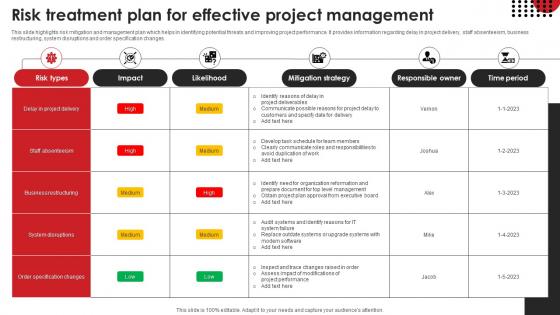
This slide highlights risk mitigation and management plan which helps in identifying potential threats and improving project performance. It provides information regarding delay in project delivery, staff absenteeism, business restructuring, system disruptions and order specification changes.
People who downloaded this PowerPoint presentation also viewed the following :
Risk Treatment Plan For Effective Project Management with all 9 slides:
Use our Risk Treatment Plan For Effective Project Management to effectively help you save your valuable time. They are readymade to fit into any presentation structure.









FAQs for Risk Treatment Plan For
Key components of an effective Risk Treatment Plan include risk identification and assessment, treatment strategy selection, implementation timelines, resource allocation, and monitoring frameworks. These elements work together by establishing clear mitigation approaches, assigning accountability across teams, and creating measurable outcomes, with many organizations finding that comprehensive plans significantly reduce operational vulnerabilities while enhancing strategic decision-making.
Organizations prioritize risks through risk assessment matrices that evaluate probability, impact, regulatory requirements, resource availability, and strategic alignment. Many financial institutions and healthcare organizations use scoring methodologies, cost-benefit analysis, and stakeholder input to rank threats systematically, ultimately enabling focused resource allocation while addressing the most critical vulnerabilities first.
Stakeholder engagement ensures comprehensive risk identification, realistic treatment strategies, and organizational buy-in throughout the Risk Treatment Plan development process. Through collaborative workshops, cross-functional input, and leadership alignment, organizations capture diverse perspectives, secure necessary resources, and enhance implementation success, with many finding that engaged stakeholders become champions who drive risk mitigation efforts across departments.
A Risk Treatment Plan aligns with strategic objectives by prioritizing risks that could impact key business goals, allocating resources to protect critical operations, and ensuring risk mitigation supports long-term growth initiatives. Through strategic risk assessment, organizations streamline decision-making, enhance operational resilience, and maintain competitive advantage, with many finding that integrated risk management ultimately accelerates strategic execution while minimizing potential disruptions.
Common risk treatment methods include risk avoidance, risk mitigation, risk transfer, and risk acceptance, each serving different organizational needs and contexts. Risk avoidance eliminates exposure entirely, mitigation reduces probability or impact through controls, transfer shifts responsibility via insurance or outsourcing, while acceptance acknowledges manageable risks, with many organizations finding that strategic combination of these approaches delivers optimal resource allocation and enhanced operational resilience.
Organizations should balance risk tolerance and treatment by aligning actions with strategic objectives, regulatory requirements, and operational capacity while considering cost-benefit ratios. Through risk matrices and stakeholder consultations, companies like financial institutions and healthcare providers determine which risks to accept, mitigate, or transfer, ultimately delivering optimized resource allocation and sustainable growth.
Success metrics for Risk Treatment Plans include risk reduction percentages, incident frequency rates, financial impact measurements, compliance scores, and treatment implementation timelines. These indicators enable organizations to track progress through quantifiable data, benchmark performance against industry standards, and demonstrate ROI to stakeholders, with many companies finding that regular metric reviews enhance their overall risk management effectiveness and strategic decision-making processes.
Risk Treatment Plans should be reviewed quarterly and updated whenever significant organizational changes occur, new risks emerge, or risk tolerance levels shift. This regular review cycle enables organizations to maintain effective risk mitigation strategies, adjust to evolving business environments, and ensure treatment measures remain aligned with current objectives, ultimately delivering sustained operational resilience and competitive advantage.
Risk management tools include risk assessment software, GRC platforms, automated monitoring systems, dashboard analytics, and incident tracking applications. These technologies streamline risk identification, treatment implementation, and ongoing monitoring by providing real-time alerts, compliance tracking, and predictive insights, with many organizations finding that integrated platforms enhance operational efficiency while reducing manual oversight requirements.
Regulatory compliance significantly shapes Risk Treatment Plan development by mandating specific risk controls, reporting requirements, and mitigation timelines across various industries. Financial institutions, healthcare organizations, and manufacturing companies must align their treatment strategies with sector-specific regulations like SOX, HIPAA, or environmental standards, ultimately ensuring legal adherence while strengthening operational resilience and competitive positioning.
Organizations typically face resource constraints, stakeholder resistance, inadequate risk assessment data, competing priorities, and insufficient coordination across departments when implementing Risk Treatment Plans. These challenges often stem from limited budgets, lack of executive buy-in, and siloed organizational structures, with many companies finding that comprehensive change management and cross-functional collaboration ultimately streamline implementation while delivering enhanced operational resilience.
Organizations integrate risk treatment strategies into project management through dedicated risk assessment phases, regular monitoring protocols, and stakeholder communication frameworks embedded within project workflows. By incorporating automated risk tracking tools, establishing clear escalation procedures, and aligning treatment plans with project milestones, teams streamline decision-making while maintaining visibility, ultimately delivering more predictable outcomes and enhanced project success rates.
Failing to effectively implement a Risk Treatment Plan can result in increased financial losses, regulatory penalties, operational disruptions, reputation damage, and strategic goal misalignment. Organizations across sectors like healthcare, finance, and manufacturing often find that inadequate risk treatment leads to cascading failures, competitive disadvantage, and stakeholder confidence erosion, ultimately compromising long-term sustainability and growth.
Lessons learned from past risk treatments enhance future planning by identifying successful mitigation strategies, revealing implementation gaps, and highlighting resource allocation patterns that delivered optimal outcomes. Organizations leverage these insights to refine risk assessment methodologies, streamline response protocols, and develop more targeted contingency plans, with many finding that documented experiences significantly reduce response times and improve strategic decision-making.
Training and awareness serve as foundational elements in Risk Treatment Plan execution, ensuring stakeholders understand their roles, responsibilities, and proper response procedures during risk events. Through comprehensive education programs, organizations enhance employee competency, improve incident response times, and strengthen overall risk culture, with many financial institutions and healthcare systems finding that well-trained staff significantly reduce operational failures and compliance violations.
-
Excellent products for quick understanding.
-
Visually stunning presentation, love the content.