

Leadership Training Action Plan Module





Try Before you Buy Download Free Sample Product
 Impress Your
Audience
 100%
Editable
 Save Hours
of Time


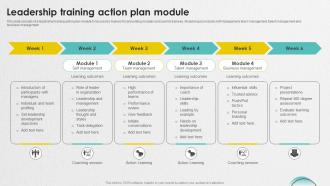
This slide consists of a leadership training action plan module to be used by trainers for presenting module curriculum to trainees. Module topics include self management, team management, talent management and business management.
People who downloaded this PowerPoint presentation also viewed the following :
Leadership Training Action Plan Module with all 6 slides:
Use our Leadership Training Action Plan Module to effectively help you save your valuable time. They are readymade to fit into any presentation structure.





FAQs for Leadership Training
Honestly? Emotional intelligence beats the old-school boss thing every time. Listen to your people for real, don't just pretend to. When stuff goes sideways (and it will), being vulnerable actually helps - weird but true. You've gotta pivot fast these days too. Digital skills are non-negotiable since everyone's working from everywhere now. The leaders crushing it focus on growing their team instead of just their own stats. Oh, and ask your people what they actually need from you. Their answers will probably surprise you more than you think.
Honestly, you've got to tailor everything to your specific industry. Healthcare leaders deal with completely different stuff than tech people - think patient safety versus moving fast and breaking things. Figure out what actually keeps your leaders up at night first. Is it compliance headaches? Crazy customer demands? Then build training around those real scenarios they face every day. Manufacturing folks need safety and efficiency focus, while finance types care more about risk and stakeholder drama. The basic leadership frameworks don't change much, but your examples better feel relevant or people will zone out. Oh, and make sure whoever's running the training actually gets your industry too.
Oh man, EQ is huge for leadership stuff. Like, way more than people realize. Most programs focus on it now because the technical parts? Pretty straightforward to learn. But reading people, managing your own reactions when things get messy - that's the hard part. I'd start watching how your emotions mess with your decisions during meetings. Sounds weird but it works. The whole self-awareness thing isn't just buzzword nonsense. You can't really motivate anyone or handle conflict well if you don't get your own triggers first. That's where you'll actually see changes in how people respond to you.
Honestly, measuring leadership training can be tricky but here's what works. Get baselines first - that's crucial. Then hit the obvious stuff: post-training feedback and knowledge tests. But the real magic happens months later when you check engagement scores, retention rates, and 360 reviews. I'm kind of obsessed with 360s because they catch things surveys miss. Don't go crazy tracking everything though - pick maybe 3-4 metrics that actually matter to your company. Wait 3-6 months before measuring again. That's when you'll see if people actually changed their behavior or just learned to talk a good game.
Honestly, I'd start with short VR simulations for practice scenarios - attention spans are trash on video calls anyway. Mix in some microlearning stuff people can do between meetings. Those interactive leadership apps work pretty well too, like escape rooms but for making decisions. Peer coaching circles are gold though - leaders just mentor each other over video. Keep rotating between live workshops, self-paced content, and actual projects where remote and office people work together. Don't try everything at once. Pick one thing, see what your team actually uses, then build from there.
Here's the thing - pair people with experienced leaders who actually meet regularly, not just those useless one-time coffee meetups. Have mentors guide real projects and give feedback on actual workplace challenges. Most programs totally bomb this because they just tack mentorship on at the end. Structure it properly with clear goals and expectations. Monthly check-ins at minimum. When someone's walking alongside participants, translating all that theory into real practice? That's when retention actually happens. Otherwise you're just wasting everyone's time with another corporate training program.
Oh man, culture stuff is huge for leadership! Different cultures have totally different ideas about authority and communication. What works great in one place can blow up in your face somewhere else - trust me, I've seen it happen with global teams. You'll want training that helps leaders spot their own biases first. Then practice scenarios where they adjust their style based on who they're working with. Communication, feedback, delegation - all of it changes depending on cultural background. Actually, start with a cultural self-assessment so they understand their default approach. Makes the whole thing way more effective.
Ugh, managing former peers is the absolute worst part - those relationships get so awkward so fast. Most new leaders also crash and burn with delegation and giving feedback though. Training programs are actually worth it because they give you frameworks for difficult conversations plus practice scenarios. Role-playing feels super cringey but honestly it's the only thing that prepares you for those terrible moments. You'll pick up how to set expectations clearly and handle conflict instead of just... avoiding it forever like I used to. Find programs with mentors if you can - they've survived the chaos already.
Here's the thing - most leadership training is total garbage because it's not connected to what your business actually needs. Start with your strategic goals first. Innovation company? Train leaders on encouraging creativity and smart risks. Figure out which specific leadership behaviors will actually impact your bottom line, then build training around those exact skills. I've watched so many companies waste money on generic programs that sound nice but don't move the needle. And honestly? Skip the satisfaction surveys - measure whether it's driving real results like revenue or efficiency instead.
Dude, case studies are game changers for leadership training. You're actually making decisions under pressure instead of just sitting through another boring lecture. Think about it - working through a real team conflict or budget mess builds that muscle memory you'll need later. It's like... you can read about riding a bike all day, but you won't actually learn until you hop on one, right? Your brain just processes it differently when you see how messy real situations get. I'd throw at least one case study into every session. Way more engaging than pure theory.
So VR training is actually pretty sick for leadership stuff. You can practice firing someone or giving terrible news without screwing up real relationships. The AI part is smart too - it notices you suck at conflict resolution and keeps throwing those scenarios at you until you get better. Way more personalized than sitting through another boring seminar. Plus you get feedback right away instead of waiting forever for someone to tell you what went wrong. Honestly didn't think I'd be recommending VR for work stuff, but here we are. Check out some of the leadership simulation programs - they're not crazy expensive anymore.
Stick to the basics that never go out of style - emotional intelligence, communication, solid decision-making. Those trendy buzzwords? They'll be dead in a year anyway. Make your content modular so you can easily swap out examples and case studies. Nothing's worse than sitting through a program that's still using ancient tech examples from like 2015. Build around core skills but keep the real-world stuff fresh. Set up quarterly check-ins with actual leaders to see what's working (or what's not). They'll tell you straight up if something feels off. Start by looking at what you've got now and figure out which parts make people zone out.
Honestly, spread the feedback throughout instead of saving it all for the end - way more effective that way. Do 360 assessments first so people know where they're starting from. During role-plays and simulations, get peers giving each other feedback too. Two-for-one deal there. Real-time coaching moments work great if you can create those safe spaces for it. External observers help tons for objective perspective. The key thing though? Make it super specific and tied to actual behaviors they can jump on right away. Otherwise it's just fluff.
Dude, self-awareness is like the base layer of good leadership. You can't lead others if you don't get yourself first, you know? Understanding your triggers and weak spots helps you stay calm when things get messy. It also means you'll actually notice how your mood affects everyone else - which honestly makes a huge difference. I've watched so many managers crash and burn just because they had zero clue about their own behavior. But here's the thing - you can totally work on this. Try reflecting after tough situations or ask people for honest feedback. Even something simple like "why did I snap there?" goes a long way.
Honestly, skip the big annual training thing - it's mostly a waste. Build peer mentoring into regular work instead. Get your leaders talking about their screwups openly (that's where the real learning happens anyway). Performance reviews should have actual development goals, not just generic fluff. Oh, and stretch assignments are huge - push people into stuff that makes them uncomfortable. Give them budget for external courses or conferences too. The whole point is making this feel normal, not like extra homework they'll ignore. When it's just part of how you operate, people actually do it.
-
They saved me a lot of time because they had exactly what I was looking for. Couldn’t be happier!
-
Eye-catching PPT designs, outstanding team, and best customer service. I’m a super satisfied customer here!