

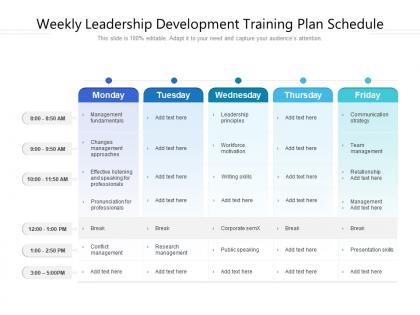
Weekly leadership development training plan schedule




Try Before you Buy Download Free Sample Product
 Impress Your
 Audience
 100%
100% Editable
 Save Hours
 of Time


Our Weekly Leadership Development Training Plan Schedule are topically designed to provide an attractive backdrop to any subject. Use them to look like a presentation pro.
People who downloaded this PowerPoint presentation also viewed the following :
Weekly leadership development training plan schedule with all 2 slides:
Use our Weekly Leadership Development Training Plan Schedule to effectively help you save your valuable time. They are readymade to fit into any presentation structure.
FAQs for Weekly leadership development
Honestly, emotional intelligence is probably the biggest one - you've gotta read the room and actually listen when people talk, not just wait for your turn. Being adaptable is huge too since everything changes constantly now. I'd say authentic communication matters way more than people think... like, your team can tell when you're being fake. Oh, and don't sleep on vulnerability - it's become so much more important lately than the old "tough boss" thing. Decision-making under pressure and developing your people are critical too. Pick one thing to work on first and just ask your team how you're doing. They'll be brutally honest.
Honestly, start with the basics - performance reviews and 360 feedback work great. But here's what I'd really watch for: how do they handle conflict? Can they influence people without being their boss? Change is another big one - some people just crumble. Give your top candidates stretch assignments or throw them on cross-functional projects. That's where you'll see their true colors under pressure. Oh, and don't get obsessed with just technical skills. EQ and communication are huge. Pick 3-4 leadership traits that actually matter for your company first, then build everything around those. Makes the whole process way cleaner.
Honestly, EQ might be more important than being smart when it comes to leadership. Like, I've watched super talented people crash and burn because they couldn't handle their own stress or read basic social cues. You've gotta know what sets you off first, then figure out how to connect with your team. It builds trust and makes conflict way less messy. The cool thing is you can actually get better at this stuff - it's not some magic trait you're born with. Maybe start watching how people react in your next few meetings? You'll be surprised what you pick up on.
Look, mentorship programs are seriously underrated for building leaders. Your up-and-coming people get real advice from someone who's actually dealt with angry clients or whatever mess they're facing. Can't learn that stuff from books, you know? Mentors help spot those blind spots we all have and push people to try new things without totally bombing. Honestly, the mentors get something out of it too - explaining leadership to others makes you better at it. Oh, and when you're setting it up? Match personalities first, not just who's been around longest. That's where most programs screw up.
Listen, you've gotta actually *listen* - like really pause and hear people out instead of just waiting for your turn to talk. Ask open-ended questions in meetings and check your own biases regularly (we're all walking around with blind spots, it's honestly crazy). Make space for the quieter voices who don't always jump in. Oh, and create mentorship opportunities across different backgrounds - that stuff actually works. The whole thing comes down to being genuinely curious about experiences that aren't yours, not just going through the motions. Maybe start by asking someone on your team this week what they thought about that recent decision you made?
Here's the thing - feedback loops let you catch your blind spots before they become disasters. You'll start seeing patterns in how people actually respond to your leadership, not just how you think they do. Trust me, that gap can be brutal sometimes! Monthly one-on-ones work great for this. Just ask what you should keep doing, stop doing, or try differently. The accountability part? Hard to ignore issues when three different people mention the same problem. Plus you can track if you're actually improving or just telling yourself you are.
Honestly, skip the classroom stuff - total waste of time in my experience. What actually works? Get them doing real projects where they can mess up and learn from it. Pair that with good coaching and you're golden. 360 reviews are solid too, gives them the honest feedback they need. Oh, and mentoring programs are clutch - match your rising stars with veterans who've been there. Create a safe space for failure though, that's huge. Don't try to do everything at once or you'll overwhelm people. Start simple and build up.
Honestly? Adaptability is huge right now - probably the biggest thing you can work on as a leader. Everything moves so damn fast that if you're stuck in old ways of thinking, you're toast. Your team needs someone who can switch gears quickly and roll with whatever chaos comes next. I've watched perfectly capable leaders crash because they couldn't drop the "but that's how we always do it" mentality. My advice? Start small with flexible decisions, then build up to the bigger stuff. Oh, and don't underestimate how much your team picks up on your energy around change - they're watching.
So I've actually seen executive coaching work really well - it's like getting a personal trainer for leadership stuff. You get honest feedback about your blind spots that nobody else will tell you. The big difference is it's totally customized to your actual problems, not some generic leadership book advice. You can practice those awkward conversations before they happen. Honestly, the accountability part is huge too. My friend did it last year and said having someone call out her communication issues (in a good way) made all the difference. If you're thinking about it, maybe pick 2-3 specific things you want to work on first?
Look, you've got to stop treating well-being like it's separate from getting stuff done. Be upfront about deadlines and why they matter - people handle pressure better when they get the bigger picture. Build in actual recovery time between sprints, and honestly? Celebrate the small wins too. Your team will burn out otherwise, which tanks productivity anyway. Check in regularly so you can spot stress before someone hits a wall. Oh, and try doing "well-being check-ups" alongside your usual performance stuff - keeps both on your radar. Sustainable teams = sustainable results. It's really that straightforward.
Look, I've seen this stuff work when it's done right. Good diversity training teaches you to spot your blind spots and actually communicate with people from different backgrounds. Some programs are total garbage though - avoid the cheesy corporate ones. What you want is practical scenarios, not lecture slides. It really does help you manage teams better and reduce drama. Plus diverse perspectives lead to way better solutions than groupthink. The empathy skills alone are worth it. Find training that feels real, not like HR checking boxes.
Honestly, tech can totally transform how you scale leadership training. VR sims are pretty cool - your future leaders get to practice tough conversations without real consequences. I'd definitely look into learning management systems that track progress and suggest personalized content based on what someone's struggling with. Video coaching platforms are blowing up right now. People record themselves practicing, then AI gives feedback on body language and tone - actually works surprisingly well. Those 360-degree feedback tools make it super easy to collect input from everyone around them too. My advice? Pick one platform that tackles your biggest headache first, then expand from there. Don't try to do everything at once.
Track the obvious stuff first - promotion rates, retention, and engagement scores before/after training. 360 feedback is solid too. But here's the thing: bad managers are literally why people quit, so engagement data is gold. Business outcomes matter just as much though - are teams actually performing better? Are leaders hitting their goals more consistently? Oh, and don't skip the long-term check-ins. See if people are still using what they learned after 6 months or if it just faded away. Start with maybe 3-4 metrics max - trying to measure everything gets messy fast.
Honestly, they'll watch what you do way more than listen to what you say, so start learning stuff yourself. Make it safe for people to admit when they're clueless about something - that was huge for me when I first managed people. Ask everyone what they want to learn this week, then actually carve out time for it. When someone tries something new and totally bombs? Celebrate that too. I throw articles at my team constantly, push them to learn each other's jobs, and we talk about development in every one-on-one. The psychological safety thing sounds fancy but it's really just "don't make people feel stupid for asking questions."
Honestly, the worst mistake is making everything way too generic instead of fitting your actual company culture. Skip the one-time workshop thing - people need ongoing practice, not just a random Tuesday seminar. Most places measure the wrong stuff too. Those "rate your experience" surveys? Totally pointless. Track if people actually change how they lead day-to-day. You've gotta give them real chances to practice what they learned - mentoring, stretch projects, whatever works. Oh, and think pipeline, not just band-aids for current issues. Build future leaders while you're fixing today's problems.
-
Great designs, really helpful.
-
Graphics are very appealing to eyes.
-
Content of slide is easy to understand and edit.
-
Great quality slides in rapid time.
-
Wonderful templates design to use in business meetings.