


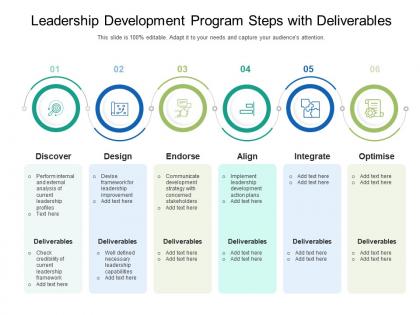
Leadership development program steps with deliverables




Try Before you Buy Download Free Sample Product
 Impress Your
 Audience
 100%
100% Editable
 Save Hours
 of Time


Our Leadership Development Program Steps With Deliverables are topically designed to provide an attractive backdrop to any subject. Use them to look like a presentation pro.
People who downloaded this PowerPoint presentation also viewed the following :
Leadership development program steps with deliverables with all 2 slides:
Use our Leadership Development Program Steps With Deliverables to effectively help you save your valuable time. They are readymade to fit into any presentation structure.

FAQs for Leadership development program
So first, figure out where everyone actually stands with their leadership skills - you need that baseline. Design training around the basics like communication and decision-making. But honestly? The mentoring part makes or breaks these programs. You've got to pair people with experienced leaders who genuinely want to coach, not just got voluntold into it. Give them real leadership chances during the program too, not just role-playing exercises. Oh, and track progress as you go - waiting until the end is pretty useless.
Honestly, start by figuring out what your managers actually suck at versus what they're good at. Survey them about stuff like communication and decision-making - but here's the thing, also ask their teams because managers think they're way better than they are. Check your succession planning too. Are people ready to move up? (Probably not.) I'd grab performance reviews and maybe do some 360 feedback. The whole point is getting different angles so you're not just making stuff up about what training they need. Oh, and look at team-building skills too - that's always a mess.
Dude, mentorship is seriously what makes these leadership programs actually worth it. You get someone who'll tell you the truth about your weak spots instead of just generic workshop advice. Plus they know people - like, my mentor introduced me to this exec who ended up hiring me later. It's basically having someone who's already walked the path give you the cheat codes. Short sentences work too. Just make sure you pick someone whose style you actually vibe with, not just whoever they assign you. Trust me, you'll still be texting them for advice years later.
Start with 360 assessments right off the bat, then build in regular peer sessions and manager check-ins as you go. Most programs totally blow it by skipping the ongoing stuff - such a missed opportunity. Focus feedback on the actual leadership behaviors you're teaching, not random generic comments. Monthly "feedback circles" work great where people in the cohort give each other real input. The whole point is making it continuous. Practice new skills, get feedback, then try again. Way better than those useless end-of-program surveys nobody reads anyway.
Honestly, start with stuff they actually deal with every day - that's what grabs people right away. Mix things up every 10-15 minutes with breakouts, role-playing, whatever keeps them awake. I've watched way too many sessions turn into snoozefests because someone just talks at people for hours. Connect everything back to their real problems, not some textbook leadership theory they'll forget by lunch. Give them time to think through how they'll actually use this stuff. Oh, and always end with something concrete they can try in the next couple days - otherwise it just becomes another meeting they attended.
Honestly, start with the basics - promotion rates and how many people actually stick around after going through the program. Employee surveys are your best friend here, trust me. People aren't shy about calling out bad managers. I'd also do some kind of 360 feedback thing before and after. The tricky part is measuring if they're actually using what they learned - maybe peer reviews or just watching how they handle situations differently. Oh, and definitely get your baseline numbers first, then check back at 6 months and a year. Don't go crazy though, pick like 2-3 things you can realistically track.
Honestly, the biggest mistake is making it feel like homework. Try pairing people from different departments as mentors - that cross-pollination thing actually works. Monthly book clubs are solid too, but don't go overboard picking dense business books nobody wants to read. Give people budget for conferences or workshops outside the company. During team meetings, maybe spend like 30 minutes talking through leadership wins and failures. The failures part is key - celebrate when someone tries something new even if it flops. Start with just one or two things though. I've watched companies throw everything at the wall and people just tune out.
Honestly, tech can totally change how you approach leadership training. AI platforms are great for figuring out where each person's struggling, then building custom learning paths around that. VR stuff is where it gets interesting though - people can practice those awkward firing conversations or handle fake crisis situations without real consequences. Mobile apps keep the learning going between your actual training sessions. The analytics side helps you see who's actually improving over time. I'd start by looking at what's not working in your current training, then find specific tech that fixes those exact problems. Way more targeted than the old one-size-fits-all approach.
Watch for people who naturally take charge when things get chaotic - they're usually the ones everyone turns to. I've noticed the best future leaders volunteer for tough projects and help teammates without being told to. Those 360 feedback surveys are super helpful too since coworkers spot leadership potential way before bosses do. During meetings with different departments, real leaders ask smart questions and somehow get everyone on the same page. Honestly, just jot down these moments when you see them happening. You'll thank yourself later when succession planning talks start.
Honestly, you've gotta feel out your team first. Watch how they react in meetings - are people actually engaging or just nodding along? Some folks need you to be super direct while others work better when you're more collaborative. I learned this the messy way with my last team lol. Try mixing it up - save the heavy conversations for one-on-ones with your introverts, but let the extroverts hash things out in group settings. Give it a week or two of just observing before you change anything major. And definitely check in with people regularly about what's actually working for them.
Dude, you can't lead people if you can't read emotions - yours or theirs. Good leaders figure out what actually motivates their team and don't make conflicts worse by being tone-deaf. We've all worked for someone who was book-smart but had zero people skills, and it's painful. Trust me, nobody follows someone they don't trust. The cool thing? You can totally work on this stuff. Next time you're in a stressful meeting, just notice what sets you off and how your energy shifts the whole room. It's kind of wild once you start paying attention.
So there's a bunch of ways to get better at this stuff. Scenario planning exercises are huge - basically you practice thinking through different "what if" situations. Case studies help too, plus getting rotated through different departments so you see how everything connects. The peer discussions are honestly my favorite part though, bouncing ideas around with other people trying to figure out the same things. Most programs throw in workshops on systems thinking and forecasting. Oh, and push for projects that make you plan 3-5 years ahead instead of just hitting next quarter's numbers. Real business problems beat textbook examples every time. Start asking "what if" questions more in your current job - it's surprisingly addictive once you get going.
Honestly, most programs crash because people try cramming too much in right away. Get your bosses on board first - like, visibly participating, not just signing off on it. Don't go generic either... I've watched so many cookie-cutter things flop because employees just zone out when it doesn't relate to their day-to-day stuff. The follow-up thing kills me though - companies spend tons on training then ghost people afterward. Track real behavior changes, not just "did they show up" metrics. Oh, and pilot it first with a small group. Way easier to fix problems early than after you've rolled out to everyone.
Look, forget those generic leadership programs everyone copies. Start with what actually makes people successful at YOUR company specifically. Innovation matters most? Build everything around creative problem-solving and taking smart risks. I've watched so many companies waste money on cookie-cutter stuff that doesn't match their culture at all. Map your values to real behaviors first. Then create scenarios based on situations your leaders actually deal with daily - not some consultant's fantasy version. The whole thing needs to feel authentic to your people, otherwise they'll see right through it.
Honestly, the best stuff happens outside those boring conference rooms. Try reverse mentoring - get your younger employees to teach the executives about TikTok or whatever's trending. Job rotation is huge too, just throw leaders into random departments they've never touched. I saw this finance guy shadow a startup founder once and it blew his mind. Action learning projects are solid because teams solve actual problems while building skills. Peer coaching circles work great, or you could gamify the whole thing with challenges. Really though, people learn leadership by doing it, not sitting through another PowerPoint presentation.
-
Understandable and informative presentation.
-
Illustrative design with editable content. Exceptional value for money. Highly pleased with the product.
-
Excellent work done on template design and graphics.
-
Easily Editable.
-
Excellent design and quick turnaround.