

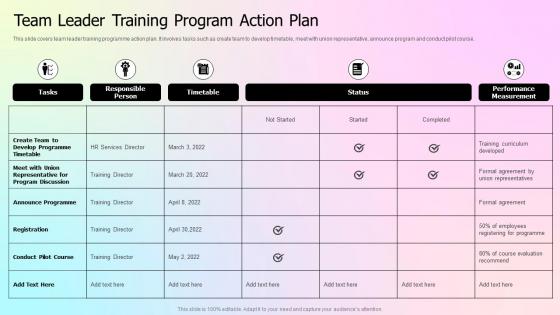
Team Leader Training Program Action Plan




Try Before you Buy Download Free Sample Product
 Impress Your
 Audience
 100%
100% Editable
 Save Hours
 of Time


This slide covers team leader training programme action plan. It involves tasks such as create team to develop timetable, meet with union representative, announce program and conduct pilot course.
People who downloaded this PowerPoint presentation also viewed the following :
Team Leader Training Program Action Plan with all 6 slides:
Use our Team Leader Training Program Action Plan to effectively help you save your valuable time. They are readymade to fit into any presentation structure.





FAQs for Team Leader Training
Honestly, start with communication and delegation - you'll use those every single day. Active listening is massively underrated too. Like, so many team issues happen just because people don't feel heard, you know? Conflict resolution and emotional intelligence are clutch, but don't stress if feedback feels awkward at first. Most new managers suck at it initially (I definitely did). Decision-making under pressure and figuring out what motivates each person on your team - that stuff takes practice. My advice? Pick maybe 2-3 skills max to focus on. Trying to nail everything at once is a recipe for burnout.
Honestly, the key is tailoring everything to what each industry actually deals with. Healthcare folks need totally different training than tech managers - like patient safety stuff vs agile frameworks. I'd start by asking participants what their biggest daily headaches are first. Manufacturing teams care about safety metrics and efficiency, while creative agencies are all about collaboration and innovation (totally different vibes). The basic leadership principles don't change, but how you apply them? Completely different story. Match your examples and communication style to their world - it makes such a huge difference in getting people engaged.
Honestly, I'd start with basic before/after tests to see if they actually learned anything. But the real magic happens when you check back in like 6 months later - get feedback from their teams, managers, whoever works with them daily. That 360-degree stuff really tells the story. Self-assessments are weirdly helpful too, people often have better insights about themselves than you'd expect. Track the actual numbers that matter: productivity, turnover, engagement scores. Oh, and definitely start measuring this stuff now so you have something to compare to later when you tweak things.
Definitely do role-playing scenarios - they work way better than just lecturing about EQ theory. Start with basics like spotting emotions in yourself and your team members. Active listening practice is huge too. The programs I've seen work best actually use real workplace drama as case studies, which sounds messy but it's honestly pretty effective. Make sure you cover stress management and how to give feedback without being a jerk about it. Oh, and 360-degree feedback sessions are gold - people get real input on their emotional blind spots. The whole thing needs to be hands-on though. Give them actual techniques they can try right away when they're back with their teams, not just fluffy concepts.
Dude, mentoring is such a game-changer for leadership training. You get real feedback on actual problems instead of just theory stuff. Pairing new leaders with experienced people works because they help you figure out your specific team situation - way better than generic advice. The ongoing support thing is huge too. Like, training ends but the mentor relationship keeps going, which honestly makes all the difference. I'd push hard to build it into your program right from the start. My old boss always said mentoring was what actually made him a decent leader, not the workshops.
Focus on active listening, de-escalation, and frameworks like the PEACE method. Role-playing is huge - conflict stuff feels super weird until you practice it tons. Your training should cover staying neutral and asking good questions to find root issues. Help people find their own solutions instead of just telling them what to do. Hands-on practice with real workplace scenarios works best, honestly. Oh, and definitely plan follow-up coaching sessions afterward. These skills take forever to feel natural, so don't expect people to nail it right away.
Honestly, micro-learning is everywhere right now - way better than sitting through those brutal 2-day workshops. Companies are finally getting that people learn better in small chunks. Remote leadership training is huge too, plus anything around emotional intelligence. Psychological safety keeps coming up since managing hybrid teams is honestly pretty different than in-person. Oh, and AI-powered stuff that personalizes your learning path based on what you actually suck at. I'd skip the theoretical programs and find something with real-time feedback and peer coaching instead.
Dude, it's huge. You're basically shaping how your whole team feels about showing up as themselves. The training opens your eyes to stuff you didn't even realize you were doing - I was shocked at my own blind spots tbh. Diverse teams just perform better, that's facts. You'll learn actual skills like running meetings where everyone speaks up and hiring without letting bias creep in. Skip the fluffy awareness stuff though. Look for programs that give you real tools you can use right away. Your team will thank you for it.
So for team leader training, I'd start with an LMS like Cornerstone or TalentLMS - tracks everything and keeps content consistent. Kahoot's awesome for quizzes, and Mentimeter works great for live feedback during sessions. Loom is clutch for making short leadership videos people can watch whenever. Oh, and Miro or Mural are surprisingly good for workshop stuff - way more engaging than I expected when I first tried them. My advice? Pick one tool that fits your budget first. You can always add more later once you figure out what actually works with your team.
Start with psychological safety training - that's your foundation. Managers need to learn how to ask good open-ended questions and actually celebrate when experiments fail. I've watched so many innovation programs crash because leaders still secretly punish people for taking risks. Train them on facilitation skills and basic design thinking. They also need to carve out real time for creative work, not just squeeze it between meetings. Oh, and this is huge - teach them to reward innovative thinking itself, not just the wins. Most people have decent ideas if you give them space to share them.
So you'll want to measure both the obvious stuff and the subtle things. Retention rates, engagement scores, how fast projects get done, plus feedback from their team members. Honestly, I think the best indicator is whether people bring problems to them instead of going around them - that tells you everything. Track their one-on-ones too and how well they set goals with people. Oh, and definitely get baseline numbers before any training starts or you won't know if anything actually improved. Give it like 30-60 days after training, then check every quarter.
Honestly, virtual leadership training can work pretty well if you don't just lecture at people. Breakout rooms are your friend - use them for coaching practice and role-plays. Polls keep everyone engaged, and definitely record sessions so they can go back later. Keep it under 90 minutes though, seriously. I learned this the hard way when I saw people checking email during a 3-hour session. Screen sharing works great for walking through real cases together. Oh, and test everything with a small group first - saves you from those awkward tech moments when you're presenting to the whole company.
Oh man, you're gonna love the one-on-ones part - seriously game changing for understanding what actually motivates people. The recognition stuff goes way deeper than just "nice work" (though honestly that still works better than nothing lol). They teach you this active listening thing that's pretty solid, plus how to connect personal goals with team stuff. The feedback section is gold - shows you how to give criticism without crushing souls. There's also psychological safety training so people aren't scared to mess up. Just start with weekly one-on-ones, trust me on this one.
Honestly? Twice a year minimum, but the really good leaders never stop learning. I'd say quarterly is the sweet spot - mix it up with workshops, online stuff, whatever works. Your core skills get stale fast these days. What killed it in 2023 might flop now. Also grab extra training when you get promoted or your team doubles in size. Don't sit around waiting for HR to plan something either (they're probably swamped anyway). Block out time this week to see what's out there. Even peer sessions with other managers can be gold.
Honestly, the worst part is getting people to actually show up and care - everyone's already drowning in their regular workload. Senior management can be a pain too if they're not backing you. Skills are all over the map, which gets messy fast. Time's always tight, and here's the kicker - you can't really prove leadership training worked right away since that stuff takes forever to actually stick. Oh, and people just hate change in general. Best bet? Try a small test group first, rack up some quick wins, then figure out how you'll actually measure success before you start.
-
Unique design & color.
-
A big thanks to SlideTeam! An incredible and diverse library of templates helped me with my business project presentation.