

Training Program Development Process Framework




Try Before you Buy Download Free Sample Product
 Impress Your
 Audience
 100%
100% Editable
 Save Hours
 of Time


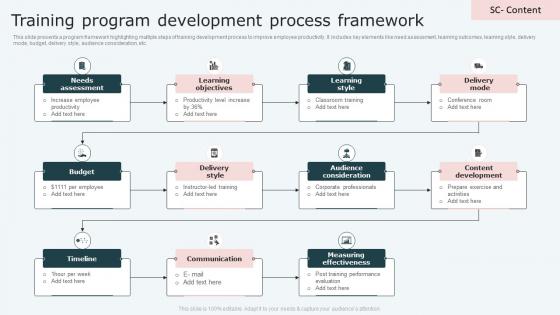
This slide presents a program framework highlighting multiple steps of training development process to improve employee productivity. It includes key elements like need assessment, learning outcomes, learning style, delivery mode, budget, delivery style, audience consideration, etc.
People who downloaded this PowerPoint presentation also viewed the following :
Training Program Development Process Framework with all 6 slides:
Use our Training Program Development Process Framework to effectively help you save your valuable time. They are readymade to fit into any presentation structure.





FAQs for Training Program
Honestly, start with your learning objectives - everything else builds from there. You'll want content that actually matches where people are skill-wise, plus interactive stuff like group work or hands-on practice (way better than just talking at them). Build in solid ways to check if they're actually getting it, and create feedback loops going both directions. The thing that kills most programs? Zero follow-up support once it's "done." People need reinforcement afterward or they'll forget half of what they learned. Oh, and make sure you're getting their input throughout - not just at the end when it's too late to fix anything.
Start with a quick survey or just chat with people informally - they're usually pretty honest about what they suck at! Look at performance data too, like error rates or customer complaints that might show gaps. Managers can give you a totally different angle on what the team actually needs (vs what they think they need). Honestly, I've found there's often a weird disconnect between those two things. Sometimes people think they need advanced stuff when they're missing basics. The trick is mixing what they're asking for with what the numbers are telling you.
So there's this framework called Kirkpatrick's four levels that's actually pretty useful. First two are easy - did people like the training and did they learn anything? Just do surveys and quick tests. The tricky part is seeing if they're actually using it at work and whether it moves the needle business-wise. Honestly, most companies skip this part because it's harder. You'll need manager check-ins, performance data, that kind of thing tracked over like 3-6 months. My advice? Start with the basics - feedback forms and knowledge checks. Then work your way up to the meatier stuff once you get the hang of it.
Honestly, tech can help at basically every step. AI tools are great for spotting learning gaps and cranking out content outlines. Then use Articulate or even Canva for the interactive stuff - Canva's surprisingly decent for this. Your LMS handles the boring delivery/tracking parts, but mobile apps work well for bite-sized learning. VR's amazing if you need hands-on training (though maybe overkill for some things). Analytics will actually show you what works instead of just guessing. My advice? Start with one problem area where tech genuinely helps rather than going nuts digitizing everything.
Honestly, learning theories are like a cheat sheet for how people's brains actually work. For skill stuff, use behaviorism - repetition and rewards work wonders. Cognitivism's your go-to when people need to grasp complex processes. Constructivism helps when they're building on what they already know. Social learning is underrated though - watching someone nail a task teaches so much more than you'd think. Figure out what type of learning you need first. Then match your approach to how brains naturally handle that content. It's way more effective than just winging it.
Honestly, switch things up every 10-15 minutes or people will mentally check out. Throw in polls, breakout rooms, case studies - whatever keeps them engaged. I swear by "tell me, show me, let me try" because it actually sticks. Skip the boring generic examples and use stuff they deal with every day. Give them time to think about how this applies to their real work too. Oh, and start each section by asking what problem they're trying to solve. Makes them feel invested instead of just sitting there absorbing information like sponges. Active participation beats passive listening every single time.
Definitely mix up your delivery - nobody wants to sit through hours of straight lecturing. Group activities and real-world scenarios are your best friends here. I always do frequent check-ins to gauge energy levels, and honestly? Good snacks make a huge difference (sounds silly but it works). Break everything into smaller chunks people can actually absorb. Setting clear milestones helps too so they feel like they're getting somewhere. But here's what really works - start each session asking what problems they're dealing with right now. Then use those specific issues in your examples. Makes it way more relevant than generic case studies.
Oh man, cultural stuff is HUGE for training design. Different groups have totally different learning styles - some love working together, others want to learn solo. Language barriers are obvious, but there's also weird subtle things like how people expect feedback or respect hierarchy. I learned this the hard way once! Colors in your materials can even be offensive in some cultures. Religious holidays matter too. Honestly, just survey people upfront about their backgrounds and what works for them. Don't assume everyone learns the same way you do.
Look, feedback is everything - without it you're just throwing money at training and hoping something sticks. I always tell people to check in during sessions, right after, and again a few weeks later. Too many companies skip this part and wonder why their programs flop. Quick pulse surveys work great, plus those post-training assessments and manager check-ins. The trick is actually reviewing that data monthly instead of letting it collect dust. Oh, and make giving feedback dead simple - people won't do it if it's a hassle.
Figure out what your company actually wants to accomplish first - real business goals, not some fluffy mission statement nonsense. Work backwards from there. What skills do people need to hit those targets? I always connect each training thing directly to a business goal so you can draw a straight line between them. Be crazy specific about what success looks like and how you'll track it. Here's what I ask myself: if this training actually works, what's gonna be different when people show up to work tomorrow? That's honestly the best way to know if you're on the right track.
Okay so first thing - figure out what people actually need to DO after they finish, not just what they should "know." Break everything into chunks under 10 minutes because honestly, attention spans are terrible these days. Skip the boring text walls and throw in some quizzes or scenarios instead. Real workplace examples make such a difference - people tune out when it feels too generic. Oh and test your stuff beforehand! Nothing kills the vibe like broken videos. Get a couple people to try it out while you're building it, not after you've spent weeks on the whole thing.
Mix up how people learn stuff - visuals, hands-on activities, discussion time. Some folks freeze up when you put them on the spot, so balance group work with solo reflection. Don't just lecture the entire time (boring as hell). Give choices when you can - like reading vs watching a demo. I'd switch up delivery methods throughout each session. Oh, and definitely ask for feedback afterward to see what's actually working. People learn differently and you won't nail it for everyone, but variety helps hit most learning styles.
Track completion rates and test scores, sure, but that stuff's pretty surface-level honestly. What you really want to see is if people are actually *doing* anything different after training. Check your performance metrics, error rates, productivity - whatever matters for your specific goals. Employee engagement and retention are worth watching too, though that takes longer to show up. Oh, and definitely set up your tracking before you launch the training. Trust me on this one - trying to hunt down data afterward is a nightmare. Behavior change is where the real value shows up.
Figure out what's really bugging them first. Usually it's fear - they think you're saying their work sucks, or they don't want to look dumb. Some people just hate change (can't blame them tbh). Explain the actual business reason upfront and how it'll make their lives easier. Don't just have managers demand it - get them genuinely on board. Try mixing up the format too. Shorter sessions work better than marathon training days. Make it feel like you're investing in them, not fixing something broken. That shift in framing makes a huge difference.
Okay so obviously you've got your big costs - instructors, materials, venue if it's in-person. But here's what everyone forgets: your people aren't working while they're training. That's lost productivity right there. Plus all the tech stuff, assessment tools, maybe travel if you're flying someone in. Oh and something ALWAYS goes wrong - trust me on this. I learned that the hard way last year. Budget an extra 15-20% for random crap that comes up. Leadership hates budget surprises way more than they hate slightly padded estimates upfront.
-
I am so thankful for all of the templates I've found on your site. They have saved me hours every week and helped make my presentations come alive. Keep up with these amazing product releases!
-
No second thoughts when I’m looking for excellent templates. SlideTeam is definitely my go-to website for well-designed slides.