

Training program framework showing learning objective and develop content




Try Before you Buy Download Free Sample Product
 Impress Your
 Audience
 100%
100% Editable
 Save Hours
 of Time


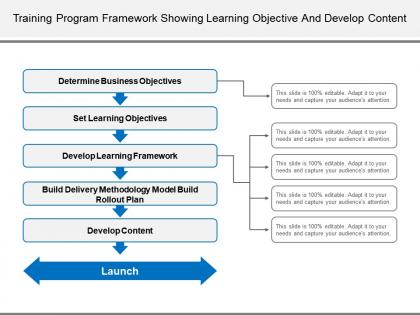
Introducing Training Program Framework Showing Learning Objective And Develop Content slideshow. Highlight the stages of the development process by explaining analysis, design, development, implementation, and evaluation. Outline your training objectives such as effective leadership, resolving key issues, etc. Showcase the steps in developing a training program. Also, describe your training process and talk about your team members and their expertise that will play a major role in persuading your clients. This industry-training compliant PPT template will help you in pitching your services efficiently in front of your potential clients. Also, present the ways to measure training effectiveness by using training metrics PPT visual. By using this ready to use employee training program PowerPoint visual you can plan, develop, implement, and evaluate a successful learning training. Develop training objectives for your business by downloading this visually attention-grabbing leadership training PPT theme.
People who downloaded this PowerPoint presentation also viewed the following :
Training program framework showing learning objective and develop content with all 5 slides:
Build firm alliances with our Training Program Framework Showing Learning Objective And Develop Content. Increase the extent of your influence.



FAQs for Training program framework showing learning objective
Okay so first thing - nail down your learning objectives. What should people actually be able to DO when you're done? Then mix up how you deliver stuff - videos, workshops, letting people practice hands-on. I'm personally obsessed with hands-on learning because lectures just don't stick. You'll want checkpoints throughout to see if anyone's actually getting it. Oh and here's the thing everyone forgets - follow up afterward! People's brains are sieves without reinforcement. Keep tweaking based on feedback too. Build everything around those specific objectives and you're golden.
Honestly, just survey your teams first to see where their skills don't match what you actually need. Talk to managers about performance problems they're noticing too. Check if people are even using current training - spoiler alert, probably not if it's deadly boring. Your turnover data will reveal gaps in skills or onboarding that you might've missed. Don't forget about future needs from your strategic plans either. Once you map this stuff out, you'll know what training actually moves the needle instead of just looking good in presentations.
Honestly, tech can totally transform how you do training. Start with learning management systems - they'll track everything and automate course delivery so you're not drowning in admin work. AI personalizes content based on how fast people learn and what they're struggling with. VR and AR are game-changers though - way better to practice safety procedures virtually than just reading some boring manual, right? Mobile learning means your team can train whenever they want. Analytics show you what's actually working vs what's a waste of time. My advice? Don't try to do everything at once. Pick your biggest headache first, then test one solution.
Here's the thing - adults are totally different learners than kids. They want to know WHY before they'll buy into any training. Makes sense, right? You can't just lecture them and expect it to stick. Instead, tie everything directly to problems they're actually facing at work. Let them control the pace too - nobody likes being rushed through stuff they need to master. Build on what they already know rather than starting from scratch. The real game-changer is switching to hands-on activities and real scenarios they'll encounter. Skip the theoretical fluff.
Look into the Kirkpatrick model - it breaks down into four parts. Did people like the training? Actually learn something? Apply it at work? And does it help the business? Most places just check if butts were in seats, which is pretty useless honestly. Post-training surveys are a good start for reactions. Test knowledge with quick assessments. For behavior changes, get managers to give feedback or just observe what's happening. Then try connecting it back to real performance numbers. Start basic and work your way up to tracking the long-term stuff - that's where you'll see if training actually stuck.
Mix up your delivery methods - some people are visual, others need to actually do stuff to learn. Videos and infographics work great for the visual crowd. Hands-on workshops hit the people who learn by doing. Discussion groups or even podcasts work for auditory learners. Survey your team first to see what they actually want. Then make sure each important concept gets delivered at least 2-3 different ways. Oh, and don't forget pacing - some folks need time to digest while others just want to power through. Way too many companies still think death-by-PowerPoint counts as training. It doesn't.
Look, feedback is like your GPS for fixing what's broken in your framework. Learners will call out confusing content and pacing problems you totally missed. Trainers? They'll hit you with the real delivery issues. Some of my best "aha moments" came from feedback I never expected - weird stuff that completely blindsided me. You want multiple ways to collect it though: surveys, focus groups, performance data, random hallway conversations. Just make sure you're actually systematic about it. Otherwise you'll drown in complaints that don't help anyone.
Honestly, just weave the training right into what people are already doing daily. Don't make it this whole separate program thing. Find the tasks where someone can actually learn by doing real work, then stick them with someone experienced who knows their stuff. Job shadowing is clutch for this - way more effective than sitting in some boring training room if you ask me. Set up rotations so people can try different roles, and definitely write down what's working so you can do it again later. The whole point is making it feel natural, not like some corporate initiative they're forced into.
Honestly, the hardest part is convincing stakeholders who want instant results when ROI takes forever to show. Resource constraints hit hard too. Content gets stale ridiculously fast - like, you'll update something and it's already outdated next month, which drives me crazy. Measuring success beyond "did they finish it" is tough. Scaling gets messy when everyone wants their own personalized path. Plus people hate change, especially if they've been doing things the same way for years. Start with a small pilot though. Get some quick wins first, then build from there. Oh, and budget way more time for tweaking stuff than you think.
Honestly, having a solid training framework is a game-changer because it stops you from just randomly picking courses that sound interesting. Instead of scattered learning, you get a clear roadmap. Map out where your skills are now versus where you need to be in a couple years - that gap is your starting point. The cool thing is you can customize it based on your actual career goals, not some generic path. It keeps you sharp as industries change too. I mean, nobody wants their skills getting rusty while everyone else moves ahead. Start with a skills audit and see what you're working with.
First thing - audit what each site's doing now, then work backwards from there. Create one master curriculum everyone uses, plus standard training videos and rubrics. Digital platforms are honestly clutch for this because they keep everything consistent and let you track who's progressing where. Set up monthly calls between trainers so they're sharing what works. Each location needs a designated training lead who can tweak things for local stuff while keeping the main content the same. I learned this the hard way at my last job - without that communication piece, people just go rogue. Regular check-ins make all the difference.
Honestly, the best training setups just make learning feel like part of the regular routine instead of some big deal. Figure out what skills your people actually need first - not what some consultant thinks they need. Then build consistent programs around those gaps. Short sessions work better than marathon training days, trust me. Your managers have to participate too or the whole thing falls apart. Nobody's buying into training when their boss acts too cool for it. Make it relevant to real work problems they're facing. Oh, and definitely tie it into performance reviews and actually celebrate when people finish stuff.
Look, if your training doesn't connect to what the company actually cares about, you're just wasting everyone's time. I've seen this happen so many times - people roll out random workshops and wonder why nothing changes. Here's what works: figure out your company's top 3 priorities first. Sales growth? Customer retention? Whatever it is. Then look at your current training and honestly ask which programs actually help with those goals. When employees see how learning connects to real business stuff, they'll actually pay attention. Plus leadership won't question your budget when they see results that matter to them.
You know what really works? Getting different departments to actually work together on training stuff. HR can team up with IT and sales to create programs that mirror how people actually work, not just boring theoretical crap. Each department knows their own headaches best, so they'll design things that people will use. Plus you can split costs - which honestly, who doesn't love saving money? The trick is having department heads check in regularly so everything stays on track. Otherwise you end up with training that sounds great on paper but doesn't help anyone do their job better.
Dude, people's attention spans are absolutely shot online, so you've gotta switch things up constantly. Break out rooms, polls, chat - hit them with something interactive every 10-15 minutes or you'll lose them. Keep your camera on and push others to do the same. Creates way more accountability that way. Try the "popcorn" thing where participants call on each other - works surprisingly well. Oh, and always have backup activities ready because tech will definitely fail you at some point. After each session, send a quick survey to see what actually stuck. Trust me on this one.
-
Illustrative design with editable content. Exceptional value for money. Highly pleased with the product.
-
Great quality product.