Corporate Software Development Training Timeline

Rating:
100%
Corporate Software Development Training Timeline
Slide 1 of 6
Favourites Favourites

Try Before you Buy Download Free Sample Product

Audience Impress Your
Audience
Editable 100%
Editable
Time Save Hours
of Time
The Biggest Sale is ending soon in
0
0
:
0
0
:
0
0
Rating:
100%
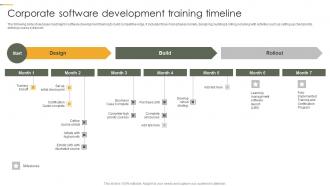
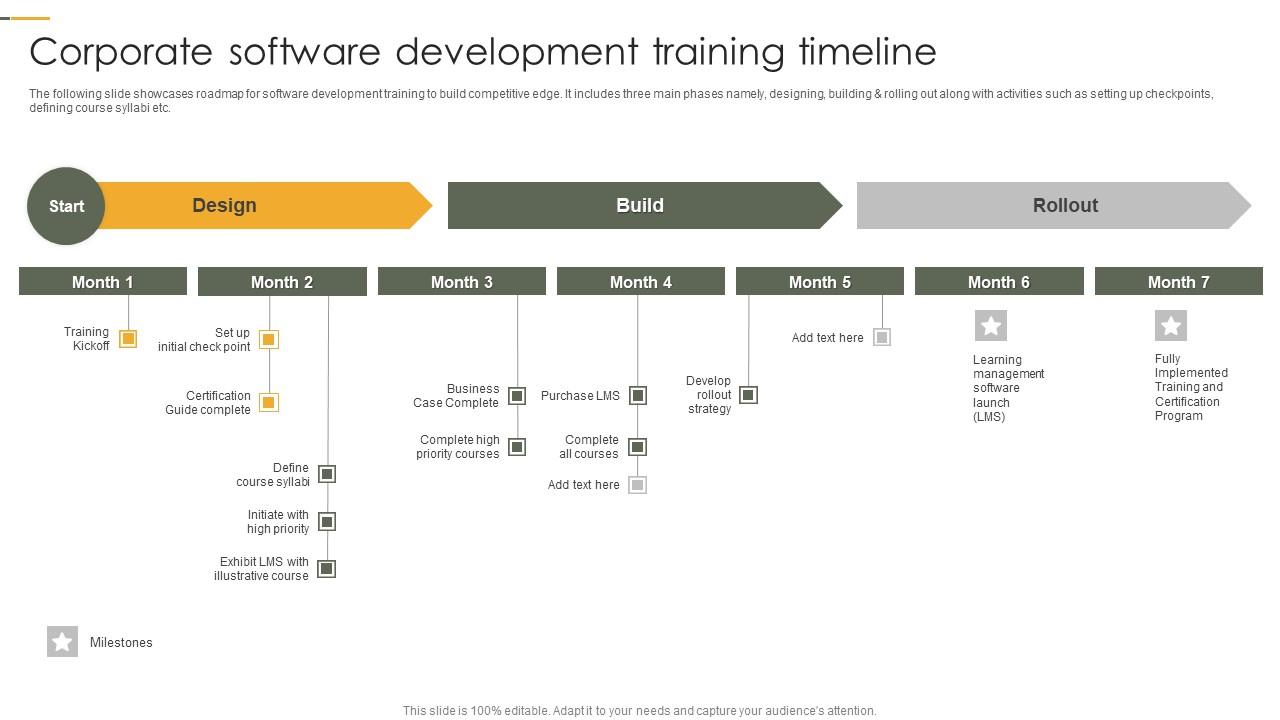
The following slide showcases roadmap for software development training to build competitive edge. It includes three main phases namely, designing, building and rolling out along with activities such as setting up checkpoints, defining course syllabi etc. Presenting our set of slides with name Corporate Software Development Training Timeline. This exhibits information on seven stages of the process. This is an easy-to-edit and innovatively designed PowerPoint template. So download immediately and highlight information on Design, Build, Rollout.
FAQs for Corporate Software

Focus on four key things: match the training to whatever tech you're actually using, work on soft skills too (communication stuff matters more than people think), do real coding scenarios instead of boring tutorials, and pair juniors with senior devs. Code review sessions are honestly the best part - people learn way more from actual screwups than fake examples. Don't make it some one-week intensive thing either. Keep it rolling throughout the year and get feedback so you can tweak what's working and dump what isn't.

So first thing - map out what skills your team actually has right now. Do some coding challenges or architecture reviews, plus get people to rate themselves and each other. Fair warning though, self-evaluations are usually trash. People either way overestimate or completely undersell themselves. Code reviews are where you'll really see the gaps. Maybe run a few mini workshops on important stuff and watch who gets lost. Oh, and don't skip the soft skills part - communication matters just as much as coding. Try it with one team first before going all-in.

Dude, tech moves ridiculously fast - your skills can go stale in like 6 months if you're not careful. Training programs are honestly a lifesaver because they give you a clear roadmap instead of wandering around Stack Overflow at 2am trying to teach yourself React (been there). Companies that actually give you time during work hours to learn? That's gold. You'll burn out fast trying to cram everything into nights and weekends. The best programs let you build actual stuff and work with other people - way better than just watching tutorials alone.

Here's what I'd do - start by checking your training against what the big tech companies are actually asking for in their job postings. Get some outside consultants in there because honestly, when you're too close to something you miss the obvious stuff. Survey your newer hires about what gaps they're seeing, and definitely ask your current devs what training actually helped versus what was just busy work. Look at your competitors too (a little corporate stalking never hurt anyone). The frameworks like Agile and SCRUM are table stakes now, but track which modules actually improve performance reviews. That's where the real data is.

Honestly? Skip the boring lectures and get people actually coding. Workshops where they build real stuff work way better. Pair programming is clutch too - developers learn faster when they're working together. Oh, and definitely do code reviews as a team learning thing. I'd throw in some bootcamp-style sessions for new frameworks. Those lunch-and-learns are pretty solid for staying current with new tech (plus free food never hurts). But first, just ask your team what they actually want to learn and how they prefer learning it. Survey them or whatever - saves you from guessing wrong.

So basically, track the obvious stuff - productivity jumps, fewer bugs, faster project delivery. Employee retention too (people stick around when they're learning, which honestly saves you tons in hiring costs). Don't go crazy trying to measure everything though. Pick like 2-3 things that actually matter to your team's goals. Most companies already collect this data anyway, so you're not starting from scratch. Compare your before/after numbers over maybe 6-12 months, subtract what you spent on training, boom - there's your ROI percentage. Code quality scores help too if you're being thorough about it.

Ugh, time is your biggest enemy here. Everyone's drowning in deadlines so training gets pushed aside constantly. Mixed skill levels are brutal too - you'll either put the senior devs to sleep or completely freak out the newbies. Budget constraints suck, especially if you want decent external help. Honestly, most developers think formal training is kinda pointless anyway since they're used to just figuring stuff out as they go. My advice? Start small and focus on actual problems your team's dealing with right now. Skip the theoretical workshops - nobody has patience for that stuff when they're already swamped.

Yeah definitely! Way better than those boring generic courses tbh. First thing - figure out what your team actually codes in every day. Then find training companies that'll build stuff around your exact tools. Most decent ones will create labs using your actual codebase or something super similar. Like, basic Python training is whatever, but Django workshops? That's where it gets good. Be really specific about your setup too. If you're running AWS, React, and Node, make that the whole focus instead of random theoretical stuff. Oh and push for hands-on projects that actually match what you're dealing with at work.

Honestly, remote work killed those awful all-day training sessions - thank god. Now everything's bite-sized and on-demand, which actually makes sense since people can learn at their own pace. You can pause, rewind, practice stuff until it clicks. Way better than cramming 20 people in a conference room for 8 hours straight. The downside though? You miss out on those random conversations and mentoring moments that just happen naturally when everyone's around. My take is go hybrid - do the structured online modules but throw in regular virtual pair programming sessions. Keeps the human element without the stale bagels.

Honestly, get your junior devs paired up with mentors from the start - don't wait for some formal program. Weekly one-on-ones are clutch for code reviews and architecture stuff. But here's what really works: having mentors actually code alongside them on real projects. Way better than any training workshop I've seen. Rotate the pairings every 6 months though, because different mentors have totally different approaches and it's good exposure. Oh, and give mentors some structure - like quarterly goals to focus on. Track progress through actual work they're shipping, not those annoying feedback surveys nobody fills out properly anyway.

From day one, bake content reviews right into your training setup. Quarterly audits work well - have your team check if frameworks and tools are still relevant. Your engineering folks are gold for this since they're hands-on with the tech daily. Most companies screw this up by treating training like homework you never revisit. Feedback loops are crucial so devs can immediately flag stale content. Oh, and buddy up with tech vendors for early feature access - that's actually super helpful. I'd start with your three most important training modules first, then expand from there.

Honestly, just bake it into what you're already doing. Code reviews are perfect for this - make developers practice giving feedback that doesn't crush souls. Pair programming naturally forces communication too. Sprint retros are amazing but nobody talks about how they build teamwork skills. Oh, and have them present their work to business people - watching a dev explain APIs to marketing is... educational lol. You could throw in mock client meetings during requirements sessions. The key is not making it feel like some cheesy workshop. Pick something from your current training and just add the people part. Way more effective than separate sessions.

Honestly, you gotta build stuff if you want any of this to stick. Reading about code is fine and all, but nothing beats that moment when your project completely crashes and you have to figure out why. That's when it actually clicks. Projects also give you real things to show off in interviews - way better than just saying "yeah I know JavaScript." The debugging nightmares you'll deal with? That's exactly what the job's gonna be like anyway. Start small with something you actually care about though. You'll stick with it longer.

Mix your internal training with outside stuff - it's a game changer. Pluralsight and Coursera have way more current tech courses than you could ever build yourself. Industry partnerships work really well too. Hit up local universities for specialized workshops, or do knowledge swaps with other companies. Just make sure whatever you pick actually matches your tech stack and goals - don't chase shiny objects because they're trending. Oh, and start with one platform first. See what your devs actually use before going crazy with options.

Block out weekly learning time and don't let meetings eat into it. Pizza tech talks actually work - have people share what they've learned with the team. Pair juniors with seniors regularly, then switch up the pairs so knowledge spreads around. You want people feeling safe to ask dumb questions without judgment. When someone nails a new framework or cracks a tough problem, celebrate it publicly. Oh, and side projects are gold for this stuff. The key is making it feel normal, not like extra homework nobody wants to do.

Ratings and Reviews

100% of 100
Review Form
Write a review
Most Relevant Reviews
  1. 100%

    by Dick Ryan

    Use of icon with content is very relateable, informative and appealing.
  2. 100%

    by Donny Elliott

    Every time I ask for something out-of-the-box from them and they never fail in delivering that. No words for their excellence!

2 Item(s)

per page: