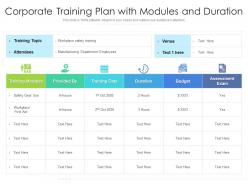
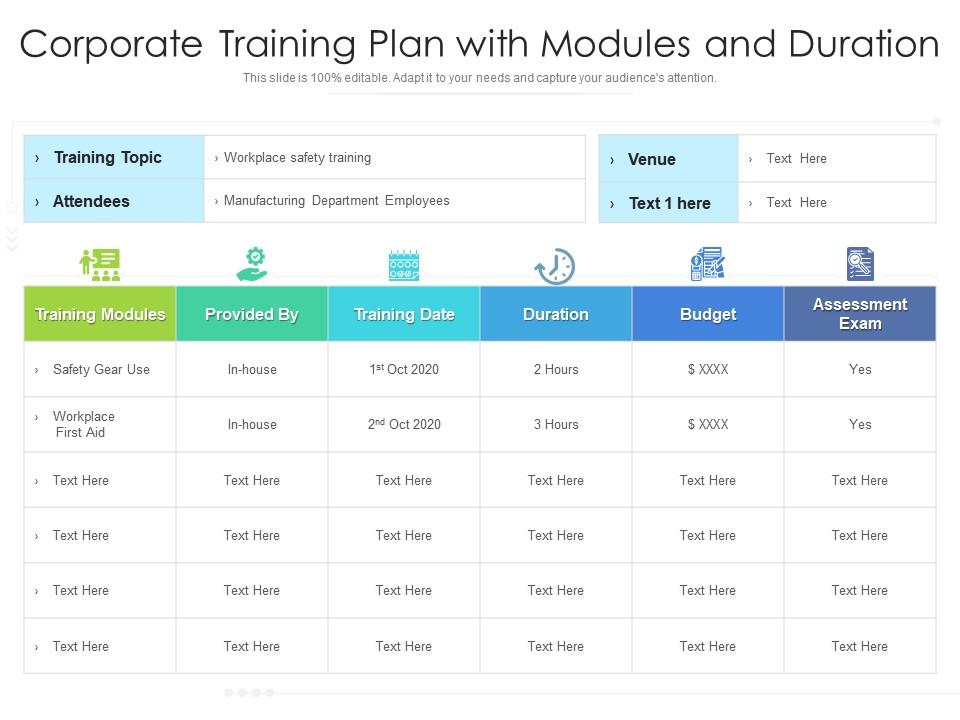
Corporate training plan with modules and duration
Try Before you Buy Download Free Sample Product
Audience
Editable
of Time
Our Corporate Training Plan With Modules And Duration are topically designed to provide an attractive backdrop to any subject. Use them to look like a presentation pro.
People who downloaded this PowerPoint presentation also viewed the following :
Corporate training plan with modules and duration with all 2 slides:
Use our Corporate Training Plan With Modules And Duration to effectively help you save your valuable time. They are readymade to fit into any presentation structure.
FAQs for Corporate training plan with
Key components of an effective corporate training plan include needs assessment, clear learning objectives, diverse delivery methods, comprehensive content modules, and measurable evaluation metrics. These elements work together by identifying skill gaps, engaging different learning styles, and tracking progress, with many organizations finding that strategic training combinations ultimately enhance employee performance, reduce turnover, and deliver sustainable competitive advantage.
A corporate training plan aligns with business goals by identifying skill gaps that hinder strategic objectives, mapping learning outcomes to performance metrics, and connecting employee development directly to organizational priorities. Through targeted programs, companies enhance productivity, improve customer service quality, and accelerate innovation initiatives, while ensuring training investments deliver measurable returns on strategic business outcomes.
Training needs assessment methods include surveys and questionnaires, performance evaluations, skills gap analyses, focus groups, and direct observation of workflows. These approaches enable organizations to identify specific competency deficiencies, prioritize training investments, and align development programs with strategic objectives, with many companies finding that comprehensive assessments ultimately deliver more targeted training and measurable performance improvements.
Different learning styles significantly impact corporate training plan development by requiring diverse delivery methods, content formats, and engagement strategies to accommodate visual, auditory, kinesthetic, and reading preferences within organizations. Effective training programs integrate multiple approaches through interactive workshops, video content, hands-on simulations, and written materials, with many companies finding that this comprehensive strategy enhances knowledge retention, employee engagement, and ultimately delivers improved performance outcomes across diverse workforce populations.
Technology serves as the backbone of modern corporate training plans through learning management systems, virtual reality simulations, AI-powered personalized learning paths, mobile learning platforms, and real-time analytics. These digital solutions streamline content delivery, enhance engagement, and provide measurable outcomes, with organizations across sectors finding that technology-enabled training reduces costs while delivering more effective, scalable employee development programs.
Organizations measure training effectiveness through pre and post-training assessments, performance metrics tracking, employee feedback surveys, retention rates, and ROI analysis. These measurement strategies enable companies to evaluate skill development, productivity improvements, and behavioral changes, with many finding that comprehensive analytics help optimize future training investments while demonstrating tangible business value and competitive advantage.
Effective engagement strategies include interactive workshops, gamification elements, peer-to-peer learning, real-world case studies, and multimedia presentations. These approaches enhance retention by encouraging active participation, creating competitive dynamics, and connecting training content to actual job responsibilities, with many organizations finding that varied delivery methods and practical applications ultimately deliver higher completion rates and improved skill adoption.
Corporate training plans should be reviewed quarterly and updated annually, with additional assessments triggered by major organizational changes, new technology implementations, or shifting market conditions. This regular evaluation cycle enables companies to maintain relevant skill development programs, address emerging competency gaps, and align training investments with evolving business objectives, ultimately ensuring workforce capabilities remain competitive in increasingly dynamic industries.
Best practices for remote or hybrid training include interactive virtual platforms, microlearning modules, recorded sessions for flexibility, regular check-ins, and collaborative digital tools. These approaches enhance engagement by incorporating breakout rooms, gamification, and real-time feedback, with many organizations finding that combining synchronous and asynchronous delivery methods ultimately delivers better retention and accommodates diverse learning preferences.
Companies promote continuous learning culture by integrating regular skill assessments, cross-departmental workshops, mentorship programs, microlearning modules, and knowledge-sharing sessions into their training plans. These approaches enhance employee engagement, accelerate professional development, and improve retention rates, with many organizations finding that strategic learning investments ultimately deliver competitive advantages and increased innovation across all business functions.
Creating inclusive training programs requires considering diverse learning styles, cultural backgrounds, accessibility needs, language barriers, and varying technological proficiency levels among participants. These considerations enhance engagement by ensuring materials are culturally sensitive, available in multiple formats, and accessible to employees with disabilities, while accommodating different schedules and learning preferences, ultimately delivering broader participation and improved organizational performance.
Feedback from trainees can be incorporated through post-training surveys, focus groups, performance assessments, and ongoing evaluations that identify knowledge gaps and learning preferences. Organizations streamline this process by implementing digital feedback systems, analyzing completion rates and engagement metrics, ultimately enhancing training effectiveness while reducing costs and improving employee satisfaction across departments.
Organizations should consider training delivery costs, technology platform expenses, instructor fees, employee time investment, materials and resources, assessment tools, and ongoing program maintenance when budgeting for corporate training. Many companies find that strategic investment in comprehensive training programs delivers significant returns through improved productivity, reduced turnover, and enhanced competitive advantage, ultimately offsetting initial costs.
Mentorship and coaching can be incorporated through structured pairing programs, regular one-on-one sessions, peer learning circles, reverse mentoring initiatives, and cross-departmental knowledge sharing. These approaches enhance skill development by providing personalized guidance, accelerating career progression, and fostering collaborative learning cultures, with many organizations finding that strategic mentorship programs significantly improve employee retention and performance outcomes.
Common implementation challenges include budget constraints, employee resistance, scheduling conflicts, measuring effectiveness, and keeping content current with industry changes. Organizations overcome these by securing leadership buy-in through ROI demonstrations, using flexible delivery methods like microlearning and digital platforms, involving employees in program design, and establishing clear metrics that track both learning outcomes and business impact, ultimately creating sustainable training cultures.
-
Qualitative and comprehensive slides.
-
The Designed Graphic are very professional and classic.
-
Wonderful templates design to use in business meetings.
-
Nice and innovative design.