


Action Plan To Overcome Leadership Challenges




Try Before you Buy Download Free Sample Product
 Impress Your
 Audience
 100%
100% Editable
 Save Hours
 of Time


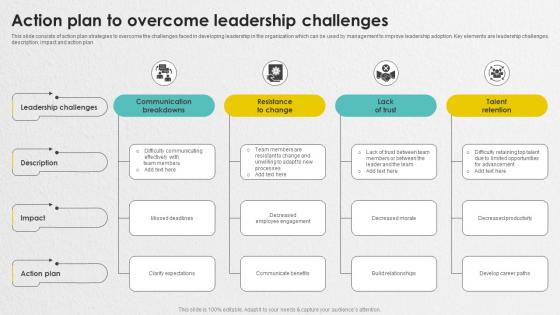
This slide consists of action plan strategies to overcome the challenges faced in developing leadership in the organization which can be used by management to improve leadership adoption. Key elements are leadership challenges, description, impact and action plan.
People who downloaded this PowerPoint presentation also viewed the following :
Action Plan To Overcome Leadership Challenges with all 6 slides:
Use our Action Plan To Overcome Leadership Challenges to effectively help you save your valuable time. They are readymade to fit into any presentation structure.






FAQs for Action Plan To
Common remote leadership challenges include maintaining team engagement, ensuring clear communication across time zones, building trust without face-to-face interactions, managing performance effectively, and fostering company culture virtually. These obstacles present both difficulties and opportunities, with many organizations finding that strategic use of digital collaboration tools, regular one-on-ones, and structured feedback systems ultimately delivers stronger team cohesion and enhanced operational efficiency.
Emotional intelligence helps leaders navigate complex team dynamics by recognizing individual motivations, managing interpersonal conflicts, and adapting communication styles to different personalities. Through enhanced self-awareness and empathy, leaders can anticipate team tensions, facilitate productive discussions, and build trust across diverse groups, ultimately creating more cohesive teams and improving overall organizational performance.
Leaders can foster inclusivity and diversity through implementing blind recruitment processes, establishing mentorship programs, creating employee resource groups, conducting regular bias training, and ensuring equitable advancement opportunities. These strategies enhance team performance by leveraging diverse perspectives, improving decision-making quality, and boosting innovation, with many organizations finding that inclusive leadership ultimately delivers stronger business results and competitive advantage.
Cultural differences significantly impact leadership styles through varying communication patterns, decision-making approaches, power distance expectations, and relationship-building preferences across regions. Global organizations increasingly find that adaptive leadership frameworks enable managers to navigate diverse cultural contexts, enhance cross-cultural collaboration, and ultimately deliver improved team performance and organizational cohesion.
Effective communication serves as the foundation for addressing leadership challenges by building trust, clarifying expectations, facilitating conflict resolution, and ensuring strategic alignment across teams. Through transparent dialogue and active listening, leaders can navigate organizational changes, motivate diverse teams, and drive collaborative problem-solving, ultimately delivering stronger team cohesion and improved business outcomes.
Leaders can balance organizational goals with employee well-being by implementing flexible work arrangements, transparent communication practices, recognition programs, and sustainable workload management. Through strategic workforce planning and supportive policies, organizations enhance productivity while reducing burnout, with many companies finding that prioritizing employee wellness ultimately delivers improved performance, retention, and competitive advantage.
Leading cross-functional teams involves navigating communication barriers, conflicting priorities, unclear accountability, and varying work styles across departments. These challenges can be addressed through establishing clear shared objectives, implementing regular cross-departmental meetings, creating unified project management systems, and fostering collaborative decision-making processes, ultimately delivering enhanced innovation and operational efficiency.
Leaders build team resilience by fostering psychological safety, promoting adaptability through cross-training, and establishing clear communication channels during uncertainty. Through regular scenario planning and stress-testing protocols, organizations enhance their teams' ability to pivot quickly, maintain morale under pressure, and ultimately deliver consistent performance, with many companies finding that resilient teams drive competitive advantage.
Leadership effectiveness metrics include employee engagement scores, team productivity rates, problem resolution timeframes, stakeholder satisfaction levels, and organizational resilience indicators. These measurements enable leaders to track progress by monitoring retention rates, project completion success, and adaptive capacity improvements, with many organizations finding that combining quantitative performance data with qualitative feedback delivers comprehensive insights into leadership impact.
Technology enhances leadership through data analytics for informed decision-making, AI-powered insights for strategic planning, collaborative platforms for remote team management, and automation tools for operational efficiency. These digital solutions enable leaders to respond faster to market changes, streamline communication across global teams, and ultimately deliver better business outcomes while maintaining competitive advantage in increasingly dynamic environments.
Best practices include transparent communication, maintaining visibility and accessibility, demonstrating empathy while projecting confidence, setting clear short-term goals, and recognizing team contributions consistently. Through authentic leadership approaches, organizations across sectors like healthcare, retail, and financial services streamline decision-making, enhance employee engagement, and maintain operational stability, ultimately delivering stronger team resilience and competitive advantage.
Leaders effectively manage team conflicts by establishing clear communication channels, addressing issues promptly before escalation, facilitating open dialogue between conflicting parties, and focusing discussions on solutions rather than blame. Through active listening and neutral mediation, organizations find that conflicts often reveal underlying process improvements, with many leadership teams discovering that well-managed disagreements ultimately strengthen collaboration and drive innovation.
Leadership transitions create challenges including knowledge gaps, cultural shifts, team uncertainty, stakeholder concerns, and operational disruptions. These challenges can be mitigated through comprehensive succession planning, structured handover processes, and transparent communication strategies, with many organizations finding that mentorship programs and phased transitions ultimately preserve institutional knowledge while enabling smoother leadership continuity.
Feedback enhances a leader's challenge-solving capabilities by providing diverse perspectives, identifying blind spots, and revealing unintended consequences of decisions. Through regular input from team members, peers, and stakeholders, leaders can adjust strategies more quickly, anticipate potential obstacles, and develop more comprehensive solutions, ultimately delivering better outcomes and stronger organizational resilience.
Leaders can develop future talent through mentorship programs, cross-functional project assignments, leadership training workshops, succession planning initiatives, and regular feedback sessions. These strategic approaches enhance organizational capability by identifying high-potential employees, providing hands-on experience across departments, and building essential skills, with many companies finding that structured development programs significantly improve retention rates and internal promotion success.
-
I can say with full confidence that all your business, academic, or professional work requirements will be sufficed with SlideTeam. Their gallery is as rich as 2Million+!!
-
I can say with full confidence that all your business, academic, or professional work requirements will be sufficed with SlideTeam. Their gallery is as rich as 2Million+!!