


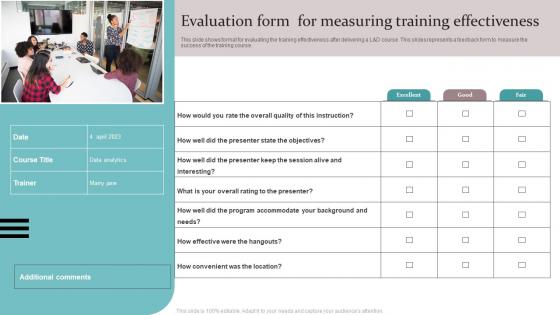
Evaluation Form For Measuring Training Effectiveness




Try Before you Buy Download Free Sample Product
 Impress Your
 Audience
 100%
100% Editable
 Save Hours
 of Time


This slide shows format for evaluating the training effectiveness after delivering a L and D course. This slides represents a feedback form to measure the success of the training course.
People who downloaded this PowerPoint presentation also viewed the following :
Evaluation Form For Measuring Training Effectiveness with all 6 slides:
Use our Evaluation Form For Measuring Training Effectiveness to effectively help you save your valuable time. They are readymade to fit into any presentation structure.
-
Evaluation Form For Measuring Training Effectiveness
-

Evaluation Form For Measuring Training Effectiveness
-

Evaluation Form For Measuring Training Effectiveness
-

Evaluation Form For Measuring Training Effectiveness
-

Evaluation Form For Measuring Training Effectiveness
-

Evaluation Form For Measuring Training Effectiveness
FAQs for Evaluation Form For
Key metrics for evaluating training effectiveness include reaction scores, learning assessments, behavior change measurements, business impact indicators, and ROI calculations. These comprehensive evaluations enable organizations to measure participant satisfaction, knowledge retention, and skill application, while tracking performance improvements, productivity gains, and cost reductions, ultimately delivering measurable competitive advantage and optimized resource allocation.
Participant feedback can be integrated through post-training surveys, focus groups, real-time polling during sessions, peer assessments, and follow-up interviews at regular intervals. These methods enable organizations to capture immediate reactions, knowledge retention, and behavioral changes, while identifying content gaps and delivery improvements, ultimately enhancing program effectiveness and ensuring training investments deliver measurable skill development and performance outcomes.
Pre-training assessment establishes baseline knowledge, skills, and competency levels, enabling accurate measurement of learning gains, identifying specific skill gaps, and customizing training content to participant needs. These assessments provide crucial benchmarking data that organizations use to calculate ROI, demonstrate tangible improvement, and validate training investments, with many companies finding that comprehensive pre-assessment significantly enhances program effectiveness.
Learning transfer can be measured through performance assessments, behavioral observations, skills applications in real scenarios, productivity metrics, and follow-up evaluations. Organizations effectively track transfer by monitoring job performance improvements, conducting manager assessments, and measuring business outcomes like increased sales or reduced errors, ultimately demonstrating training's strategic value.
Training effectiveness tracking tools include Learning Management Systems (LMS), analytics platforms like Tableau, survey software such as SurveyMonkey, performance management systems, and specialized training evaluation tools like Kirkpatrick Partners. These technologies streamline assessment by automating data collection, generating real-time reports, and measuring behavioral changes, with many organizations finding that integrated platforms deliver comprehensive insights and improved training ROI.
Aligning training objectives with organizational goals is crucial for meaningful evaluation, as it ensures programs directly contribute to business outcomes like productivity improvements, skill development, and strategic performance metrics. This alignment enables organizations to measure training ROI effectively, demonstrate tangible value to stakeholders, and make data-driven decisions about future learning investments, ultimately delivering competitive advantage through enhanced workforce capabilities.
Quantifying training ROI presents challenges including isolating training impact from other performance factors, measuring intangible benefits like leadership development, tracking long-term behavioral changes, and accounting for external market variables. These measurement complexities require organizations to combine quantitative metrics with qualitative assessments, ultimately delivering more comprehensive evaluation frameworks that demonstrate strategic value.
Qualitative data collection methods include focus groups, one-on-one interviews, observation sessions, case studies, and open-ended survey questions that capture participant experiences and insights. These approaches enable organizations to understand training impact beyond metrics, with many companies finding that combining structured interviews with workplace observation delivers deeper insights into skill application, behavioral changes, and long-term performance improvements.
Post-training performance can be assessed objectively through performance metrics comparison, skill-based assessments, behavioral observations, productivity measurements, and customer feedback analysis. These evaluation methods enable organizations to track knowledge retention, measure skill application in real-world scenarios, and quantify improvements in efficiency, with many companies finding that systematic assessment ultimately delivers enhanced ROI and competitive advantage.
Training effectiveness benchmarks should include knowledge retention rates, skill application metrics, behavioral changes, performance improvements, and return on investment calculations. These measurements enable organizations to assess program impact through pre-and-post assessments, on-the-job performance evaluations, and business outcome tracking, with many companies finding that comprehensive benchmarking ultimately delivers measurable productivity gains and competitive advantage.
Training effectiveness evaluations should be conducted at multiple intervals, including immediately post-training, 30-60 days later, and quarterly for ongoing assessment. This multi-phase approach enables organizations to measure immediate knowledge retention, practical skill application, and long-term behavioral changes, with many companies finding that regular evaluation cycles ultimately enhance ROI and identify areas for continuous improvement.
Continuous improvement can be embedded through regular feedback loops, post-training surveys, performance tracking metrics, peer review sessions, and iterative curriculum updates based on learner outcomes. Organizations increasingly integrate real-time analytics and quarterly assessment cycles, with many training departments finding that systematic evaluation processes enhance program effectiveness, reduce skill gaps, and ultimately deliver measurable improvements in employee performance and organizational competitiveness.
Learner engagement significantly influences evaluation outcomes by affecting knowledge retention, skill application, and behavioral change post-training. Highly engaged participants demonstrate better performance on assessments, apply learning more effectively in real workplace scenarios, and show sustained improvement in productivity metrics, while disengaged learners often struggle with knowledge transfer, ultimately impacting overall training ROI and organizational development goals.
Low engagement rates, poor knowledge retention scores, declining performance metrics, negative participant feedback, and failure to meet learning objectives signal redesign needs. These indicators often emerge through assessment data, supervisor observations, and post-training evaluations, with many organizations finding that addressing these warning signs early prevents costly program failures and enhances overall training ROI.
Storytelling transforms training effectiveness presentations by weaving learner success stories, before-and-after transformations, and real workplace applications into compelling narratives that demonstrate measurable impact. These narrative approaches enhance audience engagement, make statistical data more relatable, and showcase tangible behavioral changes, with many organizations finding that story-driven presentations deliver stronger stakeholder buy-in and continued training investment.
-
Making a presentation has never been this easy for me. Thank you SlideTeam for offering a splendid template library.
-
I have just started downloading templates for my presentations and I must say this is a great design. It helped accelerate my presentation design process and made it more visually appealing.